Before it became a national supermarket constant, King's Hawaiian bread had a distribution network powered largely by longing. People who tasted Robert Taira's soft, round loaves in Hawaiʻi sent them to relatives on the mainland. Tourists carried them home. The product traveled as a gift before it traveled as inventory - a clue to nearly everything that followed.
Taira, the Hawaiʻi-born son of Japanese immigrants, opened Robert's Bakery in Hilo in 1950 after finishing at the top of his baking class. His sweet bread drew on the islands' layered food culture and on the Portuguese-style sweet breads familiar in Hawaiʻi. When the bakery moved to Honolulu's King Street in 1963, it became King's Bakery. Lines formed. The bread was soft enough to tear, sweet enough to remember and unusual enough to name.
The move that changed the scale came in 1977. Taira opened a 24,000-square-foot bakery in Torrance, California, under the King's Hawaiian name. It solved the distance problem: a regional favorite could now reach mainland grocers without crossing the Pacific. More important, the company could control the thing consumers were buying again and again - an unusually tender texture that had to survive production, packaging, shipping and a few days on a kitchen counter.
The package gives instructions without using a word
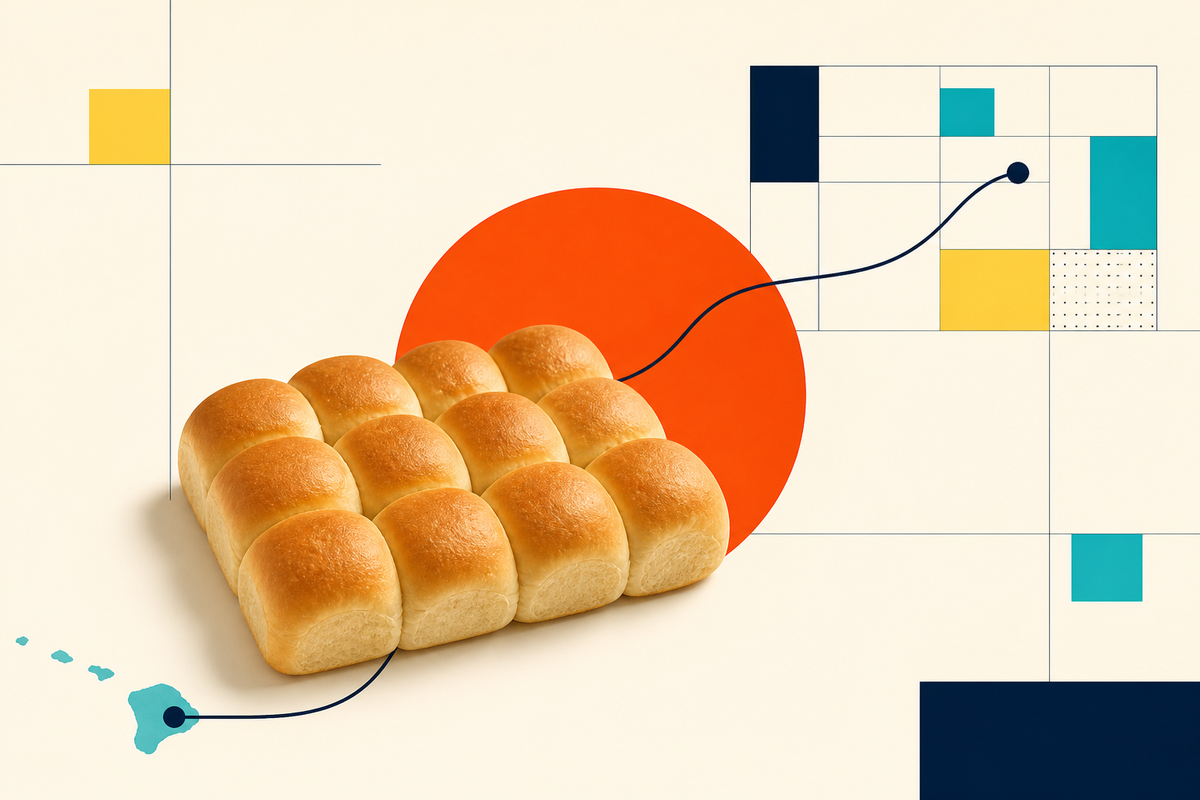
King's Hawaiian's defining product did not begin as the familiar grid of rolls. The original was a round loaf. The 12-pack of Original Hawaiian Sweet Dinner Rolls arrived in 1983, more than three decades after Taira opened his first shop. That format quietly reorganized the product. A loaf asks for a knife. Separate rolls ask to be plated. A connected tray asks someone to pull.
This is product design disguised as dinner. The rolls are pre-portioned but still attached, so separating one becomes a small public act. Pass the tray, take a corner, hand it on. The bright orange package makes the brand visible from the other side of the table and from halfway down a grocery aisle. The low-sided tray keeps the pattern intact. By the time the rolls reach dinner, they have already staged the interaction.
King's Hawaiian sells bread, but the orange tray sells a frictionless way to gather.YesPress analysis
Competitors can make soft dinner rolls. Private-label brands can make sweet ones. The harder combination to copy is sensory memory plus social format plus distribution. King's Hawaiian owns a particular balance of sweetness and pillowy chew, a recognizable color block and decades of association with holidays, sliders and shared meals. Its best recipes make the roll an ingredient rather than an accompaniment: tear-sheet sliders, baked sandwiches and party trays that call for the brand by name.
A cheerful brand with an industrial backbone
None of this works if the bread is charming in California and stale in Connecticut. King's Hawaiian's less visible expertise is scale: formula consistency, shelf-life management, packaging, forecasting and retailer replenishment. The Torrance operation expanded through the 1990s. In 2004, the company opened a larger Harborgate Way facility with round-the-clock manufacturing lines and an innovation kitchen. Production began expanding to Oakwood, Georgia, in 2010, putting capacity closer to eastern customers.
The company partnered with the University of Georgia's food science program and drew on Georgia Tech's manufacturing and robotics knowledge. A state case study later said Georgia facilities produced roughly 70 percent of the brand's bread. That figure is a useful corrective to the breezy branding. “Aloha spirit” may animate the ads; sensors, ovens, route planning and quality systems keep the promise.
King's Hawaiian is privately held and family-owned, with Robert's son Mark Taira serving as CEO. That ownership structure gives the company a different clock from a public packaged-food conglomerate. It has been able to build plants, extend capacity and protect a closely held recipe over decades. Public databases offer estimates rather than audited financials, so exact revenue and valuation remain private. The shape of the business is clearer: wholesale grocery drives scale, foodservice reaches restaurants and institutions, ecommerce handles specialty products and gifts, and the family's restaurants keep a direct line to bakery culture.
One recipe, then a widening ring of occasions
The portfolio extends in concentric circles. The nearest ring includes round bread, honey wheat, hamburger buns, hot dog buns and slider buns. Each carries the same basic promise into another meal. Sauces move the brand from bread basket to grill. Online-only coconut macadamia bread and jalapeño rolls give devoted customers novelty without asking every supermarket to find shelf space. Seasonal Ube Coconut Sweet Rolls test how the brand can welcome a different flavor tradition while keeping its familiar softness.
The more adventurous ring is snacking. Original Hawaiian Sweet Soft Pretzel Bites bring the signature sweet-salty profile into a resealable bag, ready to eat without assembly. In June 2026, Sheetz became the first convenience-store partner to carry them. That is both a product launch and a channel experiment: can a brand built around shared meals win an impulsive solo snack without losing its social identity?
Limited collaborations provide another laboratory. Illumination partnerships connected the rolls to Despicable Me 4 in 2024 and introduced shake-to-coat banana bites around Minions & Monsters in 2026. A Van Leeuwen collaboration paired Ube Coconut Sweet Rolls with ube coconut ice cream and an ice cream sandwich. These are noisy by design, but the underlying rule is disciplined. Newness arrives through a flavor, format or partner; the soft bread remains the anchor.
The restaurant is the memory bank
Packaged food can flatten its own history. King's Hawaiian has an unusual defense: places where the story can still be eaten. In 1988, Robert Taira opened a family-run bakery and restaurant in Torrance, serving tropical cakes and Hawaiian local plates. The Local Place Bakery & Café followed nearby in 2002 with a quicker format. Their practical role is modest next to national retail, but culturally they matter. They preserve recipes, give Hawaiʻi transplants a gathering place and remind a scaled manufacturer that its brand began across a counter.
That loop reached Hawaiʻi again in 2025, when King's Hawaiian and Sodexo opened King's Hawaiian Grill at the University of Hawaiʻi at Mānoa. Burgers and sandwiches use the brand's sweet hamburger buns, with rotating specials developed by chefs. The company also supports culinary education and scholarship programs in Hawaiʻi. For a business that now makes most of its bread on the mainland, those relationships are not decorative. They are part of the work required to use a place-based identity responsibly.
“The King's Hawaiian Grill is our way of connecting with students, sharing great food and creating moments that feel like home.”Mark Taira, CEO
Where it sits in the market
King's Hawaiian occupies a valuable seam between mass bread and specialty bakery. It has the reach and shelf life of a national packaged brand, but behaves like a named ingredient with a regional story. It competes with Martin's potato rolls, the broad portfolios of Flowers Foods and Bimbo Bakeries USA, Pepperidge Farm, Sara Lee, brioche buns, in-store bakeries and a growing field of private-label Hawaiian rolls. Yet the company is often competing for an occasion as much as a shelf slot.
The customer is a household trying to make a meal feel generous without making it difficult. A tray of sliders feeds a group. A dinner roll fills a holiday basket. A bun makes a weeknight burger feel specific. Foodservice operators buy the same reliability in bulk; retailers buy velocity and recognition; recipe publishers gain an ingredient that arrives with its own audience.
The practical problem is almost comically ordinary: hosts want food that looks considered but does not require another project. King's Hawaiian reduces the labor between “people are coming over” and “there is something warm on the table.” Its recipe library makes that proposition explicit, turning an intact sheet of rolls into baked sandwiches with a few cuts, fillings and one pan. For restaurants, the value is consistency at a volume a neighborhood bakery cannot promise. For grocers, the orange block is easy to recognize and useful across several seasons. Holiday dinners, summer grilling and football weekends all create reasons to merchandise the same core product again. That flexibility explains why the company markets occasions so aggressively. It is not chasing a single meal; it is training the roll to appear whenever a group needs feeding.
The risk is extension without distinction. If every sweet snack, seasonal flavor and media tie-in wears the crown, the original promise can blur. The 2025 redesign addressed a related problem: how to modernize a package loaded with memory. Agency Mrs&Mr rounded the crown and letterforms to echo the rolls, then wrapped packs with a ribbon motif inspired by native Hawaiian flowers. It changed the line, not the story. The orange remained unmistakable.
That restraint may be the most transferable part of the King's Hawaiian playbook. Start with one sensory signature. Give it a format that teaches people what to do. Attach it to a recurring social moment. Build enough manufacturing competence that the experience survives scale. Then extend only as far as the signature can travel. The result is not merely a famous roll. It is a small piece of table choreography, repeated millions of times.