On April Fools' Day in 1966, Alfred Peet opened a small coffee shop on Vine Street in Berkeley. The joke, if there was one, was on American coffee. Peet had arrived from the Netherlands, worked in the tea trade in Indonesia and found the richest country in the world drinking what he considered remarkably bad coffee. His answer was not a slogan. It was green beans selected with care, roasted darker in small batches and sold fresh to people who could smell the difference before they understood it.
That first shop gave Peet's Coffee an origin story almost too tidy for modern marketing: one exacting immigrant, one counter and one sensory rebellion. Yet the company now based in Emeryville is more interesting for the untidy business it became. Peet's is a coffeebar operator, a packaged-goods brand, an ecommerce merchant, a subscription service, a foodservice supplier and a ready-to-drink producer. A customer can encounter the same name as a hand-pulled espresso in California, a bag in a supermarket in Maine, a capsule ordered online or coffee poured at 35,000 feet.
01 / THE ORIGINAL ARGUMENTA point of view you could taste
Peet's did not invent coffee in America. It helped invent American expectations for specialty coffee. The distinction matters. Alfred Peet taught customers to care about origin, roast and freshness before those ideas became the furniture of every ambitious cafe. He also trained the founders of Starbucks and supplied their early beans. That historical link is often reduced to trivia, but it reveals Peet's real expertise: the company was a school as much as a store.
Its signature was dark roasting - a fuller, smokier profile that made thin supermarket coffee seem particularly wan. Major Dickason's Blend captures the method and the personality. In 1969, a regular named Key Dickason brought Peet an idea for a blend. The two tasted their way through combinations until they found a rich, balanced cup. Peet named it for his customer and promoted the retired sergeant to “Major” for the package. It remains the company's bestseller, now translated into whole bean, ground coffee, K-Cup pods and espresso capsules.
“I came to the richest country in the world, so why are they drinking the lousiest coffee?”Alfred Peet
The blend also explains what differentiates Peet's from competitors. Starbucks offers far greater store density and a vast flavored-beverage machine. Dunkin' owns speed and familiarity. Blue Bottle and independent roasters can claim a more rarefied, lighter-roast edge. Peet's occupies the middle ground: enough craft authority to be taken seriously, enough production and distribution to be easy to find, and a roast profile recognizable without a lecture from the barista.
02 / THE BUSINESSThe cafe is the theater, not the whole show
The obvious Peet's customer is the person walking into a coffeebar for drip coffee, an espresso drink, cold brew, tea or breakfast. But the company has designed routes for almost every other coffee occasion. Home brewers buy beans and ground coffee by roast, origin or flavor. Capsule users buy Nespresso-compatible formats or K-Cup pods. Subscribers choose a blend, grind and delivery cadence. Grocery customers make a repeat purchase without visiting a Peet's store. Universities, hotels, airports and restaurants can install a Peet's foodservice program with training and account support.
That is the business model in miniature. Coffeebars sell a high-frequency ritual and make the brand physical. Grocery and club distribution provide national reach. Ecommerce lets Peet's present the full catalog and learn from direct customers. Subscriptions turn freshness into recurring revenue. Foodservice reaches people in places Peet's does not own. Delivery through the app, DoorDash and Uber Eats catches the customer who wants the cafe but not the queue.
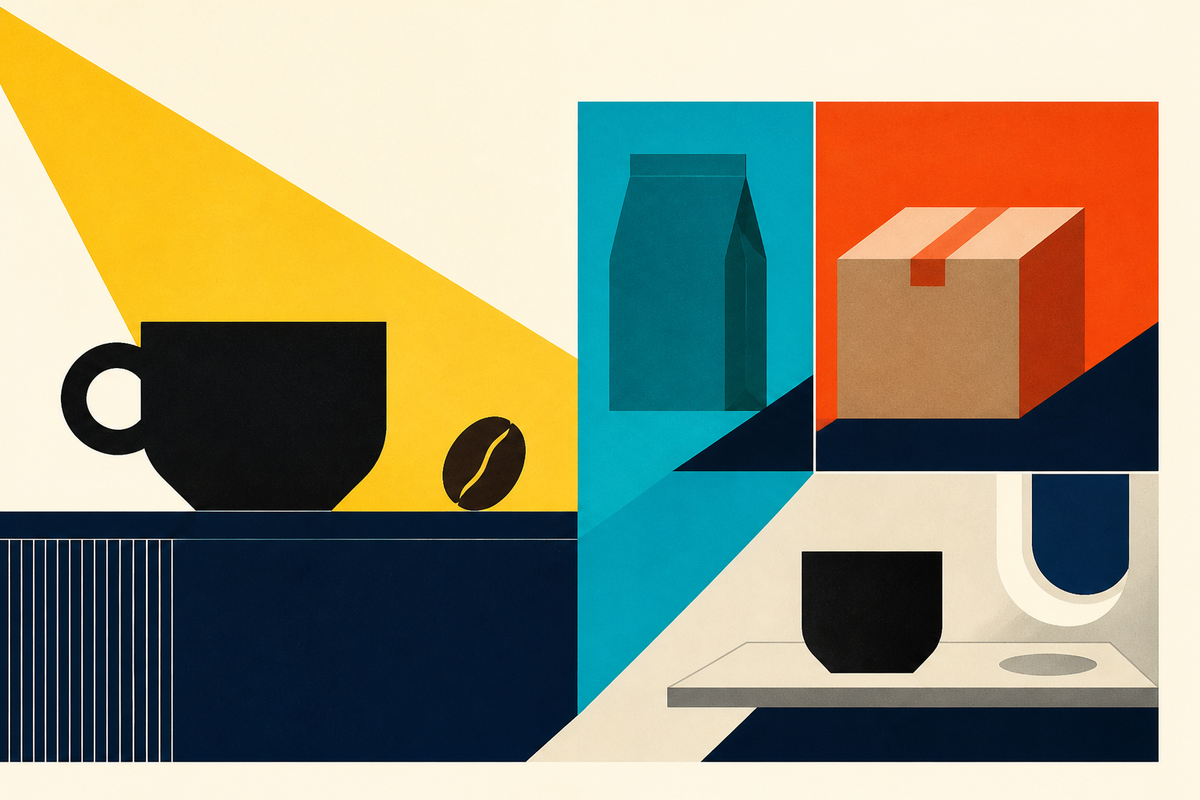
Five routes from the roast - conceptual, not revenue share
The system solves two different problems. For drinkers, it reduces the distance between wanting a dependable specialty coffee and getting one. For business customers, it supplies a recognizable premium brand plus the training and operating support required to serve it consistently. Peet's says foodservice partners receive dedicated account management and quarterly reviews - an unglamorous detail that matters more than tasting notes when staff turnover is high.
Peet's behaves like a regional cafe brand and a national consumer brand at the same time. That mismatch is an advantage: reputation is built in a concentrated store network, while packaged distribution does the geographic scaling.
03 / THE PRODUCT LABSixty years old, still fiddling with the cup
Heritage can become a museum exhibit. Peet's has instead used its roast vocabulary as a base for product experiments. The Bright Collection, launched in 2023, introduced fruit-forward coffees and a new roasting style for a company closely associated with “roasty toasty” depth. Ultra Coffee Concentrate followed in 2024, promising a Peet's-level drink from one tablespoon. The menu has moved through protein lattes, drinks with vitamins C and D, sparkling refreshers, tropical mocktails and popping pearls.
In 2026, Middle Ground, a half-caff blend, targeted the unclaimed 3 p.m. occasion: customers who want a lift but not a full-caffeine wager against bedtime. It is a clever piece of occasion design. Rather than inventing another syrup, Peet's adjusted the functional intensity of the underlying product. Its accompanying search for a “Chief Playlist Officer” was marketing fluff of the cheerful sort, but the product insight underneath it was sound.
Food is receiving similar attention. Peet's worked with The Culinary Edge on a revised menu intended to complement its coffee-first heritage and extend visits across the day. The company is not trying to become a restaurant. It is trying to remove the moment when a customer likes the coffee but walks elsewhere for lunch.
04 / SCALE WITH CONSEQUENCESWho checks the farm footprint?
Coffee has a beautiful retail surface and a difficult agricultural foundation. Smallholder incomes, labor conditions, water access, disease and a changing climate all sit upstream of the neat bag on a shelf. Peet's says every coffee purchase is responsibly sourced and independently verified by Enveritas. The model extends beyond a subset of certified farms: Enveritas uses farm surveys, audits, satellite imagery and data analysis across the supply chain.
Verification is measurement, not absolution. Its value depends on what happens next. Peet's reported that by December 2024 it had invested in 48 impact projects, 17 then active, spanning farmer productivity and clean water. It supports World Coffee Research's work on climate-smart plants and works with TechnoServe on farmer training. In Papua New Guinea, a clean-water project serves schools in coffee-growing communities. These programs connect product continuity with human outcomes: healthier farms and communities make future cups possible.
There is also a local version of that logic. Since 2018, Peet's has supported Yosemite's free bike-share program, with more than $240,000 donated by the time of its published account. A coffee company funding bicycles in a national park sounds pleasantly sideways. It also joins the brand to a practical reduction in short car trips, noise and congestion.
05 / THE NEW OWNERA Berkeley idea inside a global machine
Peet's has not been an independent neighborhood roaster for a long time. JAB took it private in 2012 for roughly $978 million. It later became part of JDE Peet's, the Amsterdam-listed group behind Jacobs, L'OR, Douwe Egberts and other coffee brands. In April 2026, Keurig Dr Pepper acquired 96.22 percent of JDE Peet's shares tendered in its offer and later passed 97 percent. The announced transaction valued JDE Peet's equity at about €15.7 billion.
KDP plans to combine those operations with Keurig and then separate a publicly traded Global Coffee Co. from its refreshment-beverage business. Peet's will sit inside a coffee company with roughly $16 billion in projected annual net sales, global purchasing power and exposure to more than 100 markets. Scale can improve sourcing, distribution and investment. It can also invite the deadly phrase “portfolio optimization,” which rarely smells like a freshly opened bag.
The tension is already visible. Peet's closed a group of coffeebars in early 2026, including long-running Bay Area locations, while continuing to push grocery, foodservice and new products. Store counts change; the company currently describes more than 170 national stores on its foodservice site. The point is not that cafes no longer matter. It is that Peet's can adjust a physical network without disappearing from customers' kitchens.
The useful lesson is simple: keep the product thesis narrow, then let the buying occasions multiply.
06 / WHAT TO STEALThe discipline of one recognizable idea
For builders of consumer companies, the transferable part of Peet's is not “start a coffee brand.” It is the relationship between a strong product opinion and a flexible distribution system. Peet's opinion was clear: better beans, more deliberate roasting, freshness and a cup with force. Every new channel had something concrete to carry. Without that center, omnichannel becomes a collection of checkout buttons.
The second lesson is that expertise can be sociable. Peet's public culture says, “We're experts, but not snobs.” That line recognizes a common trap in premium categories: customers want discernment without an oral exam. A bag can mention toast, stone fruit or processing method, while Major Dickason's can still be the coffee someone buys because it tastes like the coffee they like.
The third is to design products around moments, not just demographics. A Southwest flight, a hotel breakfast, a supermarket restock and a half-caff afternoon cup are distinct jobs. Peet's can address each without abandoning coffee as its center. Tea, food and cold drinks broaden the visit, but roast craft remains the organizing intelligence.
Where does Peet's fit now? Between mass coffee and the small specialty roaster; between a regional chain and a national CPG label; between an influential past and a corporate future still being assembled. Its most durable asset is neither a store count nor a parent company's balance sheet. It is the memory of a particular cup - bold, fresh and a little stubborn - and the operational ability to make that memory travel.