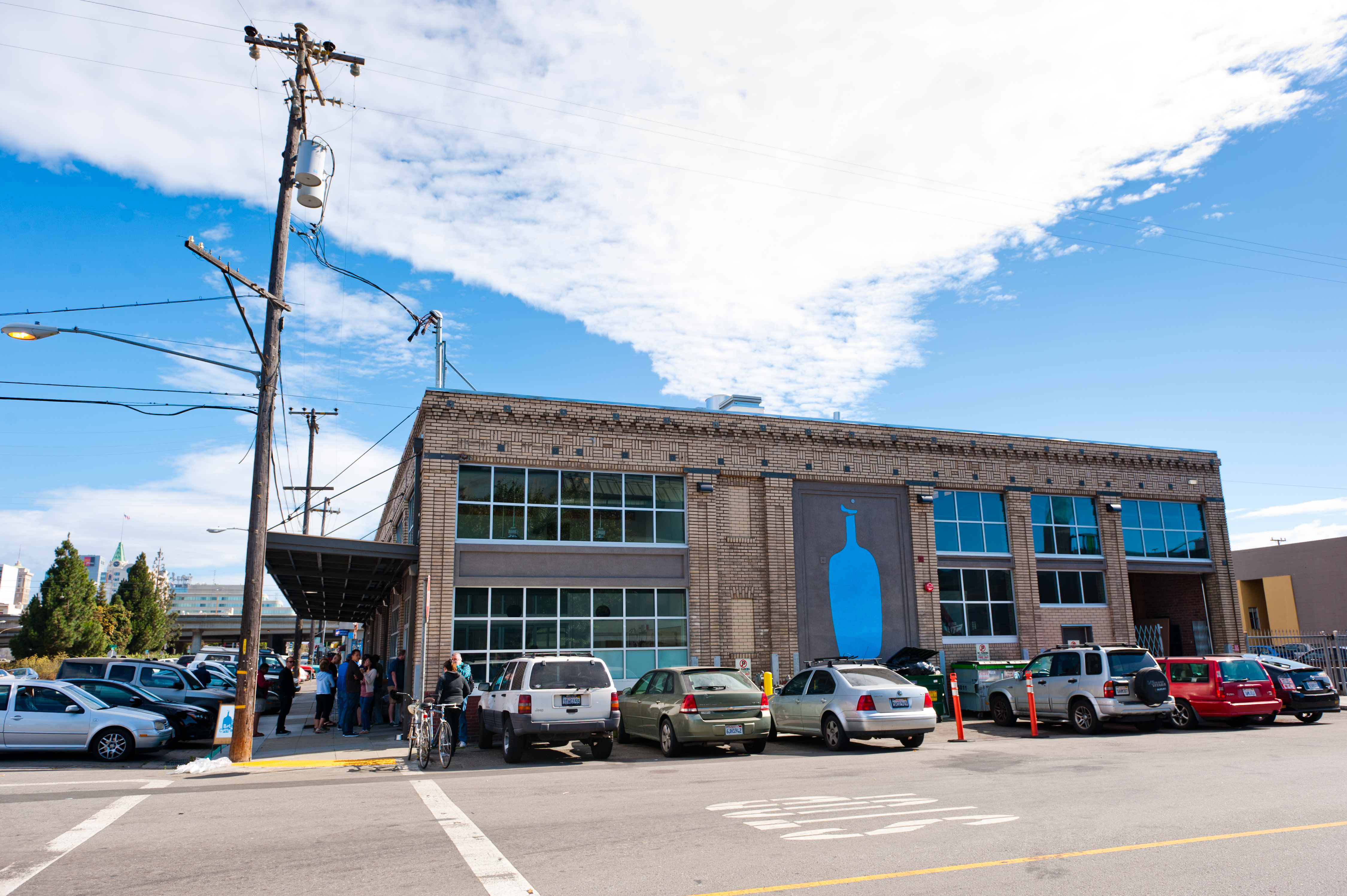
A blue silhouette on a brown bag, and a rule nobody else wanted to keep
Walk into a Blue Bottle cafe in Oakland, Tokyo, or Brooklyn and the first thing you notice is what is missing. No syrups crowding the counter. No loyalty-card upsell. A barista weighs your beans on a scale, checks a timer, and pours water in slow, deliberate circles. The whole place is built to defend a single number: 48. As in hours. As in, the coffee in front of you was roasted within two days, or it does not get sold.
That is the company today - roughly 140 cafes across the United States and Asia, a busy e-commerce and subscription business, and a packaged-goods line that reaches far beyond the counter. It is also, as of 2026, a company changing hands again. But strip away the ownership headlines and the thing that defines Blue Bottle is the same thing that defined it in a potting shed: an almost unreasonable insistence that fresh coffee is the only coffee worth selling.
The whole industry was selling yesterday's coffee
Here is the inconvenient truth that founded a company: roasted coffee goes stale fast. Within days, the aromatics that make a cup taste like blueberry or cocoa or jasmine start to flatten. The supermarket can of coffee on the shelf in 2002 might have been roasted months earlier, sealed, shipped, warehoused, and forgotten. It still smelled like coffee. It just did not taste like much.
James Freeman, then a freelance clarinetist playing part-time gigs with Northern California orchestras, could not unlearn this once he noticed it. He started roasting raw beans in his apartment oven, in batches small enough to drink before they faded. The problem was obvious to him. The opportunity was that almost no one else seemed to care - which, of course, is the most interesting kind of problem to have.
A potting shed, a Diedrich roaster, and a drive to Idaho
The bet was small, in dollars. Freeman quit music, took on roughly $15,000 in credit-card debt, and rented a 186-square-foot potting shed near his Oakland apartment for $600 a month. He drove to Idaho to buy a used Diedrich roaster directly from the maker, hauled it home, and started turning out seven-pound batches. He named the operation after The Blue Bottle, one of Europe's first coffee houses - a 17th-century cafe in Vienna - because he wanted a name with a longer memory than a logo.
Then he did the unglamorous thing: he sold cups at farmers' markets. One weekend in January 2004, the line at his cart did not stop. A year later he opened a brick-and-mortar location in what he has cheerfully described as a "pee-smelling dead-end alleyway" in San Francisco. The romance of the origin story tends to skip that part. The coffee did not.
The slow pour: a Blue Bottle timeline
Selling the roast date, not just the roast
What Blue Bottle actually sells is information you can taste. Single-origin beans with a named farm and a harvest. Blends built for a specific cup. A New Orleans-style iced coffee brewed with chicory and served cold. And the famous Gibraltar - a small milk-and-espresso drink reportedly invented by baristas who grabbed a Gibraltar glass off the shelf and never put it down.
The cafe is the showroom. The real machine is everything around it: a subscription that mails freshly roasted beans to your door with a no-catch cancellation, craft instant coffee for people who refuse to apologize for wanting convenience, ready-to-drink bottles, brewing gear, and brew guides that treat a pour-over like a recipe. You do not need a barista to use Blue Bottle. You need a kettle, a scale, and a little patience - which, conveniently, is the entire personality of the brand.
When the patient brand became a $700M headline
Skeptics had a fair question: can an obsession with slowness actually scale? The money answered. Between 2012 and 2015, Blue Bottle raised roughly $120 million from investors including True Ventures, GV, Index Ventures, and Fidelity. In 2017, Nestle bought a majority stake - reported around $500 million for about 68% - putting an implied value near $700 million on a company that had started in a shed.
The proof kept coming in revenue. For the 12 months ended June 30, 2025, Blue Bottle generated roughly $250 million, split between the US and a fast-growing Asia-Pacific business. Japan, in particular, embraced the brand so thoroughly that the influence ran both ways: Blue Bottle's spare, deliberate cafe design owes an open debt to Japanese coffee culture and the kissaten tradition.
Where the cup money comes from
Figures are approximate and reported by trade and financial press. The company has remained unprofitable even as revenue grew. Bars scaled for illustration.
Freshness first, then everything else
The stated mission has barely moved: serve the freshest, most delicious coffee possible, roasted in small batches and sold quickly. Layered on top is a sustainability agenda - responsible sourcing, long-term relationships with producers, and stated ambitions around carbon-neutral and lower-waste operations. The brand's keyword cloud reads like a manifesto: traceable coffee, zero-waste packaging, climate-conscious sourcing.
It has not all been smooth. Some US cafe workers began unionizing in 2024, a reminder that hospitality at scale is a labor story as much as a flavor story. And ownership has been a revolving door: Nestle in 2017, then a 2026 agreement to sell the retail operations to Centurium Capital - the largest shareholder of Luckin Coffee - for under $400 million, with Nestle keeping the packaged-goods arm.
What you can actually do with it
Subscribe to fresh beans by mail, brew the cafe pour-over at home with a scale and a guide, or grab craft instant for the road. The point is the same cup, wherever you are.
Why it stands out
Most chains compete on speed and sweetness. Blue Bottle competes on a roast date and a stopwatch. It made provenance and freshness into the actual product.
Who drinks it
Design-minded coffee enthusiasts and urban regulars across the US and Asia, plus a global subscription crowd that wants cafe-grade beans at the kitchen counter.
The competition
Stumptown, Intelligentsia, La Colombe, Counter Culture and Philz on one side; Starbucks Reserve reaching up from the other. Blue Bottle sits in the patient middle.
Six things that explain the brand better than a mission statement
- The founder was a professional clarinetist before he was a roaster - he traded Mozart for cortados.
- The first roastery was a 186-square-foot potting shed rented for $600 a month.
- He drove to Idaho to buy his Diedrich roaster straight from the manufacturer.
- The Gibraltar drink got its name from the glass baristas happened to use.
- The company name nods to a 17th-century Viennese coffee house, The Blue Bottle.
- The New Orleans-style iced coffee is brewed with chicory and served cold - a Southern accent in a California cup.
Back to the counter
Return to that cafe. The barista is still weighing beans, still watching a timer, still defending the number 48. The logo over the door may answer to a new owner, and the revenue may now route through two continents and a private-equity spreadsheet. None of that changes the gesture at the counter, which is the whole company compressed into thirty seconds: this coffee is fresh, and freshness is the point.
Blue Bottle's real legacy is not the 140 cafes or the $700 million headline. It is that millions of people who once never read a coffee bag now flip it over to check the roast date first. A broke clarinetist decided the coffee was stale. He was right - and he made the rest of us taste it.