★ BREAKING — BREWBIRD BREWS CHAMPION-BARISTA POUR-OVER IN 60 SECONDS • $32M SERIES A LED BY SEQUOIA CAPITAL • CUSTOMERS INCLUDE META · LINKEDIN · SALESFORCE • PODS ARE BACKYARD-COMPOSTABLE • MACHINE $10K · CUP ~$2 — UNDER THE $5 DRIP • ROASTERS: SIGHTGLASS · VERVE · EQUATOR ★ BREAKING — BREWBIRD BREWS CHAMPION-BARISTA POUR-OVER IN 60 SECONDS • $32M SERIES A LED BY SEQUOIA CAPITAL • CUSTOMERS INCLUDE META · LINKEDIN · SALESFORCE • PODS ARE BACKYARD-COMPOSTABLE • MACHINE $10K · CUP ~$2 — UNDER THE $5 DRIP • ROASTERS: SIGHTGLASS · VERVE · EQUATOR
Company Dossier · Coffee & Hardware

BrewBird.

The company that decided the worst coffee in the building was, actually, a solvable engineering problem.

Founded
2019
HQ
San Carlos, CA
Series A
$32M
Team
~51
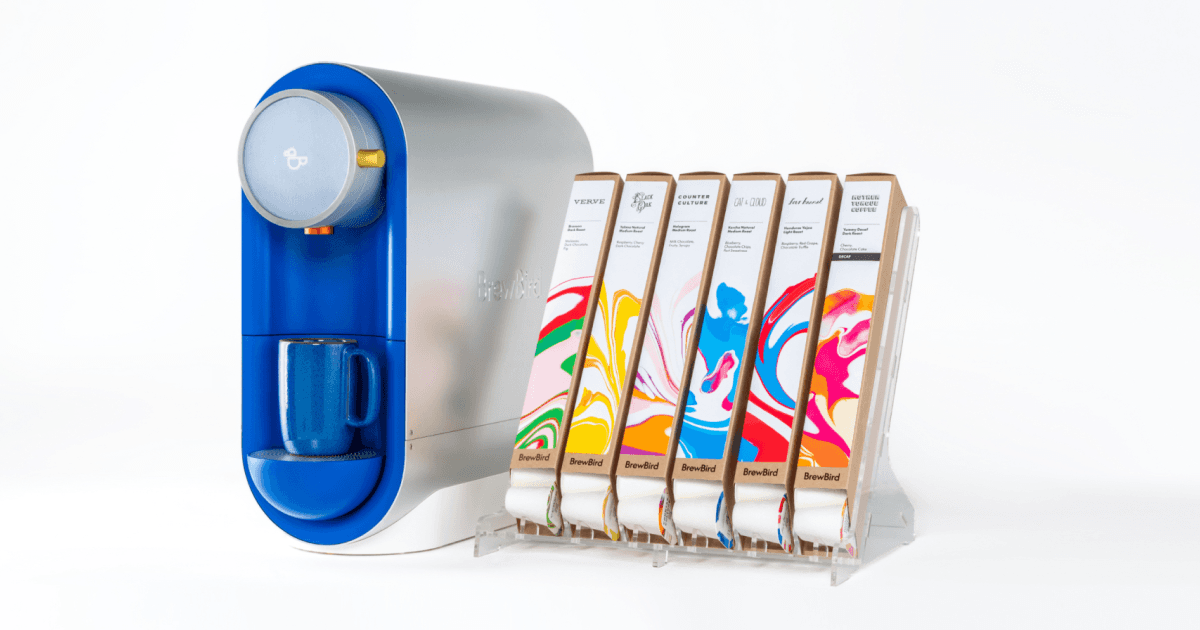
The BrewBird machine beside a rack of colorful compostable whole-bean coffee pods
THE MACHINE, AND ITS AMMUNITION. A countertop brewer next to a rack of BrewBird's compostable pods - each one a different roaster, each one a QR code telling the machine exactly how hot and how long. The whole apparatus exists to answer a small, stubborn question: why is coffee at work so bad?
The Pitch

A very expensive way to make a $2 cup of coffee, which turns out to be a good idea

Here is a business that sounds, on first hearing, slightly absurd. BrewBird sells a coffee machine for about $10,000. The machine makes single cups. Each cup costs the customer roughly $2 in pods. You could, reasonably, ask why anyone would pay five figures for a device that dispenses coffee one cup at a time when a drip pot and a bag of beans exists and costs approximately nothing.

The answer is that the drip pot and the bag of beans produce bad coffee, and everyone knows it, and the coffee at your office is a small daily disappointment that you have collectively agreed to ignore. BrewBird's bet is that this disappointment is worth $10,000 to fix - not to you, but to the company that employs you and would like you to come into the building.

The machine brews whole beans, not pre-ground plastic pods. It does a pour-over - the finicky, hand-poured method that specialty cafes fetishize - in about 60 seconds. The beans come from actual roasters you might recognize: Sightglass, Verve, Equator, Ritual. And the pod that holds them is fully compostable, which is the part that makes the sustainability people happy and the plastic-guilt people relieved.

What makes it clever is the QR code. Every pod carries one, and it tells the machine the precise water temperature and brew time for the specific beans inside. This is a nice bit of engineering sleight of hand: it takes the judgment that a trained barista carries in their head and encodes it onto a sticker. The craft scales. The barista does not have to.

“A cup of pre-brewed drip coffee at Starbucks is $5 now. We can already come in well below that - and offer a much better experience.”

That line, from co-founder and CEO Mickey Du, is the entire argument compressed into a sentence. The competitor is not the office drip pot, which is free and terrible. The competitor is the $5 latte your employees walk out of the building to buy, taking their morning and some fraction of their loyalty with them. Against that benchmark, a $2 cup of specialty coffee that appears in 60 seconds without anyone leaving the floor is not extravagant. It is arithmetic.
Under the Hood

Sixty seconds, three moving ideas

01 / WHOLE BEAN

Not pre-ground

Unlike Keurig or Nespresso, BrewBird brews whole beans and grinds at the moment of extraction - the difference between coffee and the memory of coffee.

02 / THE QR POD

A recipe on a sticker

Each compostable pod's QR code sets the exact water temperature and brew time for those beans. The roaster's craft, delivered as a set of instructions.

03 / COMPOSTABLE

Backyard, not landfill

The pods break down in a home compost pile - not just an industrial facility - sidestepping the plastic-pod waste problem that defines the category.

By the Numbers

The shape of the thing

60s
Pour-over, start to cup
$32M
Series A raised
~$2
Per compostable pod
~30
Corporate deployments
The Grind (Literal)

It did not brew a good cup on the first try

Hardware has a humbling arithmetic: the first version is almost always bad, and the only way through is repetition. BrewBird's earliest alpha took about 15 minutes to produce a single cup. Somewhere between 12 and 20 machine iterations later, it took one. That curve - from unusable to shippable - is the actual product.

Time to brew one cup

Alpha prototype vs. shipping machine · approximate
Alpha (~2020)
~900 sec
Mid iterations
~300 sec
Shipping unit
60 sec
The Founder

From alcohol and fintech to a coffee robot

Mickey Du did not come from coffee. He came from Diageo, one of the largest alcohol companies in the world, and then from NerdWallet, where he crossed from investor to product manager. Which is to say he understood both consumer packaged goods and software, and coffee-at-the-office sits awkwardly between them - a physical product with a supply chain, wrapped around a machine that is really a small computer.

The origin story is the kind that sounds too tidy but appears to be true: Du wanted a genuinely good cup of coffee where he actually spent his time, and could not get one. The office had a machine. The machine was bad. So he built a better one, and then a company around it, and then raised $32 million to put it on countertops.

“Why couldn't I get a really great cup of coffee where I was spending my time - at the office or at home?”

— Mickey Du, Co-Founder & CEO
Money & Customers

Who's paying, and who paid in

ROUND
Series A - $32M
Closed early 2022
LEAD
Sequoia Capital, with Kyber Knight
ALSO
ACVC Partners, Fernbrook Capital, Gaingels, LDV Partners, The Scope Fund - and the former CEO of Peet's Coffee
REVENUE
Estimated ~$2.8M annually (third-party estimate)
LAUNCH
First deployment at Meta (2023)
TECH
LinkedIn · Salesforce · SAP · Palo Alto Networks
RETAIL
Gap · Sephora
LEGAL
Wilson Sonsini · and roughly 30 companies total
The Supply Side

Local roasters, national countertops

The quiet strategic move is on the supply side. Small roasters have the craft but not the distribution; BrewBird has the distribution but no interest in roasting. So it partners. Each pod is a different roaster's beans, which turns the machine into a rotating tasting menu and gives regional roasters a countertop in a Meta office they would never otherwise reach.

Sightglass Verve Equator Ritual Andytown Mother Tongue Cat & Cloud Black Oak Black & White
The Record

A short history of a slow-brewed company

2019

Founded

Mickey Du co-founds BrewBird in the Bay Area to bring specialty pour-over coffee to offices and homes.

2021

Seed & iteration

Early capital funds the long hardware grind - refining the machine and the compostable pod system.

2022

$32M Series A

A round led by Sequoia Capital, with backing that includes the former CEO of Peet's Coffee.

2023

First deployments

The machine launches at Meta and starts scaling into other corporate offices.

2025

In the press

SF Standard profiles BrewBird with roughly 30 corporate customers and a growing roaster roster.

Marginalia

Things that amuse and inform

15 MIN
The alpha machine's brew time for a single cup. The shipping version does it in 60 seconds.
12-20
Machine iterations before launch. Hardware is a war of attrition.
QR
Every pod's code encodes water temperature and brew time - the barista's judgment, made portable.
HOME
The pods compost in a backyard pile, not just an industrial facility.
Questions

The reasonable things you'd ask

What does BrewBird actually make?
A countertop machine and compostable whole-bean pods that brew specialty, pour-over-quality coffee in about 60 seconds - sold mainly to offices and hospitality spaces.
How is it different from Keurig or Nespresso?
BrewBird uses whole beans and precise extraction rather than pre-ground plastic pods. Every pod is fully backyard-compostable and carries a QR code that sets the machine's temperature and brew time.
Who founded it, and when?
Mickey Du co-founded BrewBird in 2019, after stints at Diageo and NerdWallet.
What does it cost?
A machine runs about $10,000 (with lease and subsidized options for early customers), and each pod costs roughly $2.
Who uses it, and how is it funded?
Customers include Meta, LinkedIn, Salesforce, Gap and others. BrewBird has raised a $32M Series A with backing that includes Sequoia Capital.
Watch

Product & brand video

Follow the Thread

Where to find BrewBird