A spreadsheet led her to a coffee filter
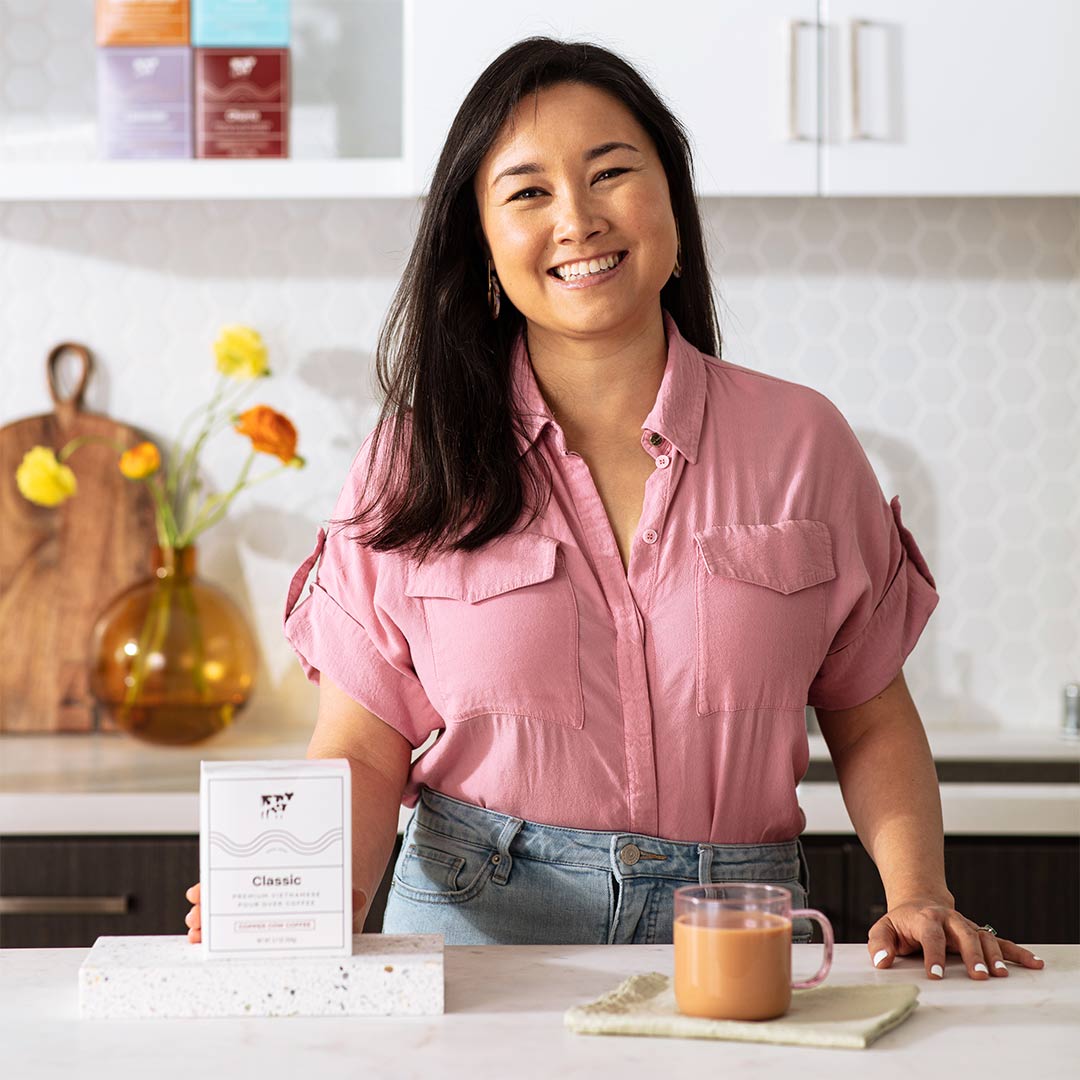
Debbie Wei Mullin runs Copper Cow Coffee out of Los Angeles, and the easiest way to understand her is to watch what she did with a supply chain. Most people who work on supply chains at the World Bank stay in the world of reports and procurement and quietly capable PowerPoint. She looked at the one running out of Vietnam's coffee farms and decided the farmers at the bottom of it were getting a bad deal. Then she went and built a company to pay them more.
Copper Cow sells a single-serve pour-over: a small compostable filter, pre-filled with ground Vietnamese coffee, that you perch on top of a mug and drown in hot water. It is modeled on the traditional Vietnamese phin, the slow metal drip filter her mother's side of the family used. The twist is that you can carry it in a coat pocket and brew it in a hotel room. Tradition, with a twist, is how she describes the whole enterprise, and she means the coffee and the supply chain both.
The company now turns up in more than 3,000 retail doors - Target, Whole Foods, Costco, H-E-B - and has sold north of 20 million coffees. It reached roughly $7 million in annual revenue. None of that was the plan. The plan was bottled cold brew.
The bottled cold brew that never shipped
When she started in 2016, the idea was Vietnamese cold brew with condensed milk, sold in bottles. The logistics were miserable - glass is heavy, refrigeration is expensive, and shelf life fights you the whole way. So she did the thing good operators do when reality argues back: she changed the product, not the mission. The pour-over solved the shipping math and kept the flavor. It also happened to be a more honest nod to how Vietnamese coffee is actually made.
She launched from her sister's garage with a $100,000 check from friends and family. Her sister and brother-in-law were the first believers. She has been candid that she hesitated to call herself an entrepreneur at all, and credits a friend who simply told her to start the business before she could talk herself out of it.
Life is too short and long for you to not do something you love.Debbie Wei Mullin
From Berkeley to Beijing to a garage
Before any of this she collected the kind of resume that does not obviously end in coffee. An economics degree from UC Berkeley. A master's in urban studies and planning from MIT. A stint as a senior program officer at The Asia Foundation, then years at the World Bank, with work that took her across Asia from Beijing to New Delhi. She grew up in the San Francisco Bay Area in a household where the cooking was a blend of Vietnamese, Chinese and Jewish-American, and where, by her own account, she basically only ate Vietnamese food. She noticed almost no one around her knew that food existed.
That gap - between a cuisine she loved and an America that had never tasted it - is the real product. The coffee is the delivery mechanism. She built Copper Cow to be a way for a Vietnamese American story to sit on a Costco shelf without being flattened into a novelty.
The farmer math
The sustainability claims here are specific, not decorative. Copper Cow keeps active relationships with farmers in Vietnam and pays them about twice the prevailing market rate, sourcing from organic and sustainable farms. For a founder who spent years studying development economics, paying double is not charity - it is the entire thesis, run as a business instead of a grant. Vietnam grows a lot of the world's robusta, and most of that value historically left the country. Her bet is that a premium American brand can send more of it back.
Sales cures all. It's easy to get bogged down in the details, but getting quality paying customers is always king.Debbie Wei Mullin
The Shark Tank handshake that wasn't
In 2021 she walked into Shark Tank's Season 12 asking for $600,000 for 4% - a $15 million valuation for a company then a few years old. Robert Herjavec admitted, on camera, that he found the coffee too sweet for his taste. He offered anyway: $600,000, a handshake, the moment everyone tunes in for. The deal did not ultimately close after the episode aired, which is a more common Shark Tank ending than the show lets on. The exposure did its job regardless - a wave of new customers and fans followed.
She raised roughly $3 million in venture capital along the way, with total reported funding around $11.5 million and a Series A in 2021. The fundraising is, by her telling, just another supply chain to optimize. She talks about hiring, inventory, and the awkward growth phase of outgrowing your early partners with the same flat practicality she brings to bean sourcing.
What she's building toward
The ambition runs in two directions. One is product: more than pour-overs - lattes, creamers, the full kit for making cafe drinks at home with natural ingredients and no refrigeration. The other is representation: more women starting companies, and more of them not waiting for permission to call themselves founders. She is open that fear is the main thing she watches for, in herself and in the people she advises. Her standing instruction is plain - don't let fear take over.
It is a tidy loop. An economist who studied how value moves through poor countries decided the most direct intervention she could make was to sell really good coffee to Americans and route the margin back to the people who grew it. The garage is long gone. The thesis is still on the shelf, one compostable filter at a time.