Company Profile / Food & Beverage
Copper Cow Coffee
Specialty Vietnamese coffee, rebuilt for the way Americans actually drink it: single-serve, portable, and made with real ingredients.
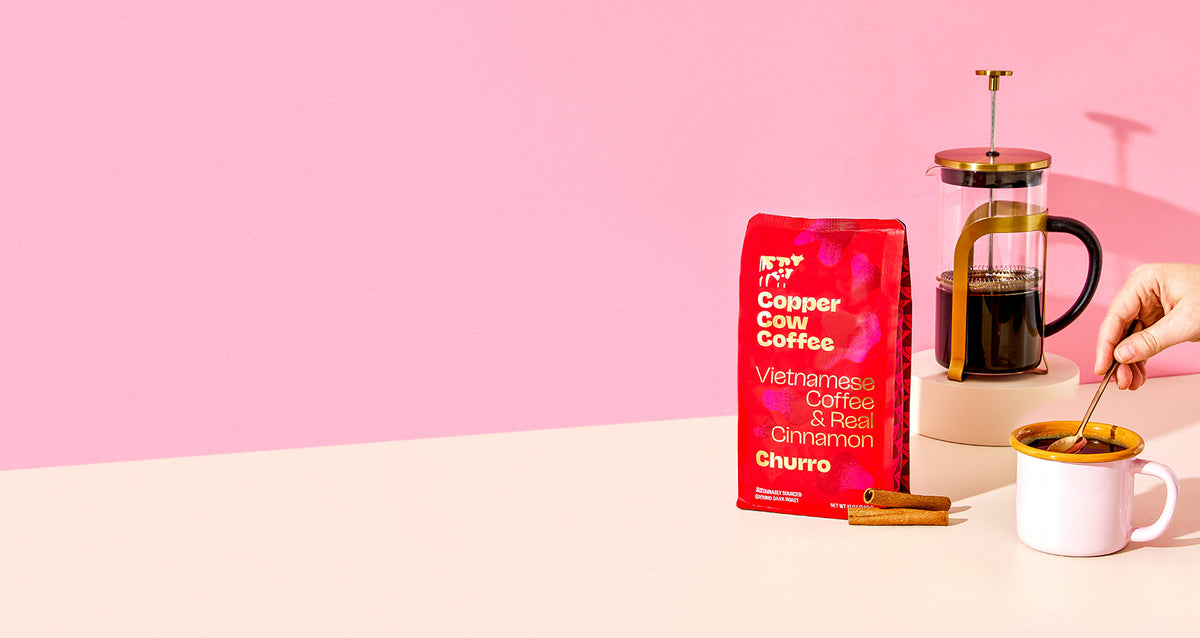
Specialty Vietnamese coffee, rebuilt for the way Americans actually drink it: single-serve, portable, and made with real ingredients.
Walk down the coffee aisle of a Whole Foods, a Target, or a Walmart, and somewhere between the cold brew concentrates and the oat-milk creamers you will find a small box that does not look like anything else there. Inside are paper pour-over pouches and packets of sweetened condensed milk. The flavor on the front might be lavender. This is Copper Cow Coffee, and it has quietly become one of the most recognizable Vietnamese coffee brands in the United States.
The company sells single-serve Vietnamese pour-over coffee, flavored ground coffee, and latte kits that pair its coffee with shelf-stable condensed milk creamers. The beans come from organic farms in Vietnam. The format fits in a carry-on. The whole thing is run by a founder who used to manage supply chains for the World Bank. None of that is an accident.
A Vietnamese-Californian obsessed with traditional Vietnamese coffee - and reimagining it for a modern world.
Vietnam is one of the largest coffee producers on earth. Yet for decades its coffee was treated as a commodity input - bulk robusta shipped off to be blended into things that never carried its name. The coffee most associated with Vietnamese culture, the strong pour-over sweetened with condensed milk, was something you found in a Vietnamese restaurant or a relative's kitchen, rarely on a national grocery shelf.
There was a second problem underneath the first. The farmers growing those beans were at the bottom of the price chain. Quality and sustainability were nobody's priority when the buyer only cared about volume. Copper Cow exists in the gap between those two facts: a heritage product with no premium shelf, and a supply chain that gave farmers little reason to grow anything better.
The coffee was everywhere and nowhere - grown by the ton, recognized by almost no one.
Debbie Wei Mullin grew up in California on Vietnamese food, with a mother from Vietnam. She earned degrees from UC Berkeley and MIT and went into international development, working on supply chains at the World Bank. Then, around 2016, she started packing coffee in her sister's garage. The company officially launched as Copper Cow Coffee in January 2017.
Her bet combined two things most people kept separate: a love of Vietnamese coffee culture and a development economist's view of how supply chains should treat the people at the start of them. Copper Cow sources from organic, sustainable farms in Vietnam and pays growers roughly double the market rate. The idea was that quality and ethics were not a tax on the business - they were the product.
The founder's academic and supply-chain background shaped how the company sources, not just how it sells.
Farmers are paid roughly double the local market rate to reward higher-quality, sustainable growing.
The brand began hand-packing coffee in a sibling's garage before it ever reached a store.
Debbie Wei Mullin begins making Vietnamese pour-over coffee out of her sister's garage.
Copper Cow Coffee officially launches, selling single-cup organic Vietnamese pour-over.
Graduates from the 500 Startups accelerator and closes a seed round of $2M+ from investors including Silverton Partners and Amplify Her Ventures.
Appears on Shark Tank Season 12 and lands an on-air offer from Robert Herjavec; closes an $8.5M Series A co-led by Cultivian Sandbox and Arborview Capital.
Reports roughly 50% revenue growth as US interest in Vietnamese coffee climbs; product line expands into latte kits and ground coffee.
Exhibits at Natural Products Expo West and continues national retail expansion across thousands of stores.
The signature item is deceptively simple: a single-serve pour-over pouch that hangs over the rim of a cup. Pour hot water through, tear open a condensed milk creamer, and you have a Vietnamese latte without a machine, a barista, or a fridge. The flavors - Just Black, Lavender, Mint, Churro, Salted Caramel, Vanilla - come from real ingredients rather than synthetic flavoring. Lavender is the bestseller.
From there the line widened into flavored ground coffees and full latte kits that bundle the pour-over bags with sweetened condensed milk creamers. The creamers are shelf-stable, which quietly solves a logistics problem most coffee brands ignore: convenience that survives a backpack, a desk drawer, or a long flight. The company also developed a fully compostable filter.
Single-serve Vietnamese pour-over in six flavors, made with real ingredients - no machine needed.
Coffee bags paired with shelf-stable condensed milk creamers. No refrigeration, travel friendly.
Flavored ground coffee for people who brew at home and want the same flavor profiles.
Creamer packets, samplers and gift sets sold direct-to-consumer and through subscription.
Convenience that survives a backpack. The latte that doesn't need a fridge to keep its promise.
Shark Tank gave Copper Cow a stage. Robert Herjavec offered $600,000 on the show, though the deal fell through in due diligence after the episode aired. What didn't fall through was the growth: the exposure helped push the brand into thousands of stores, and revenue kept climbing past the $7 million mark.
While we were excited that Robert made us a deal on the show, we ended up not going through with the deal after airing.
Copper Cow describes its mission plainly: to sustainably support and share the vibrant heritage of Vietnamese coffee. In practice that means three commitments that tend to pull against each other - authenticity, sustainability, and reach. Most brands pick one. Staying small keeps you authentic. Going organic costs margin. Scaling nationally usually means cutting corners on both.
The company is one of a small share of women-owned, venture-backed businesses, and it is AAPI woman-owned. That identity isn't decoration; it's tied to why the sourcing model and the heritage framing matter to the people running it. The compostable filter, the farmer pay, the real ingredients - they are the same argument made three different ways.
Quality and ethics were never a tax on the business. They were the product.
Return to that grocery shelf. A few years ago, a Vietnamese coffee brand sitting next to the national names would have been a curiosity. Now it's stocked, restocked, and bought by people who have never been to Vietnam and may not know that the country grows more coffee than almost anywhere on the planet. That shift - from invisible commodity to named, premium product - is the thing Copper Cow set out to make.
The work isn't finished. Sustainable sourcing at scale is hard, retail is brutal, and a single brand can only move so much. But the small box on the shelf has already changed what that aisle can hold. It proved that Vietnamese coffee could carry its own name, pay its own farmers, and still earn the space. The cup that started in a garage now travels in a lot of backpacks.