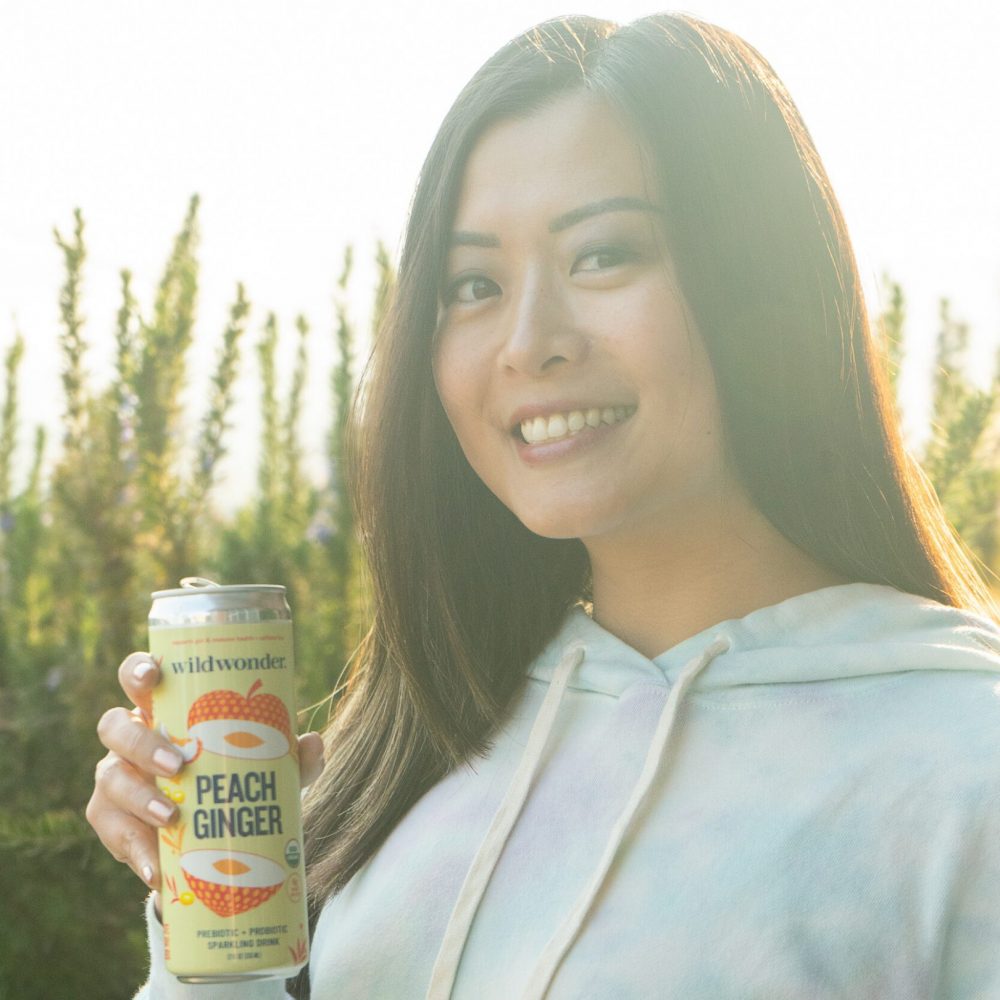
A can of belonging, brewed in a kitchen
Walk into a Sprouts, a Target, an Erewhon, and somewhere in the cold case sits a pastel can promising prebiotics, probiotics, and a flavor called Guava Rose. That can is the day job of Rosa Li, and it started with a beer keg and a length of tubing on her kitchen counter.
Li runs wildwonder, the sparkling beverage brand she founded and still leads as CEO. The pitch is short: a fizzy drink that carries both prebiotic fiber and live probiotics, no refined sugar, built on herbs and botanicals pulled from her heritage and the fruit of a California produce stand. The everyday flavors are USDA Organic, vegan, non-GMO, caffeine-free and gluten-free. It is, in her telling, "grandma wisdom combined with the contents of a California produce stand."
The grandma is not a marketing device. Li spent her first twelve years in China, raised largely by her grandmother, who brewed wild herbs into tonics that were equal parts comfort and ritual. When Li moved to the United States, she arrived without English and learned it inside three years, then talked her way onto a debate team and, as a college sophomore, into a Goldman Sachs internship. The herbal tonics stayed in the background for two decades while she did what ambitious people with that resume tend to do.
It is worth pausing on that immigrant arithmetic. A twelve-year-old lands in a new country with no language, and within thirty-six months is arguing competitively in it. That is not a charming biographical footnote - it is the operating system. Every chapter that follows runs on the same engine: arrive somewhere unfamiliar, learn the rules faster than anyone expects, then refuse to treat the rules as permanent. She would later do exactly that with a beverage category that had decided fizzy and good-for-you were a contradiction.
The detour through finance
Before there was a beverage, there was a spreadsheet. Li worked in investment banking, then private equity and venture investing, the careful business of valuing other people's companies. She earned an MBA from Stanford's Graduate School of Business in 2014, with an undergraduate economics degree from Northwestern and a stint at the London School of Economics behind her. By her own account, she went to business school less for the finance and more for the soft skills - feedback, relationships, the human machinery of running a company rather than auditing one.
Silicon Valley did what it does. The investor started itching to operate. "My story has so many ups and downs," she has said, "and it took a lot of turns to get to that next level." The first turn was a flop.
Rosali Tea, and a useful failure
From 2015 to 2017 she ran Rosali Tea, an artisanal loose-leaf company. It did not work, and the reason it did not work became the seed of the thing that did: Americans, she discovered, reach for coffee, and almost nobody has time to steep tea. But she had been serving fresh-brewed herbal tonics at corporate events around the Bay Area, and people kept asking the same question. Could she bottle this?
So she tried. The early kitchen experiments paired her grandmother's herbs with bright fruit juices. The hard part was the fizz. "It's actually quite hard to do without any industrial machinery," she has said of carbonation, which is why she and an engineer friend built a rig out of a beer keg and tubing. It was duct-tape entrepreneurship in the most literal sense, and it produced the first cans of what would become wildwonder.
The recipe itself is the part most founders skip past and Li lingers on. The drinks pair prebiotic fiber with live probiotics - a combination the brand bills as a first for the sparkling-beverage aisle - and lean on functional botanicals rather than added sugar to do the talking. The bet underneath it is a market thesis as much as a flavor one. "There's really this huge shift underway toward better-for-you food and beverages," she has said, and she had the unusual luxury of having spent years on the other side of the table, watching which consumer brands compounded and which ones fizzled. She knew what an investor wanted to see because she had been the one wanting to see it.
Glass, then cans, then everywhere
The brand launched in 2020 in glass bottles - and that was a mistake she fixed fast. Customers reported breakage in transit, so in 2021 she moved to cans, a switch she says "completely improved the product in a tremendous way." By the end of that first year wildwonder was in more than a hundred local stores, including Whole Foods, which handed her two shelf spots. The pandemic, which gutted plenty of young food brands, pushed her online instead. She called it "a blessing in disguise."
What sets the company apart from the founder-myth boilerplate is the discipline underneath it. Li ran wildwonder like the investor she used to be. "Whenever we spend, we always think about the return," she has said. She locked in a co-packer early to protect the recipe as volume grew, and built business processes before she needed them. The investor's eye never really closed.
The tank
In January 2023, wildwonder went on Shark Tank, Season 14. Li asked for $500,000 in exchange for 5% of the company - a $10 million valuation that the sharks promptly poked at. She walked out with a deal from guest shark Tony Xu, the CEO of DoorDash, for $500,000 structured as equity plus advisory shares. There is a tidy footnote here: Xu is a Stanford GSB grad too, class of 2013, one year ahead of Li. Two alumni, one handshake, on national television.
The aftermath was the kind founders dream about. wildwonder posted roughly 400% year-over-year growth and made a full year of online sales in a single month. Distribution spread to Target, Kroger, Sprouts, Erewhon, Wegmans and beyond. In a detail that reads like a Silicon Valley parable, Google reportedly swapped the kombucha in its office fridges for wildwonder.
The mission, written into the margins
From the start, Li committed 5% of profits to causes that support women and marginalized communities - a number set on day one, not bolted on after the brand got famous. wildwonder is women-owned and AAPI-owned, and the representation piece is not a side note for her. "I wanted to use wildwonder as a way to bring these heritage-inspired ingredients to the masses," she has said. The goal is not a boutique cult product. It is a mainstream soda alternative that happens to taste like somewhere.
The social commitment also runs against the usual order of operations. Most founders chase scale first and conscience later. Li wired the 5% in at the start, before there was much profit to share, which is a quieter kind of conviction - the sort you can only fake by actually meaning it. Heritage and giving were not a brand layer applied in post-production. They were load-bearing walls.
By 2024 the validation arrived in list form. Inc. Magazine named her to its Female Founder 250 and ranked wildwonder among the fastest-growing companies in the U.S. Pacific region. SPINS, the wellness data firm, flagged it as one of the fastest-growing beverage brands in the country. A 2021 seed round of roughly $2.1 million had given the company runway; by the post-Shark Tank stretch, the drink that started as a keg-and-tubing experiment had become a genuine category contender, stacked in cold cases beside names with a century's head start.
What she's chasing now
Ask Li where this goes and the answer is about reach, not exit. She wants the herbs of her childhood on the same shelves as the household names, the cultural story riding shotgun with the flavor. The flavors themselves keep coming - Mango Gold, Strawberry Passion, Peach Ginger, Pineapple Paradise, Raspberry Lychee, Guava Rose - each one a small argument that a drink can be good for you and still taste like a fruit stand in July.
There is a discipline to how she talks about growth that gives away the former investor. She does not narrate wildwonder as a rocket ship. She narrates it as a series of measured bets, each one earning the next. The glass-to-cans switch was a bet. The early co-packer was a bet. Going on television to ask strangers for money in front of millions of viewers was a bet, and the fact that it paid off does not, in her retelling, make it any less of one. "Whenever we spend, we always think about the return," she repeats, and you start to believe she means every line item, down to the tubing.
It is a long way from a Beijing kitchen to a national cold case, and Li is unusually honest that the path was not a straight line. The failed tea company, the breaking bottles, the homemade carbonator, the sharks who questioned her math - she keeps all of it. The detail she will not let go of is the smallest one: a grandmother, some wild herbs, and a recipe worth the twenty-year wait. Most people would have left it in childhood. She put it in a can and shipped it to forty states.
In Her Words