BREAKING Fellow raises $30M Series B led by NextWorld Evergreen Stagg EKG kettle becomes default home pour-over tool Opus grinder lands under $200 10 years since the Duo Kickstarter Carried by SFMOMA Museum Store Designed in San Francisco, brewed everywhere BREAKING Fellow raises $30M Series B led by NextWorld Evergreen Stagg EKG kettle becomes default home pour-over tool Opus grinder lands under $200 10 years since the Duo Kickstarter Carried by SFMOMA Museum Store Designed in San Francisco, brewed everywhere
Profile · Consumer Hardware · San Francisco

Fellow
Coffee, with taste.

A coffee-gear company that acts like a design studio - kettles you'd put on a shelf, grinders you'd argue about, and a subscription that ships beans from roasters most people pretend to have heard of.

Founded 2013 · 130 employees · Mission District, SF

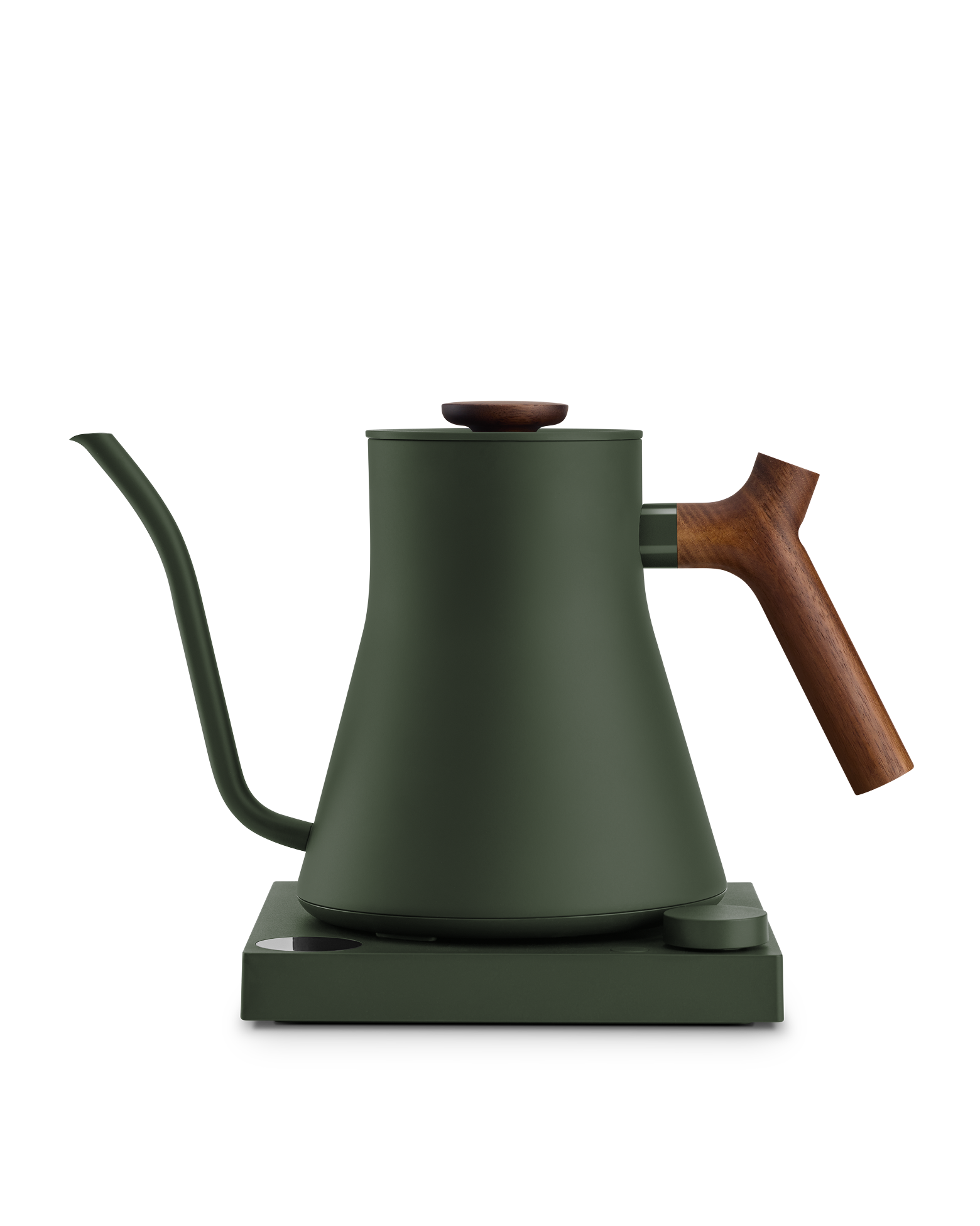
Fellow Stagg EKG Pro electric kettle in Woodland Walnut
The Stagg EKG, photographed like a sculpture. Because, frankly, it is one.
Share This Profile
Dispatch No. 01 · The Scene

It is 7:14 a.m. and the kettle is louder than the room.

Somewhere in San Francisco, a person who would never describe themselves as a coffee snob is timing a 30-second bloom on a kitchen scale. The gooseneck is matte black. The display reads 205°F to the degree. The grinder on the counter cost less than $200 and produces a near-uniform medium-fine powder. None of this was true a decade ago, at least not for civilians.

This is the world Fellow built. A San Francisco-based coffee-gear company that has quietly turned mornings into rituals and rituals into a category. It started, as a great many things in this city do, with a Stanford student and a hunch. It has since shipped to 60+ countries, raised $30 million from NextWorld Evergreen and Benchmark's Peter Fenton, and put a kettle on the same shelf as the toaster you never use.

Fellow's HQ at 560 Alabama Street doubles as a flagship store and an open-to-the-public coffee playground. You can walk in, order a pour-over made on the gear you're about to buy, and watch the team workshop a new grinder geometry through the glass. It is, depending on your tolerance for context, either a retail experience or a research lab pretending not to be.

"Fellow makes beautifully functional tools for any kitchen, designed in San Francisco and used around the world." — Fellow, About page
Dispatch No. 02 · The Problem

Specialty coffee got great. The hardware did not.

By the early 2010s, third-wave roasters had figured out how to source and roast beans that were genuinely extraordinary. The bag you bought from Blue Bottle on Saturday tasted like nothing your grandparents would recognize as coffee. Then you took it home, dumped it into a $19 drip machine, and ground it on a wobbly blade grinder.

The bottleneck had moved. Beans were no longer the problem. The kitchen was. Most home brewers had no reliable way to control temperature, no way to grind consistently, and no idea what gear a cafe actually used. The category was full of either too-cheap junk or commercial gear designed for baristas who'd been to trade school.

±1°
Temperature precision

The Stagg EKG holds water to the degree. Drip machines hold it to whatever.

31
Opus grind settings

One grinder, from espresso fine to cold-brew coarse. Previously a four-machine problem.

$197K
Original Kickstarter haul

Pre-sales for the Duo Coffee Steeper in 2013. A whole company shipped from that.

Fellow's bet was that the missing layer was design - not in the moodboard sense, but in the engineering-meets-ergonomics sense that makes a thing actually get used. A kettle that lives on your counter because you don't want to put it away. A grinder that fits the cabinet. A travel mug that doesn't dribble down your chin when you sip it.

"Help people brew ridiculously good coffee at home." — Fellow, internal mission
Dispatch No. 03 · The Founder's Bet

A dorm room, a Kickstarter, and eight years without a check.

Founder Jake Miller had two pieces of relevant history. The first was a stint at Caribou Coffee in Minnesota, where he worked with roastmasters and traveled to producing countries. The second was Stanford's d.school, where a class project became the Duo Coffee Steeper: a vessel that combined the immersion of a French press with the clarity of a pour-over.

The Duo went up on Kickstarter in 2013 and pulled in roughly $197,000 in pre-orders. That money funded a kettle. The kettle funded a grinder. And so on, for the next eight years. Fellow did not take institutional venture capital until 2021. As TechCrunch put it, it is the rare consumer-hardware company that compounded on customer cash for the better part of a decade.

This matters because hardware is brutal. Most consumer-product startups raise early and dilute often. Fellow ran the opposite play. By the time NextWorld Evergreen led the $30 million Series B in June 2022, the company already had a working factory pipeline, a profitable e-commerce engine, and roughly 85 employees. The round was less a rescue than a turbocharger.

"Fellow grew from 2 employees to 4 to 10 to 20 to 30 to, today, 85 people." — Jake Miller, founder note
Dispatch No. 04 · The Receipts

A Brief, Caffeinated History.

2013

Jake Miller launches the Duo Coffee Steeper on Kickstarter from Stanford. Raises ~$197K.

2016

Stagg pour-over kettle debuts, complete with thermometer-in-the-lid.

2018

Stagg EKG electric kettle ships. The category quietly bends around it.

2022

$30M Series B led by NextWorld Evergreen; Benchmark's Peter Fenton joins.

2023

Opus conical burr grinder lands under $200. Ode Gen 2 ships.

Dispatch No. 05 · The Product

What's actually in the box.

Fellow's lineup splits along two axes: how you heat the water and how you crush the bean. There's a third, smaller axis - how you carry it once it's made. Each product is recognizably Fellow within about half a second of looking at it: matte finishes, gentle radii, a font that looks like it was designed by an architect who got into coffee.

Flagship Kettle

Stagg EKG

Gooseneck, LCD, brew stopwatch, hold-temperature mode. The kettle that effectively defined the home pour-over kettle category.

Filter Grinder

Ode (Gen 2)

Flat-burr brew grinder for drip, pour-over, and French press. Quiet, tidy, surprisingly fast.

All-Purpose

Opus

Conical burr grinder doing espresso through cold-brew under $200. The grinder you recommend when someone asks.

Storage

Atmos Canister

Twist the lid, pull the vacuum, keep beans fresher. Solves a problem you didn't know you had.

On the Go

Carter Move Mug

Vacuum-insulated travel mug with a leak-proof drinking edge. Sips like a real mug.

Subscription

Fellow Drops

Rotating beans from a curated list of top roasters. Coffee club for people who already have opinions.

"Mornings just got easier." — Fellow press release for Opus, 2023
Dispatch No. 06 · The Proof

What the numbers say.

Anyone can call themselves a design company. The harder question is whether the design actually moves the unit. Fellow's footprint suggests it does. The company grew from a two-person operation to roughly 130 employees, opened a flagship in the Mission and a second store on Abbot Kinney in Venice, and got picked up by Williams-Sonoma and the SFMOMA Museum Store alongside it.

Fellow Headcount Growth · 2013 → 2024 (approx.)
2013
2016
2018
2020
2022
2024
Heights show the climb from two-person to roughly 130. Reported figures, not GAAP.

Distribution is broad: 60+ countries, hundreds of specialty cafes carrying gear at the counter, a Series B led by an investor (NextWorld Evergreen) that specializes in long-hold consumer brands. The Benchmark connection through Peter Fenton matters less for capital than for what it signals: a software-grade venture firm betting on a hardware-grade story.

"Fellow has bootstrapped for the better part of eight years before raising a Series B." — TechCrunch, 2023
Dispatch No. 07 · The Mission

Gear, guidance, and the actual coffee.

Most coffee companies pick a lane. Fellow runs three. Hardware is the spine. Guidance - brew guides, tutorials, the YouTube channel, the in-store classes - is the connective tissue. And Fellow Drops, the rotating roaster subscription, closes the loop by delivering the only ingredient the hardware can't manufacture.

Each lane reinforces the others. Buying a kettle gets you into a brew guide. The brew guide recommends a grind setting. The grind setting goes better with a particular bean. The bean comes from a roaster who happens to be featured in the next Fellow Drops box. It is, in industry terms, a content-to-commerce flywheel. In civilian terms, it is the modern version of asking your barista what they're drinking.

The company has been refreshingly disciplined about not turning this into a lifestyle brand. There is no Fellow yoga mat. There is no Fellow scented candle. The expansions all rotate around the same axis: water, beans, ritual.

"Bring the cafe experience home, but without the clunky equipment." — Fellow, founding premise
Dispatch No. 08 · The Stakes

Why this still matters in five years.

Cafe traffic is recovering, but the structural shift to brewing at home that began in 2020 has not reversed. People who learned to grind and bloom during lockdowns did not unlearn it. They bought better kettles. They argued about water hardness on Reddit. Fellow's TAM is, against most expectations, larger than it was before.

There are headwinds. Specialty coffee is expensive in a way that is increasingly visible at the grocery shelf. Hardware margins are tight when freight surges. Cheap competitors will continue to copy the silhouette of the Stagg without copying its tolerances. The path forward, if Fellow plays it right, looks less like a single hero product and more like a deepening platform: gear that talks to an app, subscriptions that route around a member's stated preferences, retail that doubles as education.

It is, more or less, the same bet Jake Miller made in 2013. Coffee is a daily ritual that most people will keep doing forever. The only question is whether the gear gets out of the way or in the way. Fellow exists to take the gear's side.

Dispatch No. 09 · Return to the Scene

It is 7:14 a.m. and the room is louder than the kettle.

The bloom finishes. The display ticks past 30 seconds. The person who would never call themselves a coffee snob pours water in a spiral, watches the bed rise, and does not particularly think about Fellow at all. Which is exactly the point. Good design is the design you stop noticing. Good rituals are the ones that survive your attention drifting elsewhere.

Ten years ago, this scene required either a cafe or a credential. Today it requires a kettle, a grinder, and roughly twelve minutes of patience. The credentialing is gone. The cafe came home. The kitchen, finally, caught up to the bean.

"Beautifully functional tools for any kitchen." — Fellow, in nine words