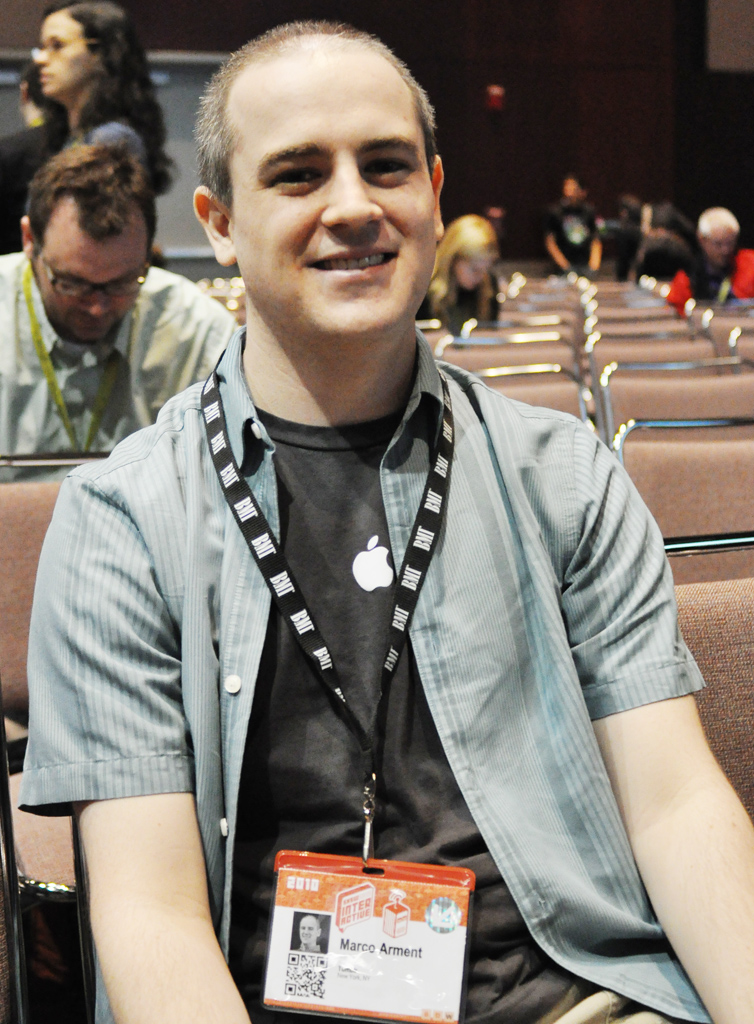
The Anomaly at the Center of the Apple Universe
Here is a tech founder who could have cashed out multiple times, raised venture capital, hired a team, and scaled. He chose none of that. Instead, Marco Arment runs one of the most popular podcast apps on the App Store entirely alone - no employees, no investors, no growth team sending push notifications designed by a PhD in persuasion. Just one developer, one app, one deeply held idea of what software should be.
That idea is not complicated: software should respect the person using it. No tracking. No dark patterns. No analytics harvesting behavior so advertisers can follow you around the internet. In a tech landscape drunk on data and engagement metrics, this position reads almost like a manifesto. Arment doesn't call it that. He just calls it the right way to build things.
The software that embodies this philosophy is Overcast, a podcast player for iOS he launched on July 16, 2014. A decade in, it remains one of the top apps in its category - 46,000+ ratings at 4.5 stars - still written and maintained by one person. In 2024, on the app's 10th anniversary, Arment announced a complete rewrite from the ground up in modern Swift and SwiftUI. Not a patch. Not a feature addition. A new foundation, rebuilt with the same care he brought to version one.
Before Overcast, there was Instapaper. The idea was simple and slightly out of its time: save articles to read later, formatted cleanly, offline. Arment built it alone starting in 2008, ran it as a solo business for five years, and eventually sold a controlling stake to Betaworks in 2013. It was never a billion-dollar exit, never the talk of TechCrunch. It was just a remarkably useful thing, built by one person, that people actually paid for. Instapaper later passed through Pinterest and eventually spun out to independence again.
Earlier still was Tumblr. In late 2006, a teenager named David Karp had an idea for a blogging platform. Arment, fresh out of Allegheny College with a computer science degree, joined as his co-developer. The two of them - essentially - built what would become one of the defining social platforms of the late 2000s. Arment served as Lead Developer and de facto CTO, helping grow Tumblr from nothing to tens of millions of users before leaving in September 2010 to focus entirely on Instapaper. When Yahoo acquired Tumblr for $1.1 billion in 2013, Arment had long since moved on, but his fingerprints were everywhere in that codebase.
The pivot that best captures who Arment is happened in September 2015. He released a Safari content blocker called Peace. Within hours, it was the #1 paid app in the US App Store. Then he pulled it. Not because it wasn't working - it was working perfectly. He pulled it because he'd concluded that an all-or-nothing approach to ad-blocking was too blunt an instrument. Small publishers who relied on advertising to survive, who hadn't consented to the surveillance advertising model any more than their readers had, were being caught in the blast radius. He couldn't square that with his conscience.
Apple refunded every purchaser automatically. Arment walked away from a #1 hit at peak revenue. The tech press wrote about it for weeks. It became a case study in developer ethics - the rare instance of someone applying moral reasoning to a commercial decision in public, in real time, and not hedging on the conclusion.
On the audio side, Arment has been a voice in the Apple/tech podcasting world since 2010, when he started Build and Analyze with Dan Benjamin on the 5by5 network. In early 2013, he joined Casey Liss and John Siracusa for what started as a car podcast - Neutral - that kept veering into Apple and tech territory. The tech tangents became the main event. Neutral ended after twelve episodes. Accidental Tech Podcast was born and has been running weekly ever since, now past episode 688. ATP is not just another Apple podcast. It is the one that people who build Apple software listen to - detailed, opinionated, genuinely informed by people who write the code they discuss.
The blog, marco.org, has been running since December 2006, the same year he started building Tumblr. It's powered by his own open-source static site engine - because of course it is. In January 2015, he published "Apple has lost the functional high ground," a post arguing that Apple's software quality had declined sharply under the pressure of annual release cycles. It went viral in the specific way that early-internet posts went viral - covered by CNN, CNBC, Business Insider - and spawned an enormous pile-on against Apple. Then Arment did something rare: he deleted it and wrote a public follow-up acknowledging that he hadn't anticipated the avalanche, felt bad about it, and thought the dogpile had gone further than he'd intended. He didn't reverse his position. He took responsibility for the consequences.
Behind all of it is a personality that listeners of ATP know well: deeply opinionated but willing to be wrong in public, obsessive about audio quality and gear, passionate about coffee to the level of frequent hardware upgrades, possessed of a dry wit that takes a few episodes to fully appreciate, and constitutionally allergic to the idea that growth for its own sake is a good thing. He owns a BMW M5 and drove the Nürburgring on a factory delivery trip in Germany - an event the Neutral podcast commemorated with an entire episode. He is, in the specific parlance of Apple-adjacent tech culture, a bit of a gear nerd.
In 2014, he invested $50,000 in Gimlet Media, a podcast production company co-founded by Alex Blumberg. Five years later, Spotify acquired Gimlet for approximately $230 million. That bet, made on the conviction that podcasting was a real medium with real staying power, returned multiples on the investment and validated a thesis Arment had been living out with ATP since 2013.
In April 2026, on Apple's 50th anniversary, Arment published an open letter to incoming CEO John Ternus. It's a document that reads less like a business memo and more like a statement of values - an appeal to preserve computing as something that enhances human capability, that treats users as adults, and that doesn't treat attention as a resource to be harvested. Whether Ternus reads it is beside the point. That Arment wrote it says everything about where his priorities sit after twenty years building things in the Apple ecosystem.
He is, ultimately, an argument in favor of something the tech industry has largely forgotten how to make: small, excellent, principled software built by someone who cares more about whether it's good than whether it scales.