Look at a supermarket coffee aisle and the names seem to be the business. Chock full o’Nuts brings old New York. Hills Bros. brings the red can and a century of pantry memory. Kauai Coffee brings volcanic soil, island sun and a place people can visit. Segafredo brings the Italian espresso bar. Then there is the store brand, designed to look as if the supermarket itself went out and learned to roast. Several of those stories can lead to the same address: 1370 Progress Road in Suffolk, Virginia.
That is where Massimo Zanetti Beverage USA keeps its headquarters and primary roasting operation. The company is one of North America’s larger coffee roasters, but size is the least interesting part. Its advantage is range. MZB-USA can source green beans, manage commodity exposure, develop a blend, roast it, put it into a can, bag, jar, pod or hotel-room packet, send it through a national distribution network and provide the equipment that turns it into a drink. It can do that under one of its own names or yours.
The product behind the products
MZB-USA calls the proposition “Coffee Complete.” Strip away the trademark and it is a practical promise to buyers: fewer handoffs. A grocer building a private-label range does not merely need beans. It needs consistent flavor across harvests, a package that survives the shelf, several price tiers, reliable fill rates and advice about whether shoppers want ground coffee, instant, pods or something more specific. A hotel has a different list. An office has another. The company’s business is translating one complicated agricultural commodity into all of them.
The consumer side is easy to see. The online shop sells roast-and-ground coffee, whole beans, instant cappuccino and single-serve products from a portfolio that includes Chock full o’Nuts, Hills Bros., Kauai Coffee, MJB, Chase & Sanborn and others. Segafredo stretches into foodservice with espresso, drip blends, cold brew and bottled cold espresso. La San Marco equipment gives the group a place on the counter as well as in the cup.
The enterprise side is quieter and potentially stickier. MZB-USA is one of the country’s major private-label coffee suppliers. A retailer can use its sourcing, sensory testing, research, graphic design, packaging and logistics capabilities to create a store brand without assembling six vendors. Foodservice operators buy beverage programs rather than a lonely bag of beans. Offices can pair coffee and tea with single-serve brewers or espresso machines. Franchising adds another route to market through coffee-shop and espresso-café concepts.
The company has two customers in every cup: the person drinking it and the business promising it.
A farm at one end, a port at the other
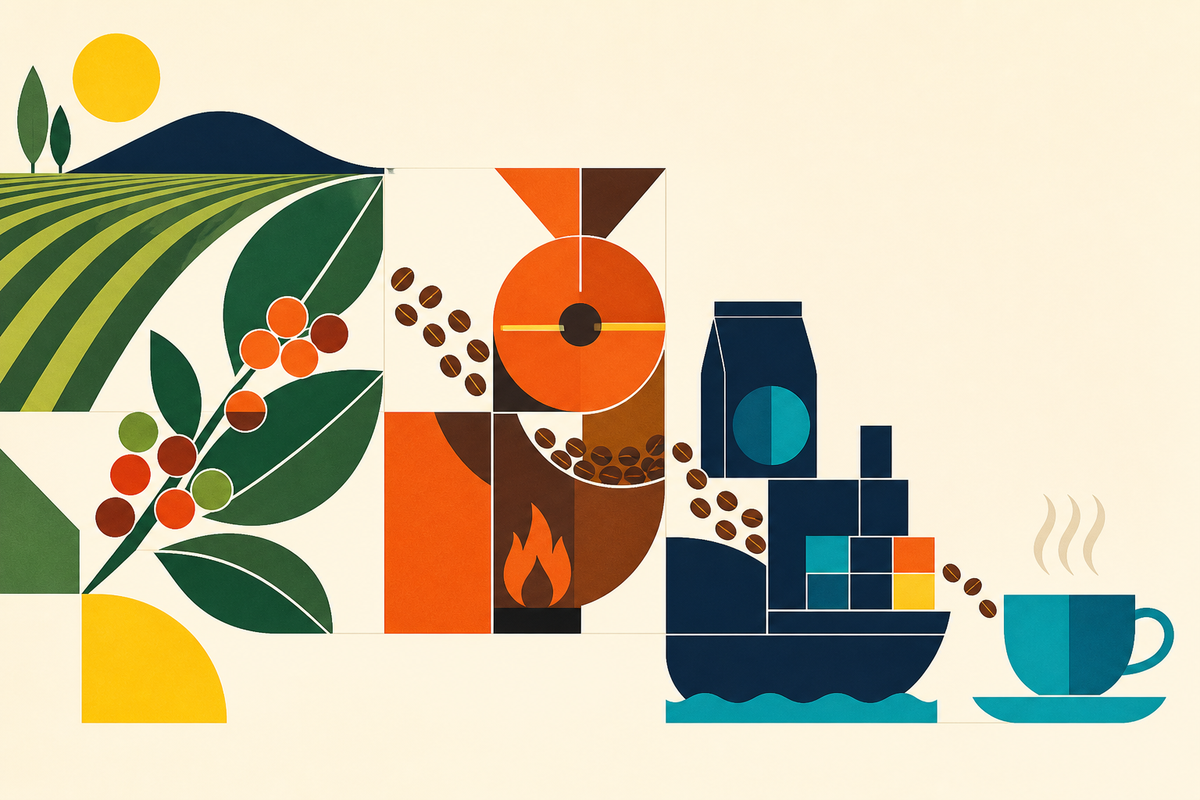
Vertical integration is often a pleasant phrase in an annual report. Here it has dirt under its nails. MZB-USA’s footprint includes Kauai Coffee Company, which operates the largest coffee farm in the United States on a 3,100-acre estate. Coffee is grown, processed and roasted there. In June 2026, the operation finalized a new agricultural lease with backing from MZB-USA, securing the farm’s use and setting out plans for machinery, technology, skilled trades, hospitality jobs and visitor experiences.
Six time zones away, Suffolk supplies a very different advantage. Green coffee enters through the Port of Virginia, moves to the roasting plant and then into a distribution center that became operational in late 2021. At 350,636 square feet, the building is bigger than four football fields under one roof. It handles bulk distribution and e-commerce fulfillment. In 2022 the company separately announced a $29.1 million project to consolidate and expand roasting in Suffolk, with 79 planned jobs.
Put the endpoints together and the strategy becomes legible. The farm gives MZB-USA origin credibility and a distinctive consumer brand. The port, plant and warehouse give it throughput. Global relationships in Costa Rica, Brazil and Honduras broaden the supply. Commodity specialists manage the fact that coffee is not a stable widget: crops vary, futures move, ships wait and customers still expect next month’s can to taste like last month’s.
The cup is also a financial instrument
In August 2026, MZB-USA announced that Nora Johnson, its vice president of commodities, had earned an Intercontinental Exchange Certified Coffee Grader license. The company said she became the youngest current holder and joined Dorothea Hescock, its senior director of quality and R&D, among the seven licensed female Arabica graders worldwide. The exam tests whether professionals can judge green coffee against the physical and sensory standards used for delivery on the global Arabica futures contract.
That sounds distant from breakfast until coffee prices surge or a crop arrives unevenly. A private-label buyer wants a repeatable taste and a defensible cost. The roaster must translate a volatile raw material into both. Grading connects the physical bean to the benchmark contract; hedging and procurement connect today’s purchase to tomorrow’s shelf. Having those disciplines close to quality and product development is a less photogenic differentiator than a celebrity blend, but it is exactly the kind that retail customers notice.
How to read this: the bars are a qualitative map of channel breadth, not revenue shares.
Old labels, new jobs
Heritage brands pose a peculiar management problem. Their familiarity is the asset, but nostalgia can become a cage. Chock full o’Nuts has been coffee since the 1930s and still carries its New York identity. Hills Bros. was an early adopter of vacuum-packed coffee cans. Segafredo’s reference point is Italian espresso. Kauai Coffee is tied to a physical place. MZB-USA must keep each promise recognizable while moving the portfolio into pods, e-commerce, cold coffee and modern foodservice.
Brand owner
Builds demand for distinct heritage and origin-led labels sold to households.
Private-label maker
Turns retailer strategy into blends, formats, packaging and dependable shelf supply.
Foodservice partner
Provides espresso, drip coffee, cold brew, equipment and merchandising programs.
Supply-chain operator
Connects procurement, roasting, packing, distribution and e-commerce fulfillment.
Packaging is one place where those jobs overlap. The company offers conventional cans, bags and jars, hotel and foodservice packs, and several single-serve systems. Its Filter Cup was designed to use less plastic than a conventional plastic cup. Hills Bros. later launched in PURPOD100 pods, certified by the Biodegradable Products Institute for commercial composting and made partly with reclaimed coffee chaff. The important qualifier is “commercial”: a compostable pod is only as useful as the collection and processing available where it is discarded.
Sustainability work extends back toward the farm. On Kauai, drip irrigation directs water and fertilizer toward roots; processing water is cleaned and reused in fields; coffee-cherry pulp and pruning mulch return to the soil. The 100% Kauai Coffee line earned Fair Trade, Rainforest Alliance and Non-GMO Project certifications in 2021. These measures do not settle coffee’s environmental questions, but they show where an integrated operator can intervene: farm practice, factory waste, packaging and freight.
What the model buys
MZB-USA competes with global packaged-coffee groups, specialty roasters, contract manufacturers and broad foodservice distributors. A specialist may have a sharper story in one niche. A giant brand may command more consumer attention. MZB-USA’s answer is optionality. It can grow a proprietary label, fill a retailer’s label, build a restaurant program or put a brewer into an office while reusing much of the same sourcing and production backbone.
That flexibility matters in a mature market because the format keeps changing even when the ritual does not. Consumers move among drip coffee, espresso, pods and cold drinks. Retailers want store brands that feel deliberate rather than generic. Restaurants need beverages that earn their place on a menu. Employers want a small amenity that works every morning. MZB-USA fits between the commodity and all those contexts, making agricultural variation behave like a dependable consumer product.
The company entered 2026 with a reorganized senior bench. Matthew Smith became president in March, charged with U.S. commercial and operational priorities alongside CEO Scott Meader. Adam Reizer arrived as chief financial officer in May. The stated agenda is disciplined growth, stronger brands and operational transformation. A Walmart Private Brand Coffee Supplier MVP award for 2025, announced by MZB-USA, points to the other half of that agenda: execution for customers whose own scale leaves little room for missed shipments.
The clever thing is not that MZB-USA owns many coffee brands. It is that one infrastructure can support many versions of the coffee business.
The company in the cupboard
Massimo Zanetti Beverage USA occupies an odd market position: consequential enough to shape the aisle, discreet enough to be mistaken for a collection of unrelated labels. That is partly by design. Private-label manufacturing works best when the retailer gets the spotlight. A heritage brand works best when its own history stays in front. Foodservice works best when the guest remembers the restaurant.
The operator remains behind the curtain, listening for the roast, the risk and the truck schedule. The next time a can promises old New York, a bag promises Hawaii or a supermarket promises its own perfect blend, the more revealing question may be printed in smaller type: who built the system that made the promise repeatable?