The first thing to know about Harvest Hill Beverage Company is that you probably know its work better than its name. The company itself is barely a decade old. Its refrigerator-door celebrities are much older: Juicy Juice, SunnyD, Little HUG, Veryfine, Fruit2O, Nutrament and Daily's Cocktails. One might have appeared beside a peanut-butter sandwich; another waited in a corner-store cooler; another went into a blender after the children were asleep. Harvest Hill gathered these separate memories into one operating business.
That business began in June 2014, when private-equity firm Brynwood Partners formed Harvest Hill to buy Juicy Juice from Nestlé USA. American Beverage Corporation followed in 2015, bringing Little HUG and Daily's. Sunny Delight Beverages arrived in 2016 with SunnyD, Fruit2O and Veryfine, plus four manufacturing facilities. Beverage assets from Faribault Foods added pouch-making capacity later that year. In May 2017, the acquired operations were consolidated under a single name. What looked from the supermarket aisle like a jumble of unrelated drinks had become a coordinated portfolio.
A young company made of old brands
Harvest Hill's unusual advantage is temporal. The corporate platform dates to the smartphone era, but its brands stretch across a century of American drinking habits. Veryfine traces its roots to 1919 apple orchards in Littleton, Massachusetts. Nutrament appeared in 1960. Two Florida fathers created SunnyD in 1963 as an alternative to frozen orange drinks. Daily's mixers arrived in 1965. The Little HUG barrel landed in 1974, and Fruit2O followed in 1999, when flavored water still needed an explanation.
One company · several drinking occasions
Those dates matter because beverage brands are habit machines. A familiar bottle shape can do work that a national advertising campaign would otherwise have to buy. Parents recognize Juicy Juice as a lunchbox staple. Little HUG's ribbed plastic barrel is nearly as important as the liquid inside. SunnyD owns a color, a silhouette and a tangy taste that its audience can identify before reading the label. Harvest Hill did not invent those memories. It bought the responsibility for maintaining them.
“The company’s real product is a bridge between brand memory and industrial scale.”YesPress analysis
What the company actually sells
At the consumer level, the answer is straightforward: juices, fruit-flavored drinks, flavored water, energy nutrition drinks, cocktail mixers and ready-to-drink alcohol. The ranges cover small boxes, barrel bottles, multi-serve carafes, pouches and slim cans. Juicy Juice offers 100 percent juice along with organic and lower-sugar options. Little HUG advertises one gram of sugar and five calories per barrel. SunnyD's nonalcoholic line comes in numerous fruit flavors, while its vodka seltzer carries 4.5 percent alcohol, 95 calories and zero sugar.
Look one layer down, however, and Harvest Hill sells access. Grocery chains need recognizable products that move. Warehouse clubs need multipacks. Convenience stores need cold single serves. Schools and healthcare operators need formats and nutrition profiles that fit institutional requirements. Restaurants and vending companies need dependable supply. Liquor distributors need an adult-beverage proposition. Harvest Hill addresses all of them without forcing a single brand to play every role.
The company also manufactures for other businesses. Its contract operation produces beverages in multiple package formats, an unglamorous service with strategic value. A brand owner can tap installed lines, quality systems and shipping lanes without building a plant. Harvest Hill can keep machinery productive beyond the volume generated by its own labels. This is where its brand portfolio and factory footprint reinforce each other.
The problems behind the pleasure
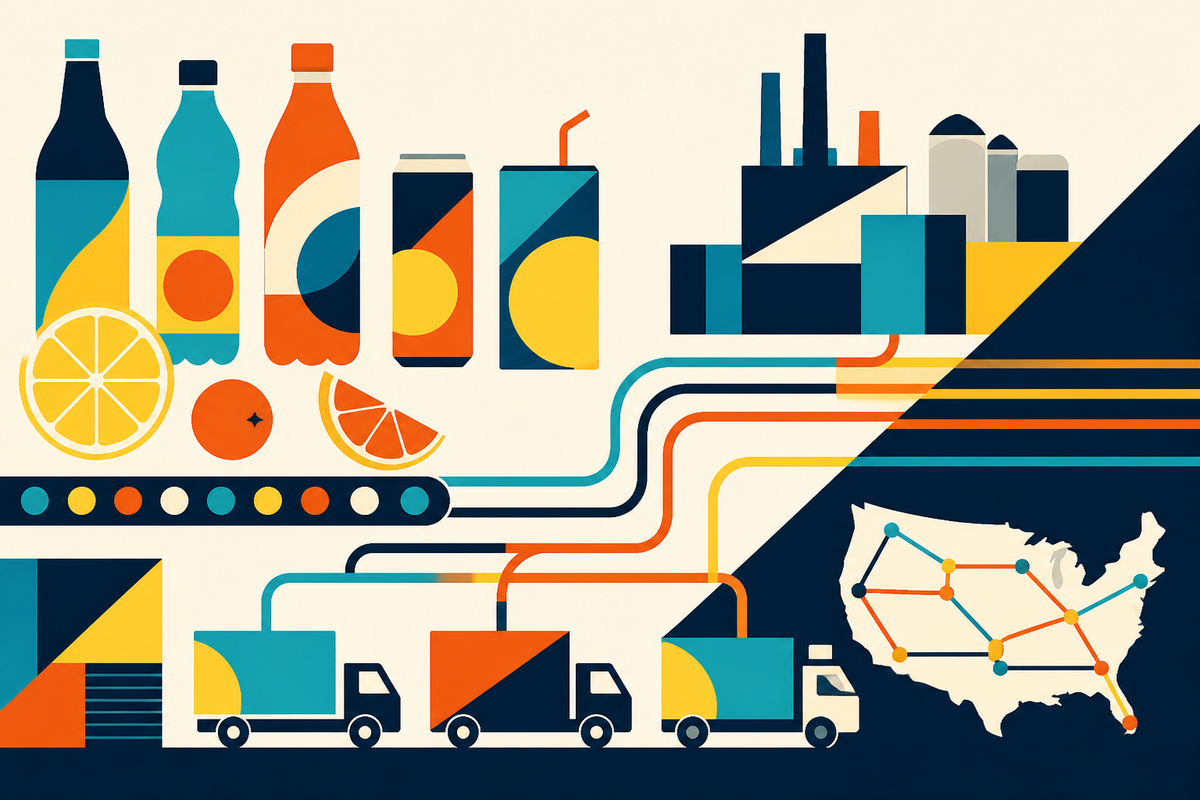
A bottled drink appears simple because its complexity has been handled before it reaches the shelf. Liquid has to be formulated consistently, packed into the right container, produced safely, carried efficiently and delivered at the moment a retailer expects it. Different channels want different case counts, sizes, shelf lives and price points. The company says its plants sit near major transportation lanes and within hours of population centers. Geography becomes part of product design: water is heavy, deadlines are unforgiving and empty shelf space earns nothing.
Harvest Hill solves a second problem for retailers: assortment. A buyer can work with one supplier across family juice, kids' drinks, hydration, nutrition and cocktails. The supplier gains more conversations with the same channel; the retailer gets recognizable brands without negotiating with a separate operating company for each one. For foodservice, Harvest Hill packages that logic into programs serving K-12 education, restaurants, healthcare and vending. Juicy Juice 100 percent fruit and vegetable juices and Fruit2O flavored waters are among the products the company identifies as meeting USDA Smart Snacks standards.
The line between nostalgia and novelty
Old brands create attention, but they can also trap their owners. Consumers may remember a product warmly and still leave it in the past. Harvest Hill's countermeasure is format innovation. Daily's translated the cocktail-mixer name into portable frozen pouches and then wine-based Poptails. Juicy Juice expanded beyond traditional 100 percent juice into organic, lower-sugar and flavored-water choices. The most visible move came in 2023, when SunnyD crossed into the alcohol aisle with vodka seltzer.
That orange can is a compact study in brand extension. Adults who knew SunnyD as children need no flavor tutorial. At the same time, the product has to work as an adult purchase on its own terms, hence the slim can, explicit calorie count and zero-sugar claim. The risk is obvious: a childhood-associated brand entering alcohol can make some buyers uneasy. The opportunity is equally clear: one sensory cue can open an entirely new occasion and distribution channel.
“A juice box and a frozen cocktail pouch look unrelated in the fridge. From the factory floor, both are exercises in formulation, packaging and route to market.”Portfolio logic
A new owner for the next pour
In April 2025, Guatemala-based Castillo Hermanos announced an agreement to acquire Harvest Hill from Brynwood Partners. The buyer is a family-owned consumer group founded in 1886, older than every brand in the Harvest Hill portfolio. Centerview Capital supplied a significant investment and joined as a strategic partner. Citi advised Castillo Hermanos and arranged financing. After regulatory approvals, the companies described Harvest Hill as part of Castillo Hermanos's effort to strengthen its United States presence.
Harvest Hill forms around the acquisition of Juicy Juice from Nestlé USA.
American Beverage adds Little HUG, Daily's and a broader manufacturing base.
Sunny Delight Beverages and Faribault assets widen the portfolio and pouch capacity.
The acquired businesses consolidate into one operating company.
Castillo Hermanos buys the platform with Centerview Capital as strategic investor.
For Castillo Hermanos, the purchase provides what would take years to assemble organically: brands with national awareness, relationships across several retail channels, production capacity and a workforce of more than 1,000. For Harvest Hill, it offers a parent with a long operating horizon and an international consumer-goods base. The announced deal terms were not disclosed, although one food-and-consumer transaction report placed the value around $1.5 billion. The more durable number is the one Harvest Hill itself gives: annual sales above $1 billion.
Where Harvest Hill fits
Harvest Hill sits between the global beverage giants and narrowly focused independent brands. It does not have Coca-Cola's fountain empire or PepsiCo's snack distribution. Nor is it a single-product challenger hoping one new formulation catches fire. Its closest strategic alternatives include portfolio companies such as Keurig Dr Pepper, established juice names such as Welch's and Mott's, and manufacturing specialists such as Refresco and Niagara Bottling. Harvest Hill's difference is the combination: mid-sized corporate identity, billion-dollar scale, a set of familiar labels and an owned operating backbone.
The company is strongest when those pieces compound. A new format can borrow an old brand's recognition. A new acquisition can use existing plants and retailer access. Contract volume can improve asset use. Foodservice can extend a retail product into schools or restaurants. None of this is as visible as a flavor launch, but it is harder to copy than a flavor.
The challenge is that beverage preferences keep moving. Sugar scrutiny, functional ingredients, private-label pressure and crowded ready-to-drink shelves can make a beloved name insufficient. Harvest Hill has to protect the memory without preserving every old assumption. Its history suggests the operating answer: keep the label familiar, adjust what sits beneath it, and make sure the package can reach the next place consumers expect to find it.
That is why Harvest Hill is an instructive company even for people who never buy SunnyD. It shows how a consumer roll-up can become more than a collection of logos. The brands win the glance; plants, packaging lines and channel relationships turn the glance into repeatable economics. Somewhere between the lunchbox and the liquor aisle, Harvest Hill built a business by treating nostalgia not as the destination, but as the first mile.