The most revealing AB InBev product may not contain beer. It sits on a shopkeeper's phone. BEES, the company's business-to-business app, lets a neighborhood retailer order cases after closing time, schedule a delivery, collect rewards, receive recommendations and, in some markets, apply for short-term credit. The transaction looks ordinary. The machinery behind it is not. A brewer that once depended on a weekly sales visit now has a live digital connection to millions of stores.
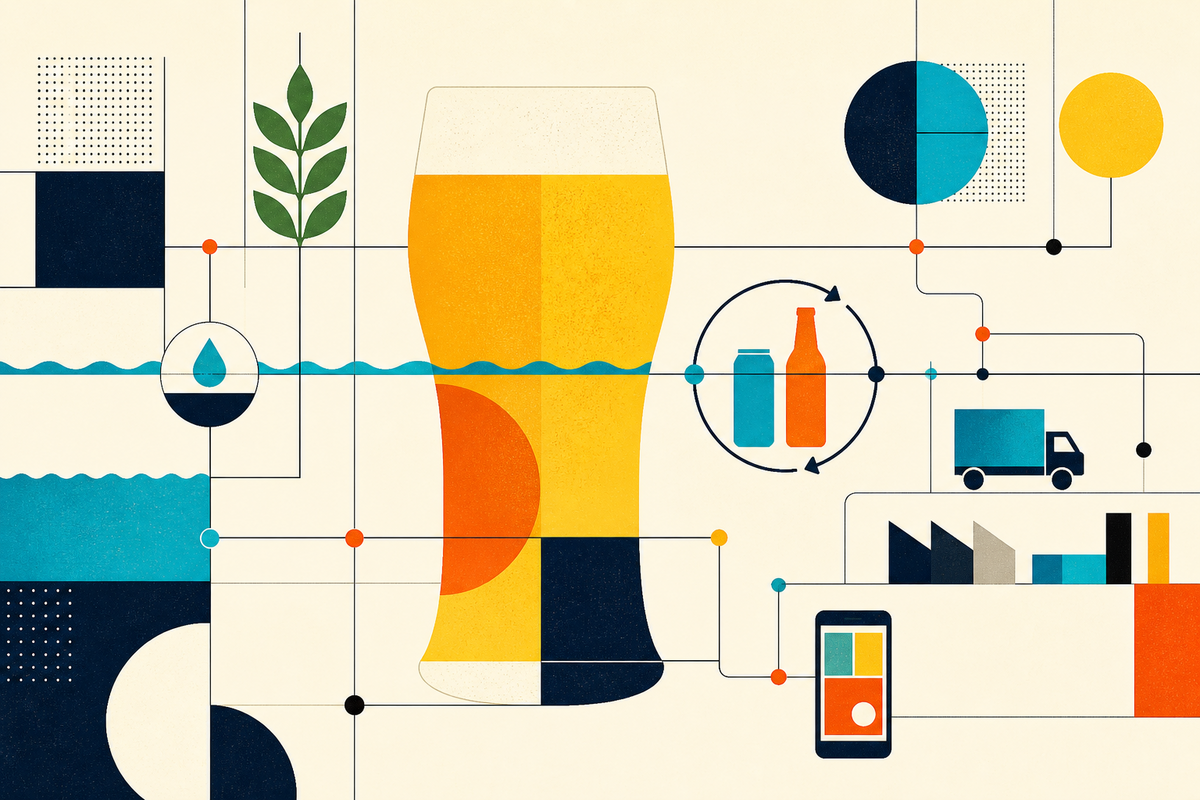
That connection explains AB InBev better than a wall of familiar labels. The Leuven-based company makes Budweiser, Corona, Stella Artois, Michelob Ultra and hundreds of regional beers. But its durable advantage is the system surrounding the liquid: farms and maltsters, breweries and packaging lines, wholesalers and cold cabinets, sports rights and consumer data. Beer is the product people can hold. Distribution density, brand memory and operating scale are the assets that compound.
A company assembled like a very long guest list
AB InBev's official timeline starts in 1240, when Leffe was first brewed at a Belgian abbey. The Den Hoorn brewery opened in Leuven in 1366. Budweiser arrived in St. Louis in 1876; Corona in Mexico City in 1925; Stella Artois was introduced a year later as a Christmas gift for Leuven. None of those moments founded today's corporation. They supplied the heritage that successive combinations later gathered under one roof.
The modern structure came together quickly. Belgium's Artois and Piedboeuf formed Interbrew in 1987. Brazil's Brahma and Antarctica created Ambev in 1998. Interbrew and Ambev combined as InBev in 2004. InBev joined with Anheuser-Busch in 2008, creating AB InBev. Grupo Modelo followed in 2013. The 2016 combination with SABMiller placed African, Latin American and other strong local franchises inside the world's leading brewer by volume.
A beer recipe can be copied. A route to market built over generations is harder to pour into a new bottle.The strategic distinction at the center of AB InBev
The company is different from a challenger brewery because it can launch across continents, negotiate inputs at scale and place products in an enormous number of outlets. It differs from a pure consumer-products conglomerate because its brands arrive with local rituals attached. Jupiler in Belgium, Aguila in Colombia, Brahma in Brazil and Cass in South Korea are not merely smaller versions of Budweiser. They are cultural fixtures. AB InBev's job is to standardize procurement, technology and operating routines without sanding away those local edges.
The portfolio is designed to catch changing taste
Scale does not protect a brewer if consumers move elsewhere. AB InBev's answer is not to bet on one universal lager. It runs a portfolio across mainstream and premium beer, local and global labels, low-calorie and no-alcohol choices, flavored drinks and canned cocktails. Corona, Stella Artois and Michelob Ultra have carried the premium expansion. Budweiser Zero, Corona Cero and Michelob Ultra Zero address occasions where alcohol is absent. Cutwater, NUTRL, Flying Fish and the recently acquired BeatBox stake stretch the company into ready-to-drink formats.
The second quarter of 2026 showed why that range matters. Beer volume grew 1.1 percent, but the faster movements were at the portfolio's edges: no-alcohol beer revenue rose 27 percent and Beyond Beer revenue rose 44 percent. Outside their home markets, Corona, Stella Artois and Michelob Ultra revenue increased 17, 19 and 21 percent. These are company-reported organic growth rates, not proof that every market is easy. China remained soft, and U.S. beer shipments still faced pressure. The portfolio's purpose is to keep more shifts in consumer preference inside AB InBev's own cooler.
BEES turns distribution into a product
BEES began in the Dominican Republic in April 2020, when pandemic restrictions made the traditional sales route awkward. It proved that the retailer relationship itself could become software. By June 2026, the platform was live in 30 markets, and AB InBev said 72 percent of its revenue was captured through B2B digital platforms. BEES handled $15 billion in quarterly gross merchandise value. Its marketplace for products from other suppliers contributed about $1.2 billion, up 50 percent from a year earlier.
For retailers, the problems are mundane and expensive: missed sales because a popular case is out of stock, time lost waiting for a representative, uncertain delivery windows and limited access to working capital. BEES gives AB InBev a way to address them while reducing friction in its own route to market. Recommendations may improve a shop's mix; digital ordering makes demand visible sooner; embedded payments and credit can pull a small business into the formal financial system. When the app sells third-party goods, the brewer monetizes a route it already paid to build.
Consumers meet a different digital layer. Zé Delivery in Brazil and TaDa in other developing markets promise cold drinks quickly at supermarket prices. PerfectDraft brings a small draft-beer machine into homes in developed markets. Together, AB InBev's direct-to-consumer brands served 13 million active consumers in the second quarter of 2026. They are modest beside the core wholesale business, but useful as laboratories for convenience, assortment and first-party behavior.
Do not digitize only the purchase. Digitize the recurring job around it. BEES combines ordering, scheduling, recommendations, rewards, payments and credit because the retailer's problem is not “buy beer online.” It is “run this shop with less friction.”
Attention is another distribution network
AB InBev calls its marketing approach “megabrands and mega platforms.” The plain-English version: put the few brands that can travel onto events with enormous, repeatable audiences. FIFA has worked with the brewer since 1986 and extended the relationship through the 2030 men's World Cup and the 2027 Women's World Cup. AB InBev is an Olympic partner through 2028, with zero-alcohol Corona Cero leading globally. Michelob Ultra has worldwide basketball rights across the NBA family and football partnerships with MLS and Concacaf.
Netflix and Live Nation widen that play beyond stadiums. The attraction is not a logo beside a scoreboard. A global rights package gives local teams a shared cultural moment, then lets them activate different labels by market. One sports property can support Budweiser in one country, Michelob Ultra in another and a regional beer elsewhere. In the first half of 2026, AB InBev put $4.1 billion into sales and marketing, nine percent more than the comparable period. The company reported 850 million social-media engagements across major events and was named Cannes Lions Creative Marketer of the Year for a third time.
Water is an ingredient and a constraint
The romance of brewing begins with grain and water; the operational reality ends there too. Crops face weather volatility. Breweries need dependable water and heat. Bottles, cans, refrigerators and trucks create emissions beyond the brewery gate. AB InBev's sustainability work therefore sits close to cost, continuity and license to operate.
Its current goals include an average brewery water-use ratio of 2.0 hectoliters for every hectoliter produced, and returning more water than it withdraws in priority high-risk watersheds. In the first half of 2026, the ratio improved to 2.3 from 2.4 a year earlier. The company also targets a 15 percent improvement in brewery energy efficiency against 2025 and more than a 35 percent value-chain emissions reduction against 2017. In agriculture, it aims to skill, connect and financially empower all direct farmers and work through malt suppliers to reach theirs.
Those targets are both environmental promises and operating questions. Efficient water use lowers exposure where water is scarce. Renewable heat and electricity can reduce volatility. Stronger agronomy can improve yields and crop resilience. Returnable or recycled packaging can reduce material demand. The difficult work lives outside a press release: aligning farmers, utilities, suppliers, municipalities and consumers across very different markets.
Where the brewer fits now
AB InBev sits at the top of global brewing, with Heineken the nearest international peer and Carlsberg, China Resources Beer, Molson Coors and Asahi among the major alternatives. Yet its competitive boundary keeps widening. Ready-to-drink products bring spirits companies into view. No-alcohol beer competes for moments that could go to soft drinks. BEES overlaps with B2B marketplaces and fintech. Rapid delivery puts the company beside consumer-commerce platforms.
The business still lives or dies by simple things: taste, price, availability and whether a drink belongs in a moment. Its 2025 revenue was $59.32 billion and normalized EBITDA was $21.22 billion, even as total volume declined 2.3 percent. In the first half of 2026, momentum improved: revenue grew 5.7 percent organically, beer volume rose 1.2 percent and underlying earnings per share increased 22.1 percent. Net debt remained material, but the ratio to normalized EBITDA had fallen to 2.86 times by June.
The strategic picture is less a pivot than an extension. AB InBev is using technology to reinforce the route it already owns, using cultural partnerships to refresh brands it already knows how to scale, and using a wider portfolio to follow consumers into adjacent occasions. The pint remains in the center. Everything around it is becoming more connected.