At the end of Prohibition, a ship carrying Heineken arrived in New York harbor. The familiar version of the story says it was the first imported beer to reach American drinkers legally again. The more useful version is about timing. A Dutch brewer had a product, a recognizable name and a route into a newly reopened market. The liquid mattered. So did everything wrapped around it.
That remains the cleanest way to understand The HEINEKEN Company. Its flagship green bottle is one of consumer goods' great visual shortcuts, yet the Amsterdam group behind it is less a single-brand business than a coordination problem solved at industrial scale. It manages more than 340 beers and ciders, sells in more than 190 countries and operates production facilities in more than 70. In 2025 it recorded €34.257 billion in revenue.
The company serves legal-drinking-age consumers, but most days it works through a more complicated cast: wholesalers, supermarkets, convenience stores, pub owners, hotels, restaurants, clubs and stadiums. Each wants a dependable delivery, the right package, cold stock, sensible margins and a brand someone will ask for without reading the menu. HEINEKEN solves that collection of small anxieties with breweries, planning systems, local sales teams, coolers, taps, advertising and data.
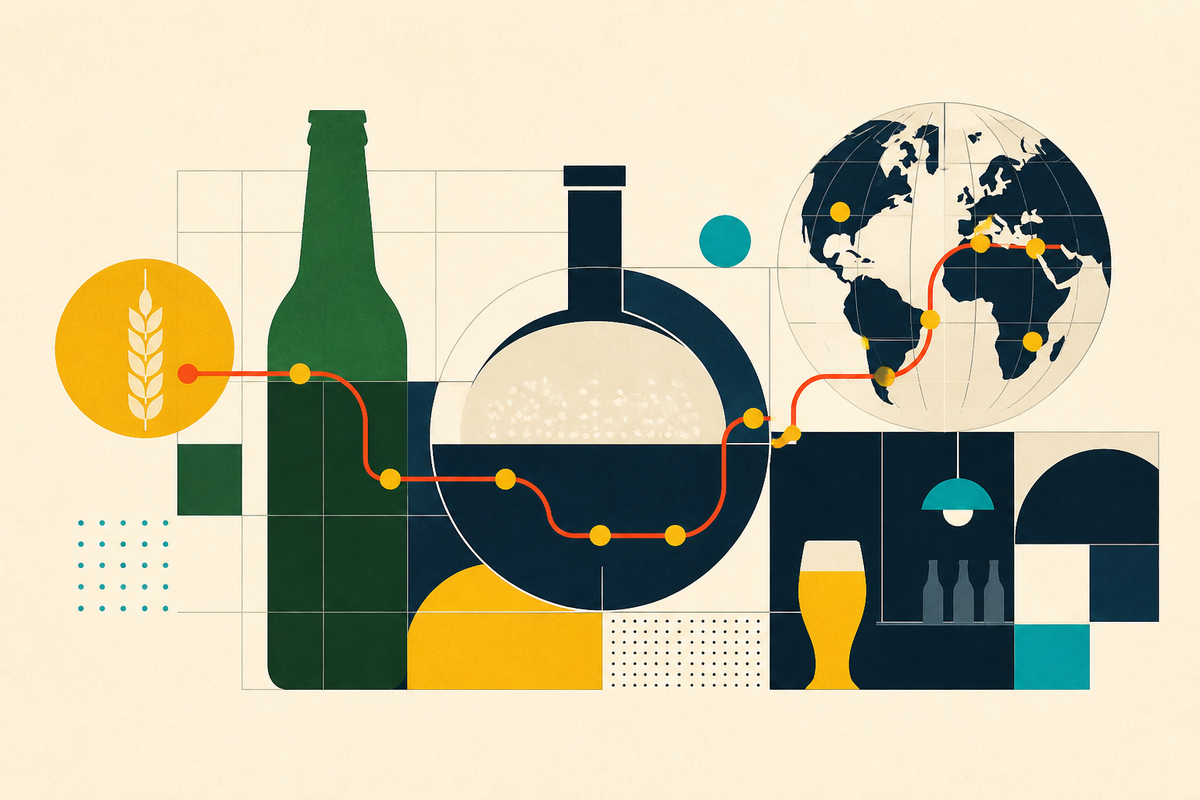
One flagship, hundreds of passports
Gerard Adriaan Heineken was 22 when he acquired Amsterdam's De Hooiberg brewery in 1864. The business later found a technical advantage in consistency: in 1886, Dr. Hartog Elion isolated the A-yeast strain still associated with Heineken's taste. A reliable product could travel. Over the following century and a half, acquisitions and local brewing operations added a different kind of reliability - the ability to meet a market on its own terms.
Heineken is the passport brand. Around it sit Amstel, Birra Moretti, Desperados, Tiger, Tecate, Sol, Dos Equis, Red Stripe, Cruzcampo and scores of labels that may be famous in one country and barely visible next door. The arrangement is deliberate. Beer appears universal from a departure lounge; in a neighborhood shop it is shaped by taste, price, tax, returnable bottles, family habits and the refrigerator's finite width.
Competitors such as AB InBev, Carlsberg, Molson Coors and Asahi play versions of the same global-local game. Craft brewers compete on proximity and novelty. Wine, spirits, ready-to-drink cans and soft drinks compete for the occasion itself. HEINEKEN's difference is not that nobody else owns brands or trucks. It is the combination of a widely recognized premium flagship, meaningful local portfolios and a distribution footprint able to place both.
The green bottle earns attention. The route to the fridge earns the sale.
A portfolio is a map of occasions
Beer companies once organized growth mainly around geography and price. The more interesting map now is time. What might someone drink at lunch, after a run, before driving, at a music festival, during dinner or in a quiet weeknight at home? A conventional lager cannot credibly occupy every square. A portfolio can.
Heineken 0.0, launched in 2017, is the clearest example. It is a product, but strategically it is permission for the brand to enter situations where alcohol is unwanted or impractical. By late 2025, HEINEKEN said zero-alcohol options were available across markets representing 91 percent of its business by volume. In March 2026 the U.S. gained Heineken 0.0 Ultimate, advertised with zero alcohol, calories and sugar. That is not merely a different recipe. It is an attempt to expand the calendar.
At the other edge, premium beers defend margin and status. In the first quarter of 2026, HEINEKEN reported premium volume up 5.8 percent and flagship Heineken volume up 6.9 percent. Global brands grew 5.7 percent, with Amstel and Desperados both up by high single digits. Those figures followed a mixed 2025, when total volume declined but net revenue and operating profit grew organically. The company was selling less liquid overall while improving price, mix and productivity.
The factory learns to talk
Brewing at this scale is a physical software problem. Barley, hops, water, glass, cans, heat and refrigeration move through equipment that must produce a consistent drink without wasting energy or stopping the line. HEINEKEN's Connected Brewery program puts a digital layer over that machinery. By early 2026, Smart Brewery had reached almost 100 breweries, around 900 production lines and 7,000 connected machines.
Its companion, Connected Worker, gives frontline employees multilingual answers drawn from process standards and operating guidance. Together, the programs recorded more than 1,200 deployments and over €18 million in savings during 2025. The number is small beside group revenue, but the mechanism is revealing. A minute of downtime, an overused burst of steam or a packaging defect can repeat across thousands of shifts. Learning once and distributing the lesson is where scale becomes useful.
Digital work continues after the brewery gate. B2B systems such as Eazle let trade customers order and manage interactions with local operating companies. The company is also moving toward a common “Digital Backbone” intended to simplify data and processes. Consumers do not buy a data architecture. They notice when their preferred drink is available, correctly priced and cold. Good infrastructure hides inside that ordinary result.
The heavy footprint of a light moment
A beer may last 20 minutes; its supply chain begins in a field and ends with packaging that must go somewhere. HEINEKEN's climate challenge includes agricultural emissions, brewery heat, water stress, refrigeration, glass and aluminum, and transport. The company targets net-zero Scope 1 and 2 operations by 2030 and net zero across its value chain by 2040. By late 2025 it reported Scope 1 and 2 emissions down 34 percent from 2022 and full water balance at 15 sites in water-stressed areas.
The practical work is local. Siemens has helped map decarbonization paths for production sites. Project TRANSITIONS brings together VIVESCIA, Malteurop, UniLaSalle and INRAE to test regenerative agriculture and more resilient barley farming. Packaging teams pursue reuse and circularity. None of it offers a universal switch: a brewery with access to biogas has a different route than one dependent on a carbon-heavy grid. Scale supplies capital and shared knowledge; geography still writes the instructions.
Beer is global in advertising and stubbornly local in physics.
Focus after expansion
HEINEKEN is now simplifying parts of the organization built through decades of expansion. It reported more than €500 million in gross savings for 2025 and plans further productivity work under EverGreen 2030. The company has said the program could reduce 5,000 to 6,000 roles over two years, while moving work into business-service centers and giving local operating companies more room to execute. That is a material human cost inside the cleaner language of efficiency.
The handover is literal as well as strategic. In June 2026 the board nominated Rafael Oliveira, then CEO of coffee and tea group JDE Peet's, to become HEINEKEN's chief executive from October 1. He would be an outside arrival at a company accustomed to growing leaders from within. First-half results released in August gave him a moving target: net revenue grew 2.7 percent organically and operating profit rose 6.7 percent organically, while consolidated beer volume was nearly flat.
At the same time, the footprint is changing. The acquisition of FIFCO's beverage and retail interests brought HEINEKEN deeper into Central America, including Costa Rica's Imperial beer, soft drinks, bottling rights and more than 300 convenience retail outlets. Elsewhere, the company has shifted or sold operations where ownership no longer looked like the best model. Expansion is becoming selective, with licenses, partnerships and retail assets used differently by market.
Marketing is being tightened too. In May 2026 HEINEKEN reduced its global creative roster to Publicis, WPP and Stagwell, kept dentsu for global media and Publicis for secondary production. It extended a historically resonant partnership with Amsterdam's Rijksmuseum through 2028, while deciding that its 30-year Champions League sponsorship would end after August 2027. Formula 1 and Premier Padel remain major platforms. The point is not maximum visibility. It is visibility that can be measured against value.
What the company actually sells
The formal answer is premium and non-alcoholic beer, cider and a widening set of beverages. The economic answer is branded liquid at huge volume. The operational answer is certainty for a retailer and familiarity for a drinker. The cultural answer is a reason to gather, rendered carefully enough that it works in Amsterdam, Mexico City, Lagos and Ho Chi Minh City without pretending those places are the same.
That is where HEINEKEN fits in the market: among a small group of brewers with the capital, portfolios and routes to market to operate globally, yet dependent on the local judgment of thousands of people. Its old advantage was a consistent lager that could travel. Its present advantage is a system that lets many products travel differently. The next test is whether alcohol-free beer, sharper brand investment, lower-carbon production and connected operations can keep that system useful as drinkers change their habits.
The bottle remains the visible part. Behind it is a machine that buys grain, reads culture, maintains equipment, negotiates shelves, supports pubs, moves crates, measures carbon and tries to arrive before thirst does. The marvel is not that it looks simple. The marvel is how much work simplicity takes.