The toilet-paper aisle is where grand theories go to become freight invoices. Rolls are light, bulky, cheap relative to the space they occupy, and annoying to ship very far. Consumers claim indifference, then reach for the same embossed package they bought last month. Retailers want price, availability and promotions. Hotels and hospitals want dispensers that do not jam. Somewhere behind all of that sits a machine the size of a building, expected to run with the temperament of a wristwatch.
Kruger Products lives inside this contradiction. The Mississauga company makes Cashmere bathroom tissue, Purex, Scotties facial tissue, SpongeTowels, Bonterra and the American White Cloud line. It also manufactures premium private-label goods for large retailers and sells commercial tissue, napkins, wipers, dispensers and hand care through Kruger PRO. In other words, Kruger sells one manufacturing capability three ways: as familiar household brands, as somebody else’s store brand, and as the quiet plumbing of offices, restaurants, hotels and health care facilities.
01 / The real productA portfolio disguised as paper
Kruger calls itself Canada’s leading tissue supplier by total dollar and volume share. Its brand map supports the claim: Cashmere leads Canadian bathroom tissue, Scotties leads facial tissue, Purex is strongest in Western Canadian bathroom tissue, and SpongeTowels sits near the top of paper towels. In the 52 weeks ending December 27, 2025, company investor materials showed Kruger at 32.3 percent of Canadian bathroom tissue, 46.3 percent of facial tissue and 25.3 percent of paper towels.
The useful distinction is that these are not merely flavours of one roll. Each brand owns a different memory. Cashmere has glamour and its White Cashmere fashion collection. Scotties has four decades of women’s curling. SpongeTowels owns the spill. Purex carries regional loyalty. Bonterra is the environmental proposition. White Cloud gives the portfolio a U.S. growth vehicle. A commodity mill sells tonnes; Kruger’s consumer operation sells reasons not to buy the cheapest tonnes.
“Making everyday life more comfortable.”Kruger Products’ mission, economical enough to fit on a tissue box
Customers sit on both sides of the shopping cart. Households buy the branded output. Major retailers buy branded and private-label supply, shelf reliability and promotional support. Kruger PRO serves the away-from-home buyer who cares less about a television campaign than cost per use, hygiene, dispenser compatibility and whether the next case arrives on Tuesday. This is why Kruger’s expertise is broader than papermaking: it includes converting giant parent rolls, packaging, forecasting, retailer category management and moving low-density goods through a continental network.
02 / What they didThey built the machine behind the moat
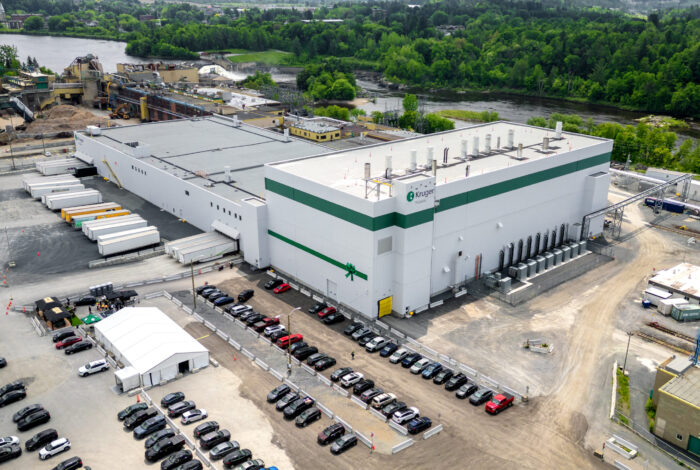
In 1997, parent company Kruger Inc. bought Scott Paper’s Canadian operations and created the modern consumer-tissue business. Memphis followed in 2002, establishing U.S. manufacturing. The bolder chapter began in 2018 around Sherbrooke, Quebec. Kruger committed C$575 million to a through-air-dried, or TAD, tissue plant. TAD technology makes the premium softness and absorbency consumers can actually feel. The facility started in 2021 with what the company described as Canada’s largest and most advanced TAD tissue machine.
Then it doubled down. The adjacent light-dry-crepe expansion cost C$377.5 million and opened in June 2025. It brought a double-width tissue machine, a facial-tissue converting line and a bathroom-tissue line. The new plant added 60,000 metric tonnes of annual capacity and 205 direct jobs. Since 2018, Kruger says the combined Sherbrooke investment has approached C$1 billion. That is not a campaign budget. It is a geographical opinion expressed in concrete, steel and hot air.
Kruger added a C$25 million digital-twin project to the original plant, with C$6.7 million contributed through federal and Quebec support. The model connects real-time data from raw-material procurement through production to customer delivery, using AI to test and improve the supply chain. The amusing phrase is “AI toilet paper.” The serious idea is that an expensive mill becomes more valuable when the company can see bottlenecks before they become empty shelves.
03 / What failed firstThe factory arrived before the easy economics
The first problem was not demand for tissue. It was the ramp. New capacity carries training, qualification and commissioning costs before it carries mature output. By mid-2022, Morningstar DBRS pointed to weaker earnings, inflation in pulp and other inputs, and rising debt from negative free cash flow and the two Sherbrooke projects. Debt-to-EBITDA had climbed above 10 times for the trailing period, and the credit trend moved to negative. A modern mill cannot negotiate with energy prices, and a half-ramped line cannot spread fixed costs like a full one.
That episode matters because it prevents the story from becoming industrial fan fiction. Kruger did not press a green button and receive margin. It had to absorb cost inflation, logistics pressure, startup friction and leverage. The company kept investing because the alternative was equally uncomfortable: rely more heavily on purchased paper, surrender premium capacity and let older assets define the product roadmap.
What changed the case was operating evidence. In 2025, more Sherbrooke production was brought in-house, helping the away-from-home business and company margins. Full-year revenue rose 7.5 percent to C$2.2034 billion. Adjusted EBITDA increased 20.2 percent to C$318.2 million, and net income reached C$75.5 million. The fourth quarter delivered a 15 percent adjusted EBITDA margin. Capacity had begun acting like capacity, not a construction project.
04 / The green ledgerProgress, with one orange warning light
Kruger’s Reimagine 2030 program treats sustainability as operations rather than a leaf printed beside a barcode. Its current scorecard reports a 31 percent reduction in greenhouse-gas intensity and a 40 percent reduction in water intensity, both against 2015 baselines. All fibre was third-party certified, with 90 percent FSC. The targets are 35 percent lower emissions, 45 percent lower water consumption and a 25 percent reduction in virgin plastic packaging intensity for branded goods.
Progress toward selected 2030 goals
The plastic line is the honest one. In its 2024 sustainability reporting, Kruger said progress against the packaging target amounted to a 2 percent decrease from the 2020 base year. That is a long way from 25 percent. Bonterra shows the technical possibility - products made from 100 percent recycled paper, wrapped without plastic, with carbon-neutral manufacturing claims - but changing packaging across giant mainstream brands is a different undertaking. Machinery, barrier performance, supplier capacity, cost and retailer handling all get a vote.
Bonterra also turns partnership into something shoppers can parse. The brand funds 4ocean’s removal of 100,000 pounds of plastic and trash each year and is working with veritree to plant more than 150,000 trees in Canada by 2028. Those numbers are comprehensible. More importantly, the paper package makes the claim visible before anyone reads a report.
05 / The stealable playbookCopy the architecture, not the paper machine
The first idea worth borrowing is channel reuse. Kruger takes a difficult capability - fibre procurement, papermaking, converting, quality assurance and delivery - and sells it under premium brands, retailer brands and business contracts. Each channel has different economics, but all can help keep the asset base productive. A software company might call this a platform. Kruger calls it Tuesday.
Second, give every brand one job. Cashmere is not asked to be Bonterra. Scotties does not need to be SpongeTowels. The portfolio covers regions, formats, price points and emotional territories without making every package tell the corporate autobiography. Third, place heavy assets near dense demand. Kruger says its plants are positioned near markets representing 90 percent of Canadian and 60 percent of U.S. consumers. When the product mostly ships air, kilometres are margin.
When this playbook breaks
- Demand is too small or erratic to keep a high-fixed-cost asset busy.
- The company lacks retailer access, brand pull or contracts before capacity arrives.
- Debt, energy or raw-material costs erase the advantage of making more in-house.
- A “sustainable” format compromises quality or asks shoppers to pay more than the promise is worth.
- The same core operation cannot meet the service levels of several channels without added complexity.
Finally, publish the awkward metric. Kruger’s emissions and water numbers look good; plastic does not. Showing both creates a more useful management instrument than a page of forest photography. It tells employees and suppliers where invention is still needed. For a company whose products vanish by design, the durable asset may be this willingness to connect a claim on the package with a number in the plant.
Kruger fits between global consumer-goods giants and retailer-owned alternatives. Procter & Gamble, Kimberly-Clark and Georgia-Pacific have enormous brands and scale. Private labels can win on price. Commercial specialists compete on systems and contracts. Kruger’s answer is Canadian share, North American manufacturing, multiple channels and a family owner prepared to think in decades. None of that makes the next roll glamorous. It makes the next roll likely to be there.