In 1999, Dan Sustar left a decade at Ford Motor Company and began mailing bits of pop culture from his Ohio home. Star Wars and Star Trek collector plates went first. Katana swords and hunting knives followed. Five months in, the fledgling eBay operation had escaped to a 2,500-square-foot space and was sending roughly 200 orders a day. Sustar remembers spending two hours at the post office. It was less a venture-backed origin story than a very busy garage sale with dial-up.
Then an uncle offered him about 400,000 poker chips for two cents apiece. Three neighborhood children sorted them by color, compensated with pizza and yo-yos. The poker boom turned the odd lot into a product line; by the middle of the decade, poker chips supplied most of the company’s revenue. But competition arrived, as it does whenever a profitable object can fit in a parcel.
What happened next explains Trademark Global better than any list of its wares. Dan and his brother Jim stopped insisting on being the seller. They let competitors sell the chips and became the supply-chain base underneath them. Overstock and Target asked the company to fulfill poker orders in 2005; Amazon, Walmart and others followed. The storefront was crowded. The loading dock was an opportunity.
We let a lot of other companies sell poker chips, and we became their supply chain base.Dan Sustar, founder and CEO
The product behind the products
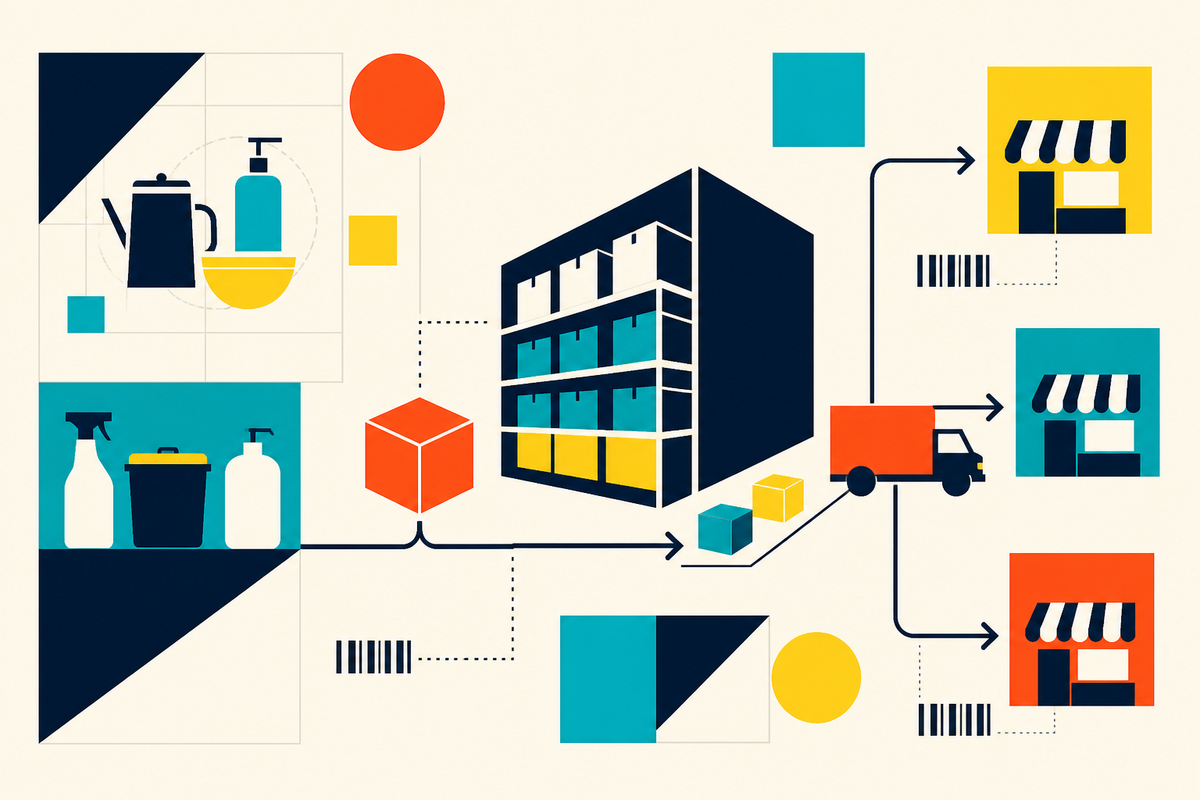
Trademark Global calls its offer an “endless aisle” solution. The phrase describes a basic internet promise - a retailer can show far more products online than any physical store can hold. The harder part is invisible. Someone must read demand, choose an item, find or make it, photograph it, write a searchable listing, hold inventory, connect order systems and send the box when a shopper presses buy.
Trademark bundles those jobs. Category managers study consumer and market data to find durable demand. Product teams develop owned, acquired and licensed goods. Global sourcing and light manufacturing turn ideas into stock. An in-house photography studio and copywriting group produce SEO-friendly product pages. Planning and reporting software track inventory across multiple warehouses. Orders from retail partners flow to those facilities and leave for the consumer’s doorstep, often without the retailer ever touching the item.
Read demand
Build product
Create listing
Hold inventory
Ship to door
For a retailer, the problem solved is not simply shipping. It is assortment without recreating an entire consumer-goods company. Trademark owns the working capital and operational mess attached to many products while the retailer keeps the customer relationship. The retailer gets more digital shelf space and less incremental inventory risk; Trademark gets distribution through high-traffic storefronts.
That makes the service most useful to a large retailer that wants to test or deepen a category without negotiating separately with a parade of small manufacturers. A buyer can reach into Trademark’s catalog for a hardware line, a pet accessory or a piece of furniture, then receive the listing assets and fulfillment connection needed to put it on sale. Once orders begin, the same supplier can watch demand and plan replenishment. It is closer to plugging in a miniature department than ordering a pallet of one item.
For shoppers, the company is often invisible. A customer may think she bought a Pure Garden planter “from” a familiar retailer; the order can pass to Trademark, whose warehouse sends it to her door. That invisibility is intentional. The consumer gets the retailer’s familiar browsing and checkout experience while Trademark handles the object. When everything works, nobody wonders which company synchronized the stock count, supplied the image or printed the label. Operational businesses tend to receive attention precisely when they fail.
Brands for the unglamorous middle
The portfolio lives in the broad, busy middle of the consumer market: products people need, replace, gift or discover while searching. Stalwart covers hardware. PETMAKER serves pet owners. Pure Garden handles lawn and garden. Lavish Home and Alaterre Furniture fill rooms; Wakeman goes outdoors; Trademark Fine Art goes on walls. Great Northern Popcorn makes the sort of machine one buys after deciding movie night deserves industrial ambition.
This breadth is deliberate. A company attached to many retailer departments can add products using systems it already paid to build. A new pet step and a garden cart differ physically, but both need research, supplier management, images, copy, inventory planning and parcel delivery. Trademark’s shared machinery lowers the friction of entering the next adjacent category.
Its difference from a conventional wholesaler is the digital layer; its difference from a marketplace seller is the operating depth. Brand aggregators can buy labels and optimize listings. Third-party logistics companies can store boxes. Product studios can design goods. Trademark’s pitch is that these pieces work together: brand ownership, product development, content, warehousing and fulfillment inside one retailer relationship.
The warehouse as a moat
In software, adding another user can cost almost nothing. Consumer commerce keeps stubbornly producing chairs, tents and foot massagers. They take up space. They arrive by ship and truck. They can break. Someone must forecast how many will sell in November and decide when to reorder. Trademark’s market position sits at this collision between digital abundance and physical constraint.
That position was earned early. The company opened its Lorain warehouse in 2008 and extended instant drop shipping across every product line. It now says it operates more than one million square feet in several states. Its corporate and light-manufacturing facility occupies part of a former Ford plant where Dan Sustar once worked as an engineer and manager - a pleasingly literal loop from making things, to selling things online, to engineering how things are sold.
The model has vulnerabilities. Retail partners have leverage. Imported goods expose the business to freight costs, tariffs and supplier risk. Holding inventory ties up cash, while a mistimed trend turns warehouse space into a museum of optimism. The same integration that distinguishes Trademark also demands competence across forecasting, sourcing, compliance, customer service and last-mile execution. A product-page typo is annoying. Ten thousand unwanted stools are a balance-sheet event.
Yet older online products can acquire a peculiar advantage: reviews and search position accumulate. In a 2018 profile, Bertram Capital described Trademark items introduced years earlier continuing to grow rather than fading on schedule. Evergreen demand is less exciting than a viral hit, but it is friendlier to warehouses and replenishment models.
An acquisition tests the machine
Private equity has accompanied the expansion. Blue Point Capital invested in 2013. Bertram Capital bought the company in 2016 in a transaction reported at more than $150 million, while Dan and Jim Sustar retained stakes and operating roles. At that time, Bertram said Trademark carried more than 80,000 SKUs across 28 categories and served 32 of the top 100 American e-commerce retailers.
The latest move shows the platform acting as an acquirer. On July 17, 2026, Trademark completed an $18 million cash purchase of assets attached to six Aterian brands: Mueller Living, PurSteam, hOmeLabs, Squatty Potty, Healing Solutions and Photo Paper Direct. It acquired their worldwide sourcing, marketing and sales operations, along with inventory and specified liabilities. Most Aterian employees dedicated to the brands were expected to move with them.
The deal is more than a larger logo collage. Acquired brands need a home for forecasting, content, sourcing and fulfillment. Trademark already owns that plumbing. If it can move the six businesses onto shared systems without losing the things customers recognize, the warehouse becomes an acquisition engine: every additional brand can use infrastructure built for the portfolio before it.
Where it fits on retail’s map
Trademark Global is neither the destination shoppers deliberately visit nor the anonymous warehouse at the very end. It occupies the connective middle. Amazon, Walmart, Wayfair, The Home Depot, Target, Staples, Macy’s and Overstock have all been publicly named as customers or partners. Those companies own audience and checkout; Trademark supplies assortment and execution.
Its competitors therefore arrive from several directions: brand operators such as Pattern and Spreetail, drop-ship distributors, traditional wholesalers, and retailers building private-label and fulfillment teams in-house. Trademark’s defense is not a single spectacular product. It is the accumulated choreography of many ordinary products - the market data, vendor relationships, listing history, retailer integrations, warehouse routines and replenishment decisions that make a broad catalog behave.
About 200 people keep that choreography moving. The public department list reads like the model rendered as an org chart: category management, sourcing, e-commerce sales, customer service, supply chain and logistics, warehousing, inventory planning, finance and information technology. Trademark describes the workplace as casual, open, inclusive and fast-paced, with hands-on training and tuition reimbursement among its development tools. The emphasis on learning is practical. A portfolio that keeps entering new categories asks employees to become conversant in products they may not have considered a season earlier.
That is also the lesson worth stealing. When a market gets noisy, move one layer down and ask what every competitor still needs. The Sustars did not win the poker-chip scrum by shouting louder. They supplied the table. Today the goods range from pet beds to popcorn machines, but the wager is unchanged: online shelves may be endless; reliable operations are not.