The modern American department store can fit inside one Manhattan office. At WHP Global, the rails hold Vera Wang bridal, rag & bone denim and Anne Klein dresses. The sporting-goods corner has Lotto. Downstairs, the imaginary toy floor belongs to Toys“R”Us and Babies“R”Us. Lands’ End sits nearby with a sensible squall jacket. None of this inventory is actually stacked at 530 Fifth Avenue. What WHP keeps there is more compact and, in the right hands, more valuable: the right to decide what those names may become.
Founded in 2019 by brand-management veteran Yehuda Shmidman with backing from Oaktree Capital, WHP buys or co-owns consumer intellectual property. It then connects that IP to companies that know how to make a bra, ship a sofa, run a registry, sell a soccer shirt or open a store in another country. Those partners pay royalties, often with contractual minimums. WHP supplies strategy, licensing discipline, marketing, ecommerce infrastructure and, when useful, sourcing support. The model is lighter than owning every factory and lease, but it is not passive. A famous name can be neglected as easily as a storefront.
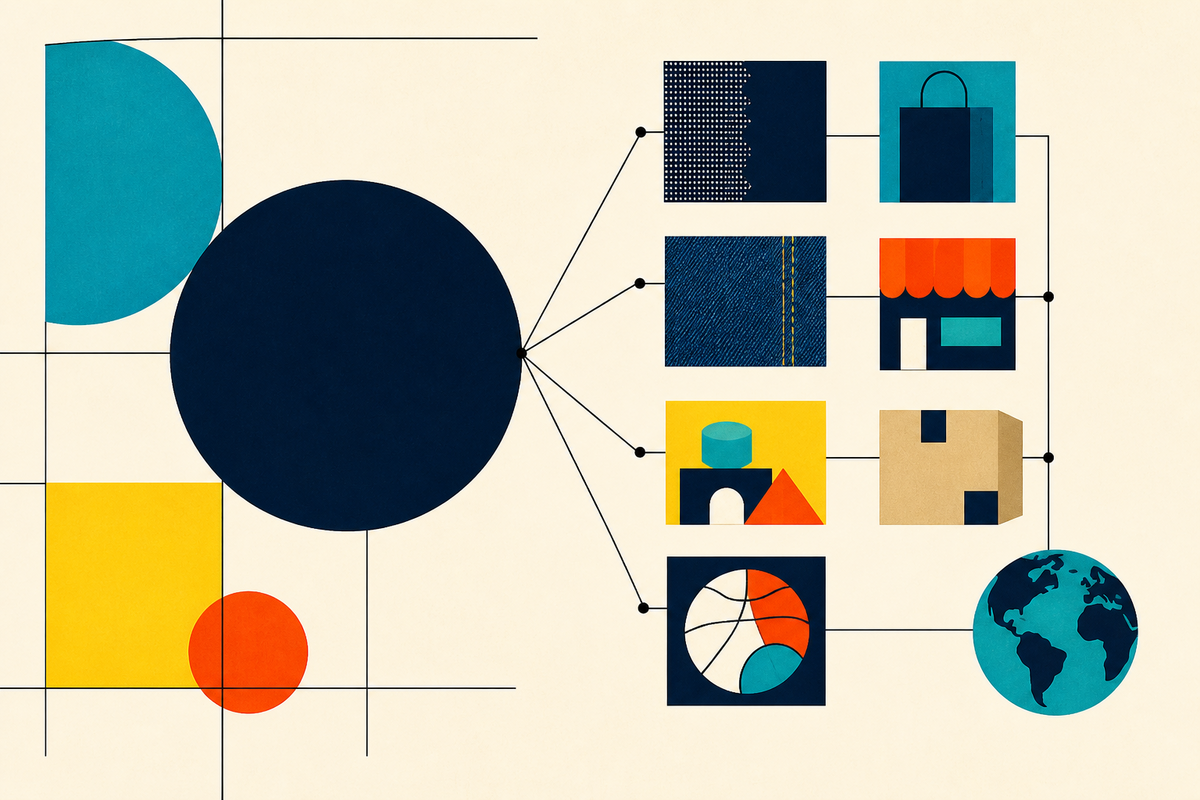
Recognition is the inventory
WHP’s stated portfolio now includes more than 15 brands generating over $8.5 billion in annual retail sales across more than 80 countries. That number is easy to misread. It is the money shoppers spend on products bearing portfolio names, not WHP Global’s own revenue. The company does not publish its revenue. Its economic slice arrives through royalties, fees, venture returns and selected operating interests. The retail-sales figure is useful as a measure of reach, not as an income statement.
The customer, in the strict sense, is often another company: a manufacturer seeking a resonant label, a department store seeking foot traffic, a regional distributor seeking a ready-made story, or an operator that can run stores more efficiently than the former owner. The end user may be a bride, a parent, an office worker or a tennis player. WHP sits in between, selling controlled permission. The license can be limited by category, channel and geography. One partner gets eyewear; another gets European ready-to-wear; another gets a toy department inside its stores.
“Relationships are crucial to everything we do.”Yehuda Shmidman, founder, chairman and CEO
The four-step machine
The company’s work begins with an acquisition, but the purchase price is only the entry ticket. WHP looks for a name with recognition that has survived some combination of stale distribution, a strained balance sheet or an owner with other priorities. After the deal, it separates the durable brand from the operating structure around it, decides which parts should remain intact, and finds partners for the rest. This is why two WHP transactions can look unrelated. G-Star kept its Amsterdam leadership and operating functions when WHP bought a majority interest. Express passed through bankruptcy into Phoenix, an operating platform backed by WHP and major mall owners.
The operating loop
Around that loop sit two quieter services. WHP+ is a turnkey direct-to-consumer ecommerce platform. WHP Solutions is a sourcing agency based in Asia. An internal AI Innovation Lab experiments with creative and operating tools; the most public result was a 2024 Toys“R”Us commercial made with generative video. Together, these capabilities give WHP more than a contract drawer. It can help a brand reach a shopper directly, locate product expertise and produce marketing without rebuilding a full traditional conglomerate.
How the cabinet filled
Company-reported annual retail sales across the portfolio at selected announcements
The giraffe learned to travel
Toys“R”Us is the clearest demonstration because its American failure was so visible. The old chain’s stores vanished after liquidation in 2018, but Geoffrey the Giraffe remained lodged in family memory. WHP acquired a controlling interest in parent company Tru Kids in 2021. Instead of attempting to recreate the old national big-box chain, it assembled a collection of formats: a destination flagship at American Dream, toy departments inside Macy’s, standalone stores with Go! Retail Group, an airport shop at Dallas Fort Worth, ecommerce, military-base stores and international licensees.
The result is less uniform and more adaptable. Toys“R”Us now reports more than 1,650 stores and ecommerce sites in 35 countries. In the United States, the shop-in-shop approach gives Macy’s a recognizable toy destination without forcing WHP to own hundreds of department-store leases. The first online phase also produced a striking signal: Macy’s said toy sales in its first quarter of 2022 were 15 times the comparable pre-partnership period. Nostalgia supplied the invitation; somebody else’s distribution did the heavy lifting.
The Macy’s toy signal
Reported toy-sales growth in the first quarter of 2022 versus the comparable period before the Toys“R”Us partnership. A known name turned unused floor space into a destination.
A joint venture in plain English
The 2026 Lands’ End deal makes the financial plumbing unusually visible. Lands’ End put its brand IP and licensing agreements into a new venture. WHP paid $300 million for a 50 percent controlling interest and took the lead on global licensing. Lands’ End kept full operating control of its existing direct-to-consumer and business-to-business businesses, then licensed its own name back from the venture. Guaranteed minimum royalties begin at $50 million in the first year. The cash allowed Lands’ End to repay a roughly $234 million term loan.
For shoppers, the website, catalog and familiar products did not need to change. Behind the curtain, however, ownership and operation became separate jobs. Lands’ End could keep serving the customers and schools it understands, while WHP searched for new countries, categories and licensees. The arrangement also left Lands’ End with half the venture’s upside. It is a concise answer to the question WHP poses to potential sellers: what if the brand is worth more when its intellectual property has a specialist owner?
A brand can keep its voice while changing who owns the microphone.
The strange coherence of the closet
Fashion adds a different problem. A toy retailer can trade heavily on memory; a clothing label must remain current without looking desperate to be current. WHP has built tiers rather than a single house style. Vera Wang and rag & bone anchor premium fashion. G-Star and Joe’s Jeans bring denim. Anne Klein, Joseph Abboud, Bonobos, Express, Warners and Isaac Mizrahi cover distinct wardrobes and price points. Lotto bridges sport and fashion. The collection looks miscellaneous until viewed as a licensing portfolio: each name offers different categories, customers, partners and geographic white space.
WHP frequently preserves a creative or operating leader close to the brand. Vera Wang remained founder and chief creative officer and became a WHP shareholder. G-Star’s existing shareholders retained a stake, while its team continued to run product and distribution from Amsterdam. Guess became the operating partner in rag & bone. The proposed Marc Jacobs acquisition follows the same habit of shared roles: Marc Jacobs would stay creative director, while G-III would join WHP in a 50/50 venture and operate parts of direct retail and wholesale. This is ownership designed as an ensemble cast.
The moat and the mess
WHP competes most directly with Authentic Brands Group, Marquee Brands and Bluestar Alliance, all of which turn consumer recognition into licensing income. Traditional private equity and strategic fashion groups also bid for the same assets. WHP’s difference is partly its age and compact scale: it has assembled a large platform quickly while keeping room for bespoke partnerships. WHP+, sourcing support, operating ventures and the AI lab give it tools beyond pure royalty collection. But competitors can copy tools. The harder asset is a reputation among sellers and licensees that the firm will respect what made a name valuable.
The advantage
Recognized brands can enter new markets faster than unknown labels, while specialist partners absorb much of the inventory, manufacturing and lease risk.
The constraint
Too many products, weak licensees or mismatched distribution can dilute the same recognition the model depends on. Asset-light does not mean consequence-light.
That tension explains the blunt house phrase, “Partner or Perish.” A licensing platform is only as good as the operators between its trademark registry and the customer. Every expansion produces revenue potential and another point where quality can slip. A bridal name on the wrong hotel, a denim label at the wrong price or a toy store without delight can spend decades of accumulated meaning in one season.
What comes after the mall
WHP’s latest deals move it upmarket and deepen its use of joint ownership. It completed the Lands’ End venture in April 2026. In May, it announced an agreement to buy Marc Jacobs from LVMH, a transaction that would push the company further into accessible luxury if it closes. The portfolio is also testing hospitality, media and AI-assisted storytelling. These are not random adjacencies. Each is another surface on which a consumer name can appear.
The useful lesson is not that any tired logo can be revived. WHP’s entire system depends on choosing the few names that still contain unpaid attention - then resisting the urge to cash it everywhere at once. Its product may be the name on the box, but its craft is the sequence of decisions before the box reaches a shelf. In a retail market full of abandoned storefronts and stubborn memories, that sequence has become a business of its own.