The expensive part of an ecommerce order is often the distance between a shelf and a cardboard box. A picker walks the wrong aisle. A batch groups the wrong orders. Inventory appears in two systems but not the third. Then the warehouse buys more labor to absorb the confusion - and, under the traditional software model, more user licenses for the people hired to fix it.
Logiwa has built its company around that awkward loop. The Chicago enterprise-software firm sells Logiwa IO, a cloud-native fulfillment management and warehouse execution platform for third-party logistics providers, fulfillment networks, and brands shipping large volumes of B2B, B2C, and direct-to-consumer orders. It tracks stock, receives orders, routes work, batches picks, guides handheld scanners, produces labels, rates shipments, reports performance, and connects the warehouse to ecommerce stores, ERPs, carriers, robots, and returns tools.
That is the broad product description. The more interesting answer to what Logiwa does is this: it tries to decide the next useful thing that should happen on a warehouse floor, then sends that decision to the person, screen, or machine that can act on it.
He sold the old world before building the new one
Founder and chief executive Erhan Musaoglu did not arrive at warehouses through a pitch deck. An industrial engineer with more than two decades in the category, he started LA Software in 2012 to resell and implement established on-premise systems, including RedPrairie, Mantis, Descartes, and Snycron. That business gave him a close view of what failed first: not necessarily the database or the pick screen, but adaptability. Ecommerce customers added channels, altered service promises, and introduced new warehouse rules faster than installed software could be reworked.
The observation changed his mind about what to build. Instead of another implementation practice, Musaoglu and co-founder Cagdas Yildiz started Logiwa in 2017 around cloud delivery. The original wedge was a WMS for fast-moving retail and ecommerce operations. The ambition expanded as warehouses needed order orchestration, automation, analytics, and labor decisions in the same real-time loop. In 2024, the company introduced the Logiwa IO name and described the architecture as headless, versionless, and serverless.

“Before Logiwa IO, it was really like herding cats... Now, fast forward, Logiwa IO has rolled out. It's really like a symphony.”Cody Moreland, Senior Director of Fulfillment, Flexport
A traffic controller, not a prettier clipboard
A traditional WMS is a system of record: what arrived, where it sits, who picked it, and whether it shipped. Logiwa wants IO to be a system of execution. Its algorithms group orders into jobs, calculate routes through the building, establish labor standards, rebalance tasks as conditions change, and synchronize decisions with other systems through APIs. Mobile workflows guide receiving, putaway, picking, packing, counting, transfers, and exceptions.
The platform includes real-time inventory and order synchronization, multi-client 3PL management, configurable automation, analytics dashboards, mobile operations, shipping logic, and pre-built integrations. The company also operates an app-store model for add-ons in shipping, returns, retail compliance, hardware, order management, and automation. Customers can use open APIs to build private extensions instead of waiting for the core product roadmap.
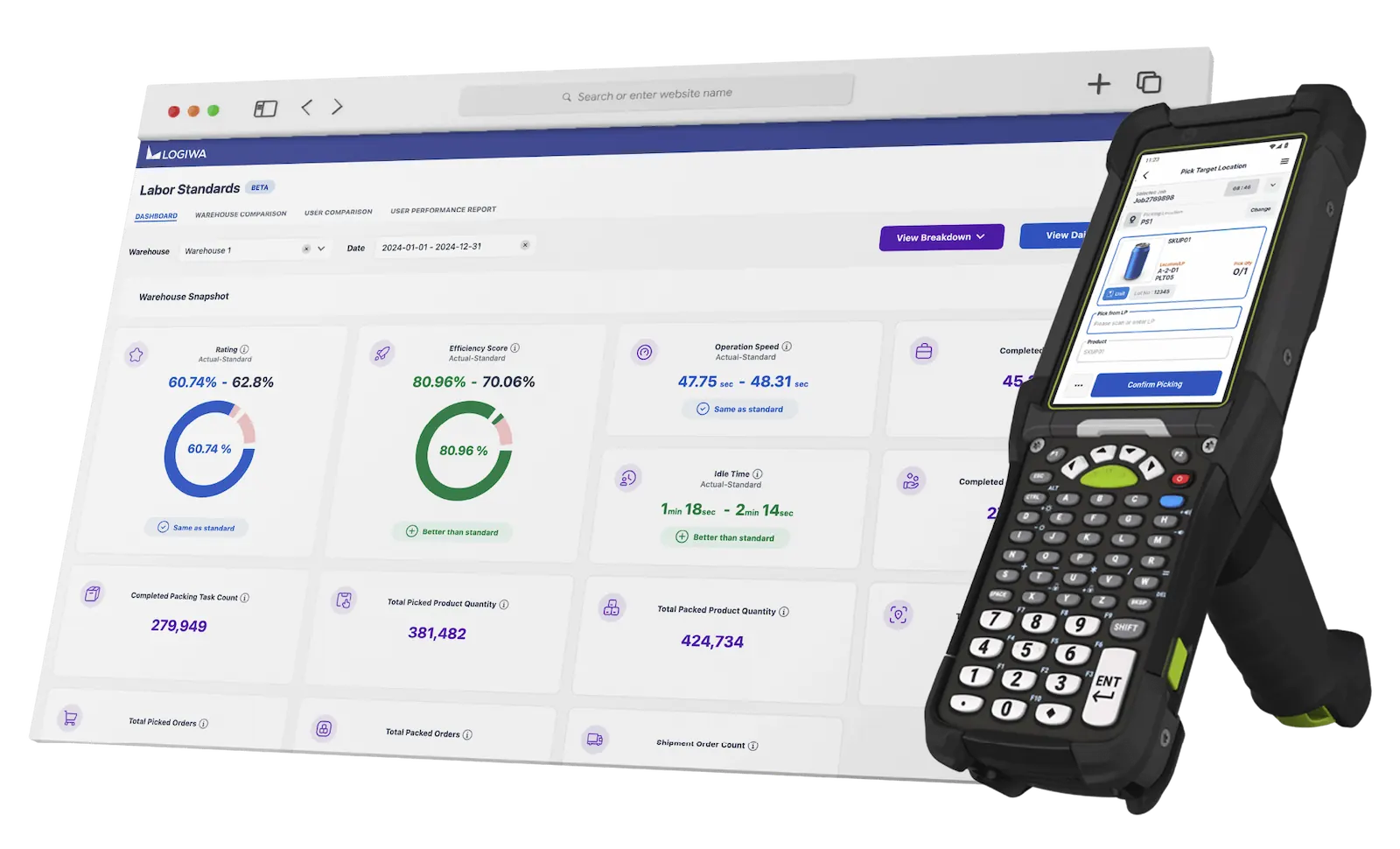
The clearest proof comes from customers, though the numbers are case-study claims rather than controlled experiments. Flexport says Logiwa supported more than 100 percent network growth over a few months, helped it onboard more than 1,500 associates in six months, and brought new warehouses live in about six weeks on average. It reports a 15 percent increase in pick productivity and savings of as much as $1,300 per 10,000 order lines, or roughly ten cents per item.
The pricing model is the quiet provocation
Logiwa is private B2B SaaS. It does not publish list prices; a discovery call determines workflow, integration, and scale requirements. The company says the core WMS suite, standard integrations, implementation, support, and continuing updates sit inside the commercial relationship. The important detail is its volume-based model. Pricing follows transactions rather than named users, according to Logiwa, so peak hiring does not automatically produce a second software penalty.
That creates a neat incentive. A per-seat vendor earns more when a warehouse adds labor. A transaction-priced vendor earns more when the warehouse processes more business. Logiwa also says professional services account for less than 10 percent of its revenue, contrasting that with legacy providers whose products can require recurring consulting. The claim is self-reported, but the strategic point is sound: recurring configuration work can be lucrative for a vendor even when it is irritating for a customer.
The model is not cheap by definition, and public pricing is unavailable. Enterprise integrations, process mapping, scanners, automation, training, and data cleanup still cost money. But buyers can copy Logiwa's evaluation lens even if they never buy Logiwa: ask what makes the vendor's invoice increase. More seats? More support hours? More modules? Or more orders successfully processed? Pricing architecture is product architecture wearing a necktie.
Small beside the suites, quick between the systems
Logiwa competes in a crowded band between heavyweight enterprise suites and narrower warehouse tools. Manhattan Associates, Blue Yonder, SAP, Oracle, Körber, and Softeon bring large installed bases and broad supply-chain portfolios. Cloud-focused alternatives such as Deposco, Extensiv, and Infoplus promise speed and modern interfaces. Some operators stitch together an ERP, order manager, shipping platform, and custom code instead.
Logiwa's differentiation is a bundle of choices: high-volume ecommerce as the default use case, multi-client 3PL operations, configurable workflows, transaction pricing, and an API-first architecture that lets specialist systems remain specialists. The Pipe17 relationship illustrates the approach. Their joint accelerator combines Logiwa's warehouse execution with Pipe17's order operations and hundreds of commerce connections. Radial says the resulting Fast Track offer can launch clients in 15 days, cutting conventional onboarding time by 90 percent.
The Kardex partnership goes a step further. Kardex is integrating Logiwa's batching logic into FulfillX, which orchestrates AutoStore robots and workstations. It is Logiwa's first publicly described true headless implementation: Kardex can consume the batching brain as a standalone service without adopting the full WMS. The partners project a 30 percent efficiency gain through fewer, smarter picking requests. “Projected” matters. Still, this is a tangible version of composability, not a cloud diagram with arrows.
Capital funded the transition. Public announcements describe an $8.5 million Series A in 2021, then $26.4 million across two Series B closings in 2022. NewRoad Capital Partners led the first Series B tranche; Prologis Ventures and BAM Elevate led the $10 million extension. Third-party databases put total funding around $38 million. No public valuation is available. Inc. ranked Logiwa No. 2,073 on its 2025 Inc. 5000, reporting 208 percent three-year growth and a staff band of 51 to 200.
Turn the customer's bottleneck into your scoreboard
There are five portable ideas here. First, learn the broken workflow from inside it; Musaoglu spent years implementing the systems he later challenged. Second, choose a metric customers already feel in their margins. Logiwa talks about pick rate, order lines, launch time, and labor hours, not vague transformation. Third, align pricing with the desired result. Fourth, make configuration a product capability instead of permanent billable labor. Fifth, expose one valuable capability on its own. The Kardex deal turns batching from a feature on a checklist into something another platform can buy directly.
The playbook has conditions. AI routing needs clean item, location, labor, and order data. Dynamic batching helps most when volume and complexity are high enough to create meaningful choices. Fast onboarding depends on repeatable processes and existing connectors. A small warehouse with stable orders, a handful of workers, and simple inventory may get better economics from a modest WMS or even disciplined ERP workflows.
Software cannot optimize a warehouse that refuses to standardize its locations, scan its movements, or maintain reliable master data. It also cannot erase the physical limits of aisles, docks, carrier cutoffs, labor supply, or automation equipment. A composable stack trades vendor lock-in for integration ownership; someone still has to operate the seams.
The most durable idea in Logiwa's story is not “AI-native,” a phrase currently applied to nearly everything with a login. It is that warehouse software should be judged by motion. Did fewer people walk fewer unnecessary feet? Did a new client launch before the sales promise went stale? Did one more order clear the dock before cutoff? When those answers improve, the dashboards have earned their screen space.