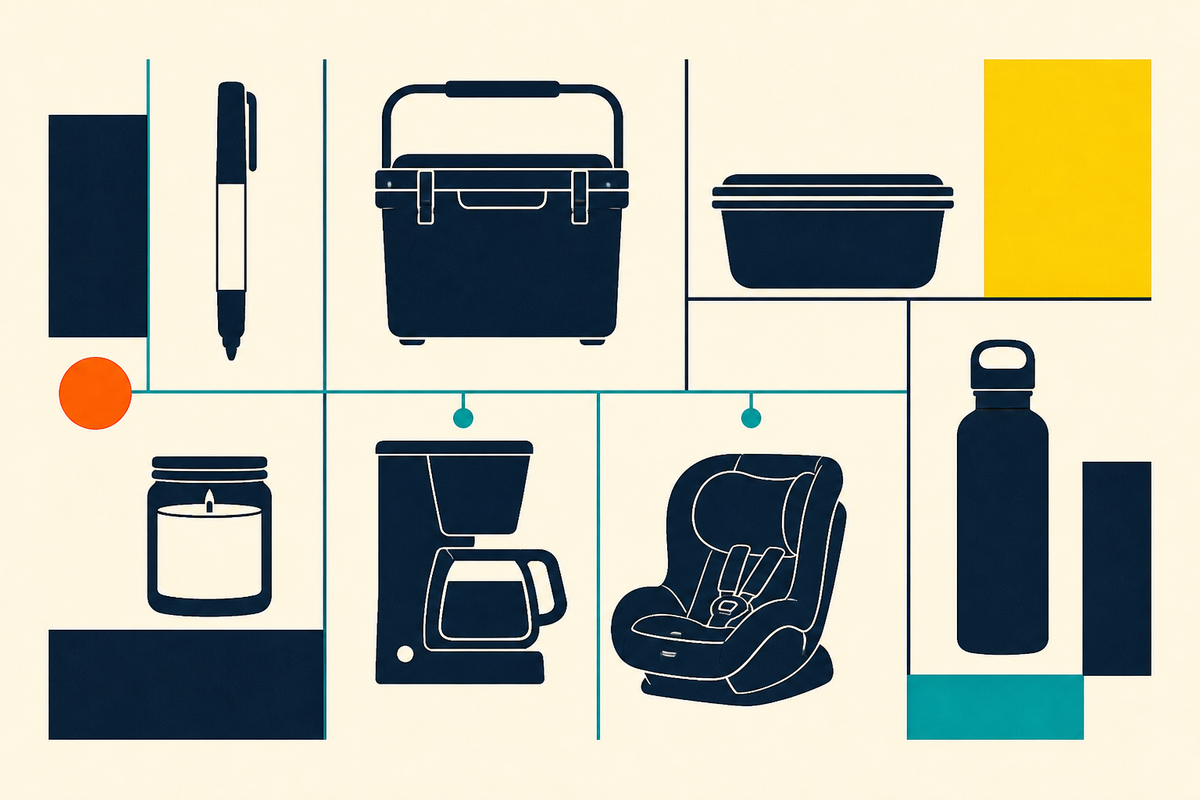
Open the average American junk drawer and you may find the outline of a public company. There is the black Sharpie with the chewed cap, an Elmer's glue stick, a Paper Mate pen that migrated home from work. In the kitchen: Rubbermaid containers and a Crockpot. In the garage: a Coleman cooler. Upstairs: a Graco car seat and a Yankee Candle. Newell Brands is the connective tissue among these objects, but it mostly lets the objects do the talking.
That anonymity is useful. A parent does not need to know that the same Atlanta company sits behind a stroller and a scented candle. Each brand can occupy its own emotional territory while Newell works behind the curtain, pooling product research, sourcing, manufacturing, distribution and access to retailers. The company says its family contains roughly 50 brands, sold in more than 150 countries. In 2025, those small, practical purchases added up to $7.2 billion in net sales.
A portfolio of tiny problems
Newell's best products often begin with annoyances too mundane for a strategy deck. An empty hard cooler hogs the trunk. A rear-facing infant seat makes an adult bend and twist. Leftovers go stale. A dry-erase marker disappears against the whiteboard. The commercial opportunity is to remove one piece of friction, put the improvement under a trusted name and make it easy to find.
Coleman's Snap 'N Go cooler is a clean example. Introduced in March 2026, it promises the insulation and durability of a hard cooler, then collapses to one-third of its full size. The insight was not that people had stopped going outdoors. It was that more outdoor occasions are short and casual - a beach day, a tailgate, a child's game - and the bulky container becomes dead space on the trip home. Graco attacked a different geometry with its first rotating infant car seat, launched in February. Its Turn & Slide mechanism brings the seat toward the caregiver for loading.
The products span six practical worlds. Learning and creative tools include Sharpie, EXPO, Paper Mate, Prismacolor, Elmer's and DYMO. Baby includes Graco, NUK, Baby Jogger and Aprica. Kitchen reaches from Rubbermaid and Sistema storage to FoodSaver, Ball, Calphalon, Crockpot, Mr. Coffee and Oster. Home fragrance includes Yankee Candle, WoodWick and the relaunched Chesapeake Bay Fragrance. Coleman, Campingaz, Contigo, bubba and Marmot cover outdoor life. Rubbermaid Commercial Products and related brands serve facilities with cleaning, hygiene and material-handling equipment.
The brands live in different aisles. The advantage, if Newell can capture it, lives between the aisles.YesPress analysis
The customer has two faces
Newell serves the person using the product, but it first has to satisfy the company controlling the shelf. Its retail network includes discount, grocery and drug chains, warehouse clubs, home centers, office suppliers, specialty stores and e-commerce platforms. Amazon accounted for about 17 percent of 2025 sales; Walmart contributed about 13 percent. Costco, Grainger, Office Depot, Staples, Target, Home Depot, Kroger and Uline were also among the ten largest customers.
That concentration is both distribution power and strategic exposure. A place in Amazon search results or a Walmart planogram can move enormous volume. It can also give the retailer leverage over price, promotion, inventory and assortment. Newell's answer is to bring more than a product pitch. Its category data, consumer research and broad portfolio can help a retailer rethink an aisle. In 2026, the company described using its baby-category research in Target's enhanced shopping experience, helping organize a complicated purchase journey for expectant parents.
Commercial customers add another layer. Offices, schools, warehouses, restaurants, hospitals and other facilities buy cleaning carts, waste containers, gloves and hygiene systems through distributors such as Grainger and Uline. In this corner of Newell, durability, worker safety, total cost and reliable delivery can matter more than an Instagram campaign. The company therefore operates in both B2C and B2B modes, with a growing direct and e-commerce layer.
Scale is only useful when it moves
A portfolio this broad can generate economies of scale, but it can also generate meetings. Newell's history is a century-long accumulation: Edgar Newell began making metal curtain rods in upstate New York in 1903; Sharpie joined in 1992; Rubbermaid and Graco in 1999; Paper Mate, Parker and Waterman in 2000. The 2016 combination with Jarden added Coleman, Yankee Candle and Mr. Coffee, among others. Each addition brought recognition and revenue, along with systems, factories, suppliers, SKUs and internal boundaries.
The present turnaround is an attempt to make the scale operational. Since 2023, Newell has described its choices with unusually plain labels: Where to Play and How to Win. It is concentrating investment on its largest and most profitable brands, ten priority countries, faster-growing channels, winning retailers, mid- and high-price tiers, and younger consumers. Behind those choices sit five capabilities: proprietary consumer understanding, brand communication, innovation, go-to-market execution and a more unified supply chain.
A portfolio does not become a platform because its parts share an owner. It becomes a platform when shared insight, procurement, distribution or technology makes every strong part better.
In practice, the company has created cross-functional brand management, centralized portions of domestic retail sales, digital technology, quality, accounting and human resources, and standardized more of its regional go-to-market organization. The aim is not to make a Sharpie feel like a stroller. It is to let both teams use a better research engine, common operational discipline and more persuasive retailer relationships.
A turnaround, with an asterisk
The second quarter of 2026 offered evidence that the machinery may be moving. Newell reported $2.0 billion in net sales, up 3 percent from a year earlier, while core sales rose 2.3 percent. It was the company's first quarter of year-over-year sales growth in more than four years. Learning and Development led the three segments with 4.9 percent core growth; Outdoor and Recreation grew 3.7 percent. Home and Commercial core sales slipped 0.4 percent as commercial weakness offset gains in kitchen and fragrance.
Profit figures need context. Gross margin jumped to 40.7 percent from 35.4 percent, but the quarter included roughly $126 million in pretax recoveries tied to tariffs previously expensed in 2025 and early 2026. Productivity, pricing and sales also helped, while commodity and transportation costs pushed the other way. Debt stood at about $5.0 billion at quarter end. This is why one favorable quarter is a marker, not a finish line.
Still, the company raised its full-year view. Management projected 2026 net-sales growth of 1 to 2 percent and core sales from flat to 1 percent growth. More important for the brand thesis, executives attributed the better sales trend to new products, heavier advertising and promotion, and improved go-to-market execution. Those are precisely the front-end capabilities Newell has spent several years rebuilding.
“The improvement was broad-based across the portfolio.”Chris Peterson · President and CEO · July 2026
How to stay different in ordinary aisles
Newell competes against specialists, conglomerates and store brands. Depending on the aisle, the alternative might come from Clorox, Spectrum Brands, Helen of Troy, Stanley Black & Decker, Whirlpool, Mattel, Procter & Gamble or a retailer's own label. A generic container can be cheap. A marker can be copied. A candle can smell pleasant without a famous name. The moat is therefore a stack, not a single wall: recognition, design, safety and quality systems, category knowledge, manufacturing and sourcing scale, reliable delivery and the ability to keep winning distribution.
Partnerships keep familiar products culturally visible. In 2026, Sharpie and Elmer's wrapped creative tools in Disney and Pixar's Toy Story 5; Sharpie worked with Under Armour on a De'Aaron Fox capsule; Coleman began a multi-year relationship with musician Kane Brown; Yankee Candle paired quarterly scents with Reese's Book Club; Ball Home Canning recruited chef David Chang to make first-time preserving feel less intimidating. These collaborations are not substitutes for product improvement. They are ways to create occasions around objects that otherwise wait quietly on a shelf.
The company also has a credibility test beyond sales. It reports a cumulative 53 percent reduction in Scope 1 and 2 greenhouse-gas emissions at global manufacturing sites and says 23 percent of electricity used at those sites had shifted to renewable sources by 2025. With about 13,250 of its 21,900 employees working in manufacturing and supply-chain roles, operations are not a footnote. Product safety, responsible sourcing, energy, labor practices and resilience all sit inside the promise printed on every brand.
The company in the background
Newell fits into the market as a diversified branded-goods operator: broader than a category specialist, more product-focused than a retailer, and dependent on both. Its expertise is turning observation into physical design, then moving that design through a global supply chain and into high-volume channels. Its business model is straightforward product revenue. The difficulty lies in repeating the process across dozens of categories without wasting the scale it worked so hard to assemble.
For consumers, the value is practical. Newell makes tools for writing, storing, feeding, cleaning, cooking, scenting and getting outside. For retailers, it offers recognized brands, category insight and a broad relationship. For investors, the question is whether operational savings and sharper brand investment can restore durable growth while the company manages retailer concentration, tariffs, inflation and debt.
The most revealing Newell product may never be a headline object. It may be the yellow dry-erase marker EXPO brought back in 2026, or a candle designed to match a season of reading. These are modest bets on attention. That is the charm and the discipline of the business: find a recurring moment, remove a little friction, give the object a name people remember, and earn the right to return to the drawer.