The modern car accessory has a peculiar assignment. It must solve a problem that the driver has tolerated for years, explain itself in the few seconds available beside a retail shelf, survive the indignities of a garage installation and then disappear into daily life. Allen Chai has spent more than two decades working inside that assignment. His products illuminate footwells, watch the road, revive batteries, reveal what is behind a vehicle and give off-road drivers fewer wires to wrestle. The objects vary. The wager does not: an ordinary thing can become valuable again when somebody notices exactly where it wastes time or confidence.
Chai is the founder and CEO of Horizon Brands, the Costa Mesa consumer-products company behind TYPE S and a collection of automotive, home and lifestyle lines. He also owns ADC Solutions Holdings, the parent company whose interests extend across consumer brands. His public biography is spare, but the trail of products is unusually talkative. It describes an operator who likes mature categories, practical technology and the exacting theater of mass retail. There is little room there for fog. A camera either clarifies the blind spot or it does not.
Begin with the irritation
TYPE S began more than 20 years ago with Chai and a business partner named Dan, both described by Horizon as automotive enthusiasts. Their stated ambition was straightforward: offer high-quality accessories that improve the driving experience. That sentence contains the seed of the portfolio. It begins with the experience, not the specification sheet. The customer wants a safer reverse, a brighter cabin or a way home after a dead battery. Lumens, pixels and amps arrive later.
The company says millions of TYPE S do-it-yourself products have since been sold worldwide. Its retail roster has included Costco, AutoZone, Advance Auto, Pep Boys, Target and Walmart. The relationship with AutoZone dates to 2003, a useful reminder that shelf space is not a single victory. It is a recurring examination. Packaging, supply, advertising, customer service and product relevance all sit the test together.
In 2022, AutoZone gave TYPE S its “Whatever It Takes To Get The Job Done Right” award. The recognition followed investments in inventory, marketing and collaborations with Formula DRIFT and driver Vaughn Gittin Jr. It is tempting to read the award as a trophy for a flashy LED category. Its criteria were more revealing: partnership, in-stock dedication, sponsorship and innovation. The bright lights were supported by the darker arts of dependable operations.
“To improve the everyday lives of our customers by creating innovative, high quality solutions.”Allen Chai, on Horizon Brands’ mission
A portfolio written in verbs
Horizon’s brands do not live inside one tidy product aisle. Koda works in home and workplace lighting. Tiny Traveler makes in-car monitoring technology. Yada focuses on road electronics. PROJECT X develops off-road lighting, mounting and wireless control. Horizon also distributes automotive matting and soft accessories under the Michelin and BFGoodrich names in North America. The assortment can look eclectic until you read it as a collection of verbs: see, light, start, monitor, secure, carry, control.
Those verbs keep the expansion honest. A holding company can collect brands as casually as a desk collects cables. Chai’s public mission supplies a stricter test: does the product improve an everyday life, and does it respect the customer’s time, money and resources? The standard is not philosophical once a package reaches the aisle. It becomes a hand-wave activation for a backup monitor, step-by-step guidance on a jump starter or motion sensing in a shop light.
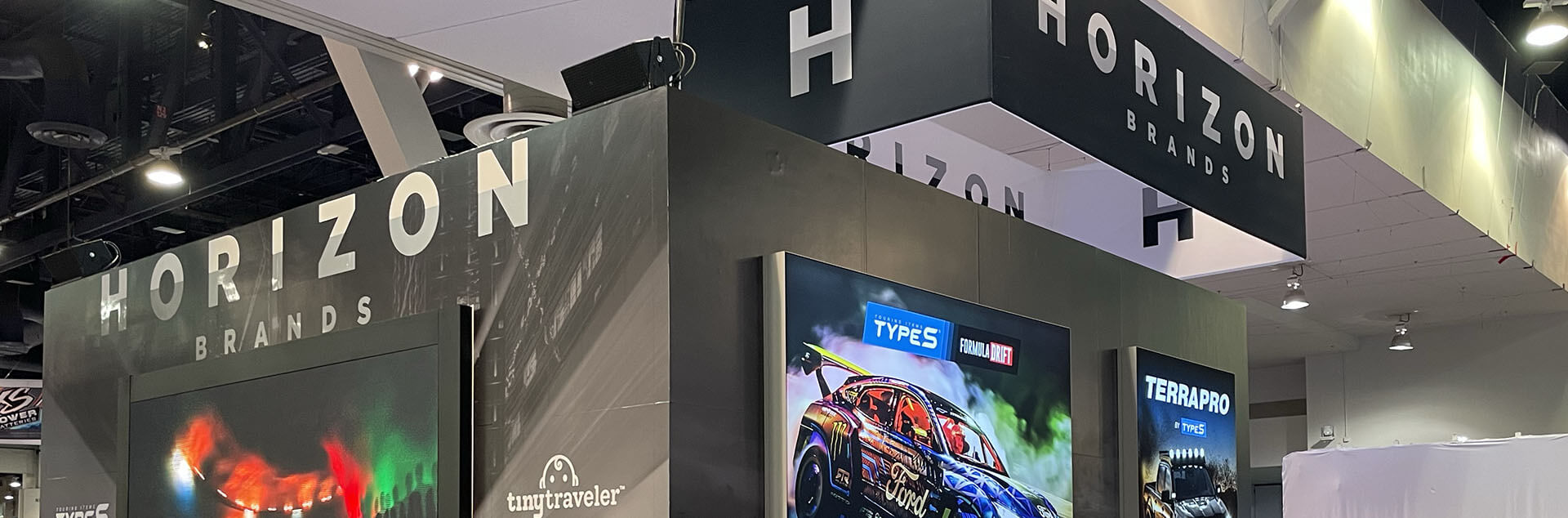
At SEMA in 2023, TYPE S presented a neat cross-section of this approach. One lighting kit allowed voice control and color matching through a phone. A jump starter combined an inflator, power bank, floodlight and on-screen instructions. A 4K dashcam offered driver-assistance warnings and incident recording. A solar-powered wireless backup camera paired a wide view with an ultrasonic sensor and avoided complicated hardwiring. Each product added technology, yet each pitch could be reduced to relief: fewer steps, more visibility, one less reason to be stranded.
The useful-upgrade loop
The system hiding behind the switch
PROJECT X makes the portfolio logic particularly clear. The brand began with off-road lighting, then confronted the awkward web of cables and switches that grows when enthusiasts add equipment to a vehicle. Its answer was not another lamp alone. It was an ecosystem for mounting, powering and wirelessly controlling accessories. The category moved from object to system because installation friction was the larger problem.
This is the most portable idea in Chai’s work. A founder need not dream up a new appetite when an existing one is badly served. Look for the knot of extension cords around the accepted solution. Look for the instructions everybody skips, the switch that requires a hole, the camera that asks too much of the installer. The opportunity often sits one layer above the product everyone thinks they are buying.
Do not ask only how to improve the object. Ask what the customer must do before and after using it. The overlooked business may be hiding in those extra steps.
Koda’s linkable shop light offers the domestic version. Up to six lights can run from one power source, reducing the switches and loose wiring in a large space, while motion sensors automate the on-and-off ritual. Retail judges selected it for a Hardware Retailing Innovation Award. Again, the technology is not the plot. The plot is a person walking into a garage with full hands and finding that the room has already understood.
Family, with a scorecard
Chai’s most personal public statement concerns the company rather than the cars. When people ask what Horizon is like, he says his first reaction is that it does not really feel like work; it feels like family. “We support each other, and together we’re stronger,” he says. “When one of us succeeds, we all succeed.” It is warm language from a business whose output depends on a decidedly industrial relay: designers, engineers, suppliers, marketers, retail buyers and operations teams passing a product from idea to shelf.
Horizon’s published values keep the metaphor from floating away. The company talks about metrics, training, open communication, clear responsibilities, continuous improvement and seeking solutions instead of blame. Family, in this telling, is not an exemption from standards. It is the reason to share knowledge and make the handoff clean. Consumer goods are merciless about those handoffs. A missed detail upstream arrives in the customer’s driveway wearing your logo.
“We support each other, and together we’re stronger. When one of us succeeds, we all succeed.”Allen Chai, on the culture at Horizon Brands
There is a quieter piece of evidence in Chai’s volunteer record. From August 2017 through May 2019, he served on the board of the Fullerton Chinese Culture Association. He described the work as supporting a community school that offered language and culture classes to Chinese and non-Chinese-speaking families, helping bridge cultures and generations. The detail fits his chosen business language: value passes through connection, whether the gap is between a child and a heritage or between a product team and the person opening the box.
The patience of practical ambition
In 2025, ADC Solutions Holdings arranged a $40 million senior credit facility to refinance existing debt and provide growth capital. The financing belongs to a parent portfolio larger than Horizon alone, but it shows the scale beneath the apparently modest products. Familiar objects demand serious machinery when they travel through global supply chains and national retailers. Working capital is one of the least photogenic ingredients in a well-lit garage.
Chai’s career resists the tidy myth of a single breakthrough. There are awards and launches, but the stronger achievement is repetition across two decades: finding a category where an existing product disappoints, making the improvement legible, coordinating the people who can manufacture it and earning another turn with a retailer. This kind of ambition wears work boots. It is less concerned with announcing the future than with fixing the part of Tuesday afternoon that still does not work.
That may be why the word “everyday” sits at the center of Chai’s mission. Everyday is where products lose the protection of a demonstration. The battery is dead now. The garage is dark now. The trailer is behind the truck now. A useful object must meet the moment without asking the customer to admire how ingenious it is.
The shelf, meanwhile, remains a ruthless editor. It rejects vague promises and forgettable boxes. Chai has kept returning with products that can finish a sentence the customer already started: I wish I could see; I wish this were simpler; I wish all these switches would talk to one another. Horizon Brands supplies the practical second half. After more than 20 years, the method still feels fresh because irritation, unlike fashion, is endlessly renewable.