A bag of grass seed contains an awkward promise. You pay today for something you cannot inspect until weeks later. Weather gets a vote. So does soil. And the person scattering it may be doing this for the first time. The Scotts Miracle-Gro Company has spent generations making that purchase feel a little less like a wager.
- Brands: Scotts, Miracle-Gro, Ortho, Tomcat.
- Reset: Hawthorne sold in April 2026.
- Lesson: sell supplies with a path to success.
Its origin makes the point rather neatly. In 1868, Orlando McLean Scott opened a hardware store in Marysville, Ohio, and sold weed-free seed to farmers. The innovation was a useful absence: fewer of the things a customer did not want. His successors brought seed directly to homeowners. A business rooted in agricultural quality became part of the American lawn.
Today, the company sells lawn food, grass seed, soils, plant nutrients and pest-control products. The interesting part is how it wraps those purchases in instructions, recognizable brands and reassurance. Its recent history also supplies a warning: being good at helping things grow does not make every growing market a good business.
01The other ingredient is confidence
Miracle-Gro arrived from a different direction. Nurseryman Otto Stern and advertising executive Horace Hagedorn launched the business in 1951. One understood plants; the other understood how to reach the people buying them. Scotts and Miracle-Gro merged in 1995. The combination joined the lawn outside the house to the flowers and vegetables growing beside it.
The customer is usually a homeowner, gardener or household trying to fix a particular problem. Thin grass. Hungry tomatoes. Insects near the house. Scotts serves the lawn; Miracle-Gro serves plants and soil; Ortho handles weeds and insects; Tomcat tackles rodents. These are separate brands because the jobs are separate. You rarely enter a garden aisle looking for a diversified consumer-products corporation.
The money comes chiefly from selling physical products through retailers such as The Home Depot and Lowe’s, with online shopping and direct lawn plans adding routes to the customer. Many supplies get used up, creating opportunities for repeat purchases. Compare that with hiring a lawn service: Scotts generally puts the equipment, materials and decisions in the customer’s hands.
Against competitors including Central Garden & Pet and retailer-owned labels, its defense is a combination of product development, distribution, familiar names and help. Scotts introduced a money-back guarantee in 1959, retailer training in 1962 and a consumer helpline in 1970. Reassurance was part of the product long before an app could send a reminder.
02A laboratory with grass stains
There is real technical work beneath the cheerful packaging. In its 2024 responsibility report, the company described more than 100 scientists and engineers, spanning soil science, molecular biology and chemical engineering. It reported nearly $36 million of research and development investment in fiscal 2023. Products move through testing of biology, formulations, packaging and commercial feasibility.
That expertise matters because a garden is an untidy testing environment. Heat, cold and sunlight change results. A formulation must survive contact with those conditions and with ordinary human application. A helpful instruction can be as consequential as an ingredient when the person holding the spreader is guessing.
The company’s stated purpose is “to GroMoreGood, everywhere.” Its culture statements emphasize innovation, community and developing employees. There is a practical expression in its history: Give Back to Gro, introduced in 1999, gives associates paid time to volunteer. These are company commitments, rather than an independent verdict on every workplace.

03The $450 million detour
Then came a different kind of growing. Through Hawthorne Gardening, ScottsMiracle-Gro expanded into hydroponic nutrients, lighting and supplies. In April 2018, it announced a $450 million transaction for distributor Sunlight Supply, including $425 million in cash. The plan promised access to more than 1,800 hydroponic retailers and at least $35 million in financial synergies.
The announcement itself contained a caution: both businesses expected unit-volume declines that year because of disruption in California. The wider lesson is easy to miss during an acquisition. Buying a distribution network gives you access to customers; it does not give you control over their demand.
By fiscal 2022, Hawthorne sales had fallen 50%. Companywide free cash flow was negative $242.5 million, with inventories and lower accounts payable driving the outflow. The business responded with Project Springboard, including overhead cuts and a smaller operating footprint. Demand and cash conversion had become urgent problems.
The eventual change in direction was concrete. ScottsMiracle-Gro completed the sale of Hawthorne to Vireo Growth in April 2026. Consideration took the form of Vireo shares held by an independent strategic partner. Management described the sale as a way to concentrate on its core lawn-and-garden business. Hydroponics belongs in this company’s history; it should no longer be presented as its defining current operation.
Buying a distribution network gives you access to customers; it does not give you control over their demand.THE LESSON FROM HAWTHORNE
04Smaller sales. Better margins.
The financial picture explains the appeal of that focus. As originally reported, fiscal 2025 revenue was $3.413 billion, down 4% from 2024. Yet GAAP gross margin rose from 23.9% to 30.6%. Selling more and keeping more are different achievements. Here, the second improved while the first went backward.
Nate Baxter became president and CEO in June 2026, succeeding Jim Hagedorn. His SMG 2.0 strategy emphasizes innovation, channel expansion and consumer engagement. In September, the company announced it had achieved its $275 million free-cash-flow target and redeemed $250 million of notes using revolver borrowings and planned excess free cash flow. Refinancing and cash generation both mattered.
Less revenue. More room.
05The next customer might have a patio
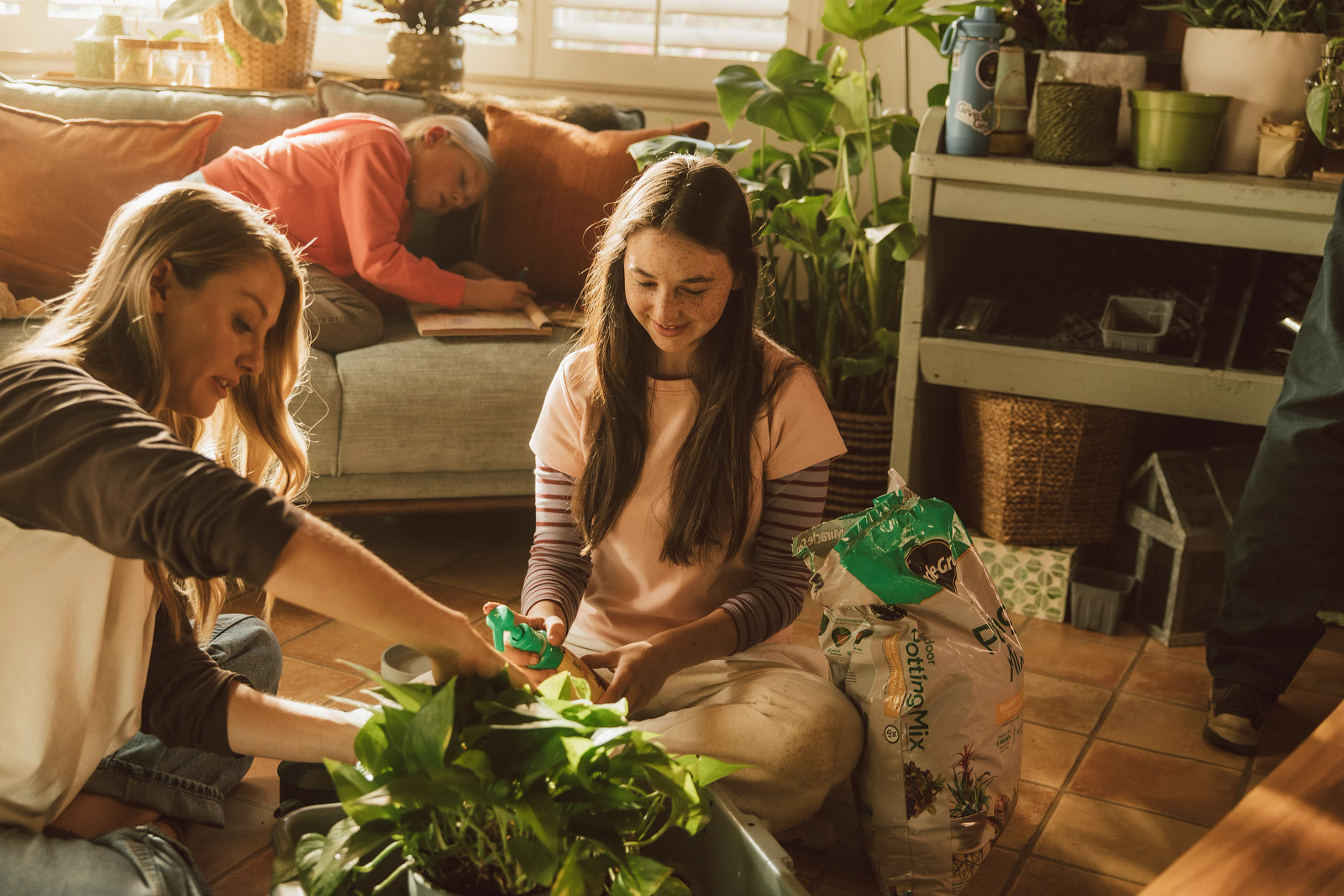
One new offering makes the strategy tangible. In March 2026, ScottsMiracle-Gro, Bonnie Plants and Gardenuity introduced Inspired to Gro. Each garden bundles a five-gallon grow bag, soil, four rooted plants, Miracle-Gro plant food and personalized guidance, including weather-based notifications. The package addresses the beginner’s actual difficulty: assembling compatible pieces and knowing what to do next.
For a reader, the useful move is to start with the job. Choose lawn products for the grass and growing media suited to the container or bed. Use the application guidance. For another business, the transferable idea is to sell the supplies alongside a credible path to a first successful result.
The limits remain biological. Packaging cannot replace suitable growing conditions and care. Seasonal demand remains a financial risk. The useful ambition: help someone succeed on the patch of earth they have.
Go get your hands dirty
Explore company website, lawn-care products, Miracle-Gro and Martha’s Garden Collective.
Follow LinkedIn, Instagram, X and Facebook. Read the corporate newsroom or quarterly results.