Consider the moment a trash bag breaks. Until then, it has been almost invisible: a thin plastic liner, purchased with very little ceremony. Suddenly it becomes the most consequential object in the kitchen. Reynolds Consumer Products lives in that peculiar interval between something working and somebody having to clean up after it.
- Two ways onto the shelf: Reynolds and Hefty brands, plus products made for retailers’ own labels.
- The promise: easier cooking, storage and cleanup.
- The catch: familiar names still depend on reliable factories, affordable materials and working disposal systems.
Its products are unglamorous by design. Foil covers the dish. Parchment separates the cookie from the pan. A slider closes the bag. Disposable plates shorten the journey from party to cleared table. The useful thing being sold is a little less friction, repeated across millions of domestic routines.
The rival might also be the customer
Walk down the household aisle and you encounter what looks like a contest between famous packaging and cheaper alternatives. Reynolds participates on both sides. Alongside its own brands, it manufactures store-brand products. Presto, its retailer-facing business, supplies food bags, waste bags and plastic wrap. That makes the retailer both a route to market and a customer with a brand of its own.
This is the interesting part of Reynolds’ position. A shopper choosing a retailer label has not necessarily left its manufacturing orbit. Selling both lets the company serve different budgets and gives it a reason to discuss the whole category with a buyer. It also creates a delicate balancing act: the branded product must earn its price while the retailer’s version must earn its space.
Alternatives include Clorox, S.C. Johnson, Handi-Foil and specialist plastics manufacturers. Reynolds’ distinction is the combination of household names, manufacturing capability and private-label relationships. The model earns money through shipments of consumable products. People finish a roll, empty a box and buy another. There is no subscription required to make the purchase recur.
“Simplify Daily Life to Enjoy What Matters Most”
Reynolds Consumer Products’ stated mission
A pink bag is still an engineering problem
Sometimes the innovation is pleasantly ridiculous. In May 2025, Hefty introduced Fabuloso Watermelon-scented trash bags, including a pink version. The launch extended a licensing relationship with Colgate-Palmolive’s cleaning brand. John Cena was part of the advertising campaign. Even taking out the rubbish apparently has room for casting decisions.
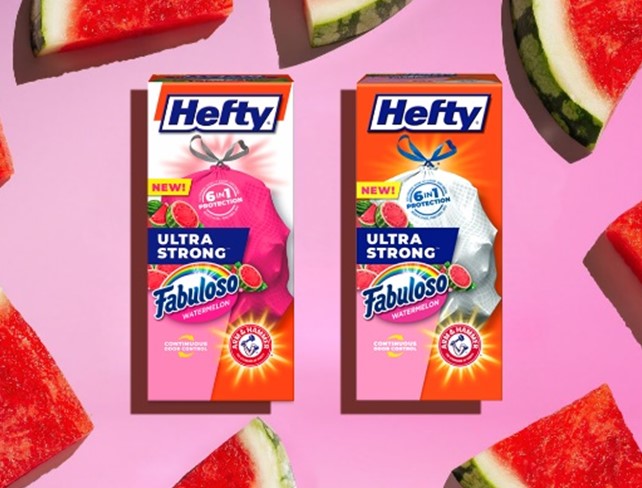
The launch prices were concrete: $9.49 MSRP for the listed 13- and 30-gallon offerings, and $4.99 for the smaller sizes. Those were launch recommendations, not today’s universal shelf prices. Scent and color give shoppers another reason to notice. Drawstrings, strength and odor control still have to perform after the advertising has done its work.
For a home cook, the choices have practical consequences. Ordinary foil can be used shiny side or dull side toward the food; the different appearance comes from manufacturing. Non-stick foil is different: its dull side carries the non-stick surface. The useful purchase depends on the job, whether that is wrapping a sandwich, handling sticky food or covering a larger pan. Familiar packaging still rewards reading the instructions.
Reynolds has tried similar small departures in the kitchen. Its 2024 holiday Fun Foil carried an embossed pattern designed with Brittany Jepsen of The House That Lars Built. Food wrapping became part of the gift. The underlying insight is useful: improve an existing task, then look for a neighboring task the same material can do.
Then the machinery stopped cooperating
The less photogenic story is the more instructive one. In late 2022, Reynolds Cooking & Baking suffered unplanned equipment downtime. Manufacturing costs rose. The company bought supplemental milled aluminum at a premium to its own production costs. Lower household foil consumption compounded the problem. In the fourth quarter, the segment’s adjusted EBITDA fell 49%.
Management responded with a recovery plan covering organizational changes, equipment reliability and operations. At its 2024 investor day, Reynolds described better supply planning, reduced reliance on outside metal, and technologies that detect vibration and electrical changes in equipment. Operators and floor leaders received more immediate information. The practical shift was toward anticipating maintenance rather than discovering the problem through lost production.
The cooking business’s adjusted EBITDA rose from $142 million in 2022 to $184 million in 2023. That is a non-GAAP profit measure, not cash in the bank. Still, the mechanism matters: fix the process that makes the product promise possible. A recognizable blue box offers little protection when making its contents becomes unexpectedly expensive.
+$41m in a year. Reynolds linked the higher spending to automation and productivity investment.
The bill arrives before the payoff
Reynolds spent $161 million on capital projects in 2025, compared with $120 million the year before. Those are company-wide expenditures, not a disclosed price tag for the earlier recovery plan. They show the continuing cost of keeping ordinary goods competitive. A brand business still contains a substantial industrial business.
Recent results also resist an easy victory lap. In the second quarter of 2026, revenue reached $944 million and net income $89 million, while retail volumes fell 5%. Better earnings can coexist with fewer units. Pricing and efficiency help, but they do not make demand irrelevant. Reynolds scheduled its next quarterly results for November 4.

A bag cannot build its own destination
There is a sharper limit in disposal. Hefty says it is phasing out ReNew, its program for hard-to-recycle plastics, because downstream markets did not develop at the expected scale. Bag distribution is due to end in 2026; collection continues through June 30, 2027. Participation alone could not complete the system.
That is the condition attached to this convenience business: the surrounding machinery must work, too. For another manufacturer, the transferable ideas are specific. Serve more than one price point. Watch equipment before it fails. Improve a chore people already do. Check that the destination exists before expanding collection. For the person opening the kitchen drawer, the test remains wonderfully direct: does this make the next small job easier?