A trash bag has a fairly unforgiving performance review. It either gets the rubbish to the bin or introduces the kitchen floor to yesterday’s dinner. Aluminum foil has a quieter assignment, but the principle holds: the customer expects the ordinary thing to work. Scott Huckins now has responsibility for a company built around millions of those expectations.
Since January 1, 2025, he has been president and chief executive officer of Reynolds Consumer Products, the Lake Forest, Illinois business behind Reynolds Wrap and Hefty. His route to the job passes through corporate treasury, jewelry retail, food manufacturing, and a captive reinsurance company. It is a career with rather more variety than the contents of a kitchen drawer might suggest.
The connection is responsibility for how businesses function beneath their familiar names. Huckins has spent years dealing with capital, costs, and cash. At Reynolds, those concerns meet products people buy repeatedly and seldom discuss at length. The financial work continues. The promise attached to it is now the whole company’s.
The customer inside the factory
For a glimpse of how Huckins describes that responsibility, consider his account of visits to four Reynolds facilities: Appleton, Bellwood, Carrollton, and Louisville. He went alongside members of the executive leadership team and board. His description focused on listening to employees and understanding what would help them do their work.
He described plant teams as customers whom he needs to support. It is an unusual ordering of the corporate relationship. The people making the products become people the chief executive serves. He also described the visits as enjoyable, pointing to the pride employees take in their work and the chance to celebrate their accomplishments.
“I see our plant teams as some of my most important customers.”
Scott Huckins, on visiting Reynolds facilities
Read that language alongside his finance background and a particular version of the job emerges. A plant team needs support; a retailer needs dependable service; a household needs a product that performs. An executive can describe all three relationships in financial terms, but each begins with someone else needing something done properly. His account of the visits gives that chain a human starting point.
A career with several balance sheets
Huckins studied finance at Arizona State University, then earned a Master of Management at Northwestern University’s Kellogg school, concentrating in finance and management strategy. He studied at Kellogg in 1993 and 1994, graduating with Highest Honors. The combination of finance and strategy would recur in the responsibilities that followed.
Between 2001 and 2008, his work at Koch Industries and affiliated companies included treasury leadership, divisional finance roles, and the presidency and chief executive role at Koch Financial Products. He also served as CFO of KoSa. These were several different seats within a broader industrial and financial setting, rather than one uninterrupted climb through a single department.
After a period at Pioneer Advisors, he became vice president of treasury, tax, and investor relations at RSC Holdings. Sears followed in 2012. There, his responsibilities included serving as vice president and treasurer of Sears Holdings and president of Sears Reinsurance Company. A retail name above the door concealed another set of financial businesses behind it.
From 2016 to 2019, he was CFO of Claire’s Stores. Jewelry and accessories were a change of merchandise, though the assignment still involved the underlying structure of a business. His tenure included recapitalization and consolidation initiatives followed by a change of ownership. The breadth of the résumé comes from those responsibilities as much as from the succession of industries.
The fruit business was part of the job
In September 2019, Huckins became CFO of SunOpta. The food company’s chief executive, Joe Ennen, welcomed his experience in operations and strategy as well as finance, emphasizing his discipline around costs and cash. The appointment put Huckins into another business undergoing change, with growth and the organization’s structure both on the agenda.
At SunOpta, the operating responsibilities became quite literal. Alongside the CFO position, he served as general manager of the fruit business during 2021 and 2022. He also led the 2020 sale of the global ingredients segment, then SunOpta’s largest business unit. Buying capacity, running a business, and selling a division all sit closer together in this chapter than a conventional finance title might imply.
In 2022, Twin Cities Business included him among its Notable Chief Financial Officers. The recognition credited him with leading a $180 million investment in SunOpta’s plant-based production capacity. That distinction puts a tangible scale on the work: money committed to making more product, with a future operating business expected to justify the commitment.
The SunOpta period helps explain the next appointment. When Reynolds recruited Huckins, it highlighted his experience managing profit and loss and his additional operating role. By then, his record included responsibility for both the financial framework and a business unit living within it. The two jobs had already occupied the same working day.
Fourteen months to a different chair
Reynolds announced his arrival in October 2023. He joined in an advisory capacity on October 23, then became CFO on November 13, succeeding Michael Graham. The transition began with time alongside the existing leadership. Huckins’s stated aims were further growth and margin expansion, grounded in the strength of the company’s brands and products.
In September 2024, he appeared with then-CEO Lance Mitchell at the Barclays Global Consumer Conference in Boston. The company’s photograph captures an ordinary scene from public-company life: executives in chairs beneath a large screen carrying their names and titles. Huckins was still the CFO. Within a few months, the title under his name would change.
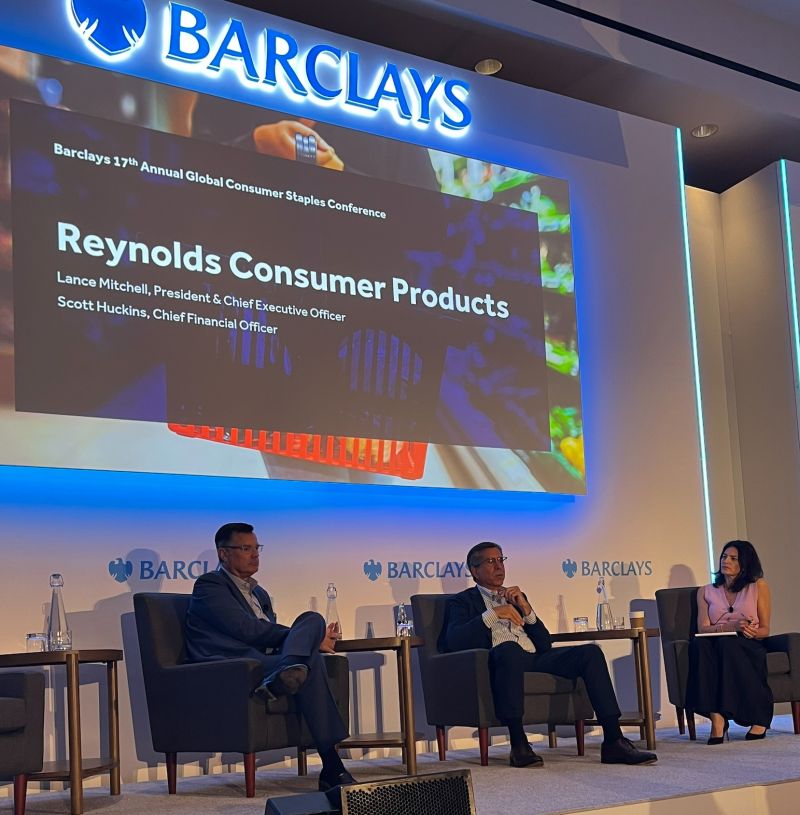
In October 2024, Reynolds announced the succession. Mitchell would step down as president, CEO, and director on January 1, 2025, with an advisory period before retirement. Huckins would take those positions. Nathan Lowe would become CFO. For Huckins, the interval between joining Reynolds and becoming its chief executive was about fourteen months.
The promotion enlarged the scope of an already familiar financial assignment. As CEO and a board member, he would carry responsibility for the company’s direction as well as its results. The sequence also matters: he had joined an established business, worked within its leadership, and then inherited the broader remit. This was a succession inside an operating company with long-standing brands and customers.
The cupboard is already crowded
Reynolds products are found in 95% of U.S. homes. That reach includes Reynolds Wrap foil, Hefty trash bags and tableware, and products made for retailers’ own brands. For a chief executive, a large existing audience changes the growth question. Much of the work concerns people who already know what the company sells.
of U.S. homes contain Reynolds Consumer Products items.
Huckins’s public message emphasizes continuing to earn trust and offering improvements that make daily life easier. “How we do it is just as important as the products we make,” he says. Quality, service, and integrity feature in the same message. They are straightforward commitments, attached to products whose usefulness is usually settled during the next household task.
The brand and store-brand combination adds another relationship to manage. The retailer is both a route to the shopper and a customer with products of its own. A business selling household essentials has to make sense on both sides of that shelf. Huckins’s experience spans the retail and manufacturing settings that meet there.
There is room for ambition in such ordinary merchandise. A product improvement can help with cooking, storage, or cleanup without demanding a new household ritual. The commercial challenge is to make the improvement useful enough to earn another purchase. Huckins’s stated goals place those small decisions beside the larger financial ones.
When earnings and volume disagree
The 2026 results show the balancing act. In the first quarter, Reynolds reported $877 million in revenue, up from $818 million a year earlier. Retail volume rose 2%. Huckins emphasized consistent execution across the organization. That opening quarter supplied an encouraging set of numbers, with sales and volume moving upward together.
The second quarter was more mixed. Revenue reached $944 million, against $938 million a year earlier, and net income rose from $73 million to $89 million. Retail volume fell 5%, or 2% excluding foam. Manufacturing efficiencies helped earnings. The figures make room for progress and pressure in the same quarter.
For a former CFO now leading the business, that combination is a practical test. Higher earnings matter. So does the amount consumers buy. A single improving number cannot answer every question about the next year. The responsibilities of the job sit in the relationship between those measures, and in the decisions made before the next reporting date.
By September 2026, Huckins was back at Barclays, this time alongside Lowe as CFO. The discussion concerned investments in people, innovation, digital commerce, and manufacturing. The progression from one conference photograph to the next is a compact version of his Reynolds story: a familiar setting, a changed title, and a wider set of promises to keep.
The next scheduled checkpoint is November 4, when Reynolds plans to report third-quarter results. For now, the second-quarter numbers leave a useful question hanging over the coming announcement: how will the company’s earnings performance develop alongside demand for its products?
Those promises ultimately travel beyond the conference room. Someone opens the cupboard, pulls out a bag, or covers dinner with foil. The product gets its performance review. Huckins’s assignment is to keep the business behind that small encounter working well enough to earn the next one.