Mike Speetzen found wedding invitations in the office mail. There were baby announcements, too. Customers were including Polaris in occasions usually reserved for relatives and friends. Some photographs placed the couple beside a vehicle. A manufacturer had somehow acquired a seat at the family table.
He recalled the discovery in a June 2025 conversation with Polaris Adventures host Jared Christie. His assistant was away, the mail had accumulated, and opening it revealed a kind of customer relationship that would be difficult to summarize in an earnings presentation. Most businesses are pleased when customers remember the warranty. These customers remembered the chief executive when ordering invitations.
That is a useful place to begin with Speetzen, whose professional biography could otherwise read like a very orderly succession of finance jobs. General Electric. Honeywell. StandardAero. ITT. Xylem. Polaris. The numbers mattered in all of them. At Polaris, the things people attach to the products can be harder to count.
Polaris sells machines for work and recreation. Its chief executive has to consider factory capacity, dealer stock, cash, product development and the uses people find for those machines. The wedding invitation brings those responsibilities together in miniature. Somewhere behind a sentimental photograph sit engineers, suppliers, a dealership and a purchase someone considered worth making.
Before the trails, the finance department
Speetzen earned a management degree at Purdue University and an MBA at Thunderbird School of Global Management. His early career took him through General Electric from 1993 to 1995 and Honeywell from 1995 to 2007. These were long apprenticeships inside industrial businesses, where finance has to contend with physical things: components, production schedules, inventories and customers who expect equipment to work.
From 2007 to 2009 he was chief financial officer at StandardAero, the aircraft maintenance, repair and overhaul business owned by Dubai Aerospace Enterprise. He joined ITT in 2009, working in its water businesses. In 2011, when those operations became Xylem through a spinoff, he became the new company’s CFO. The products changed; the work kept bringing him close to manufacturing and international operations.
At Xylem, his responsibilities extended across planning, accounting, controls, treasury, acquisitions, investor relations and strategy. By the time Polaris hired him in 2015, he had helped establish the financial organization of a public company whose business crossed national borders. Polaris was buying experience in decisions as much as experience in reporting their results.
The appointment also involved a family move. Speetzen, his wife Julie and their four daughters were relocating from Connecticut to the Minneapolis area. He succeeded Mike Malone, who was retiring after more than three decades at Polaris. Joining a business with that sort of institutional memory means learning what its spreadsheets omit: which habits are useful, which loyalties matter and why people stay.
- 1993General Electric
Finance - 2007StandardAero
CFO - 2011Xylem
CFO at spinoff - 2015Polaris
CFO - 2021Polaris
CEO
Six years learning the machinery
Speetzen arrived as executive vice president and CFO in August 2015. He became interim CEO on January 1, 2021, following Scott Wine’s departure. The board appointed him permanent chief executive on April 30 and announced the decision on May 4. Bob Mack, who had been interim CFO, received that role permanently alongside him.
The pairing mattered. Mack brought experience in corporate development, adjacent markets and boats. Speetzen had spent nearly six years inside the company before taking charge. Their appointments gave Polaris continuity across both the operating business and the financial decisions behind it. A succession can change the names on the doors while leaving a great deal of working knowledge in the room.
His first year as CEO produced $8.2 billion in company sales. Parts, garments and accessories exceeded $1.5 billion, while international sales reached $1 billion. Those are company results, earned by a much larger organization than its executive office. They also show the range of Speetzen’s assignment: selling a vehicle is one transaction in a longer relationship involving maintenance, equipment and the next purchase.
He has also served on Pentair’s board since 2018 and chairs its Audit and Finance Committee. The connection runs back toward the water and industrial businesses of his earlier career. His route into powersports was through finance, but it was finance repeatedly attached to businesses that make, service and sell equipment.
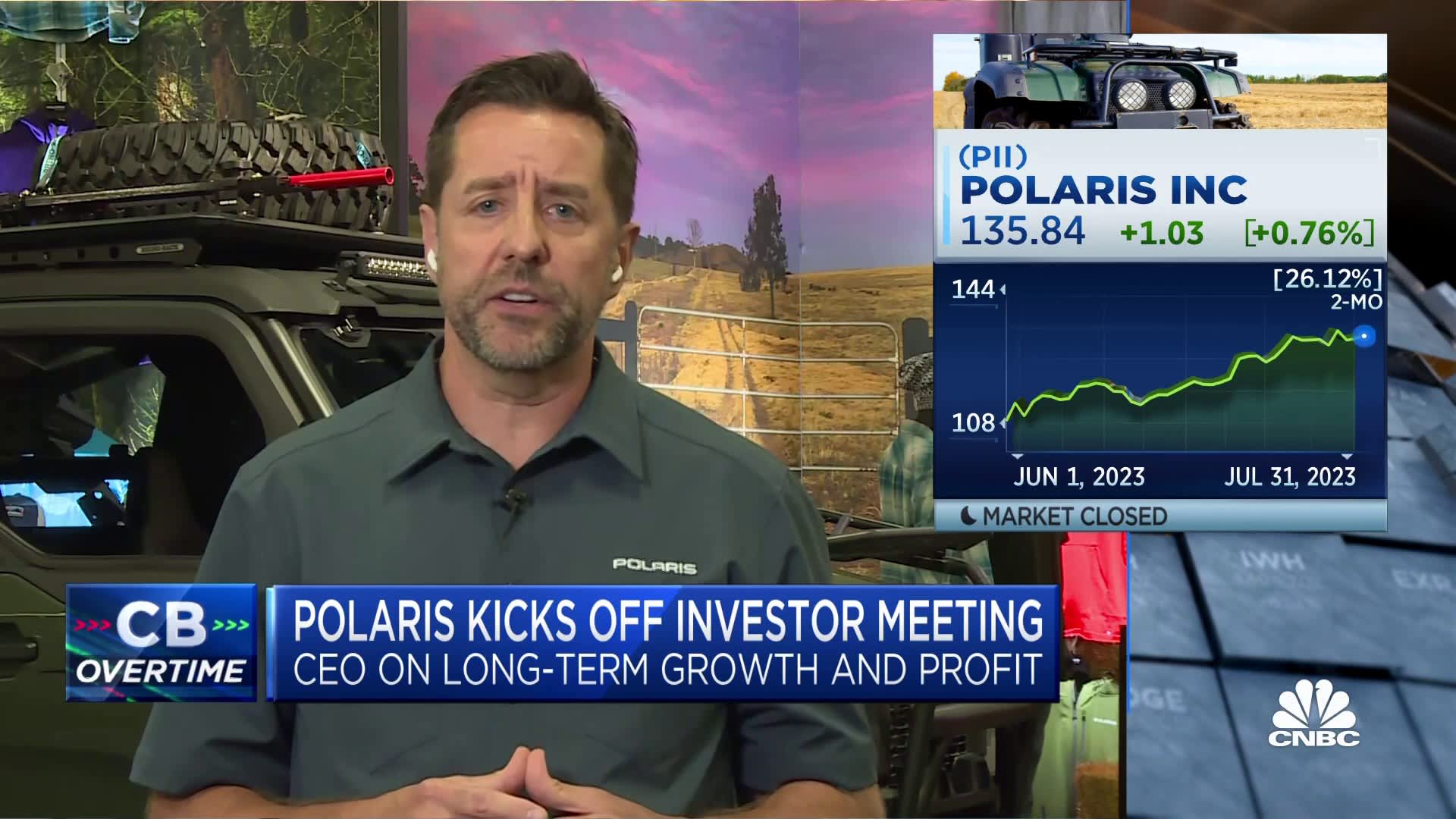
The customer with an employee badge
On a riding trip in Arizona, Speetzen and members of his team put themselves in the driver’s seat. He described the outing publicly in 2023 as a way to understand the owner’s experience. The pleasure was part of the point. A meeting can establish what a product promises; using it gives the discussion something concrete to return to.
In the 2025 Adventures conversation, he named the RZR Pro R as his favorite and described keeping four-seat vehicles so family and friends could come along. He also said product teams received plenty of feedback from him. “I’m a huge user of the products,” he said. It is a useful complication for an engineering review when the CEO has opinions acquired outside the conference room.
His public account of a February 2025 week placed a leadership meeting beside a visit to King of the Hammers, where he watched the RZR Factory Racing team win. He connected the two through preparation, changing conditions and persistence. Racing gives those abstractions an unusually unforgiving demonstration. The finish line has little interest in the elegance of a presentation.
There is a practical question underneath the enthusiasm. How much can a senior executive learn from being a customer, and how well can that experience represent customers with different budgets and needs? Riding provides a starting point. Dealers, engineers and owners still have to widen the view. The useful habit is getting close enough to the product to ask better questions.
“I’m a huge user of the products.”
Mike Speetzen · Polaris Adventures Podcast · June 2025
Two million chances to try it
Polaris Adventures offers another route into that relationship. Launched in 2017, the rental and experience business passed two million customer rides in June 2025. At the time, its network included 250 outfitters across 41 states and more than 600 available adventures. Forty percent of riders were new to powersports, according to the company’s milestone announcement.
The distinction between a ride and a sale deserves attention. A visitor can try a vehicle without first making room for it at home or committing to ownership. Local outfitters contribute their knowledge of routes and conditions. Polaris contributes vehicles and a business system. For Speetzen, this puts the company in the business of arranging an introduction as well as manufacturing the object being introduced.
The network had passed one million rides in 2022 and expanded internationally that year into Mexico and New Zealand. By 2025, it had also added operator tools through Adventures Elite and an optional weather guarantee through a partner. These details concern the machinery around an outing: booking, running a small business and dealing with a forecast that refuses to cooperate.
It is easy to draw a straight line from a happy rental to a future vehicle purchase. The actual relationship has more branches. Some people will rent again. Some will buy accessories or clothing. Others will simply remember an afternoon. A company selling recreation has reason to care about the experience before it can know which kind of customer will emerge.
The discipline of a smaller portfolio
By March 2025, Speetzen was addressing a different audience at Polaris’ Capital Markets Day. The discussion covered a market downturn, operating efficiency, customers and dealers. The financial executive’s task had come back into sharp view. Enthusiasm for the products could coexist with a need to manage the business more tightly.
The following February brought a consequential decision into effect. On February 2, 2026, Polaris completed the separation of Indian Motorcycle and sold a majority stake to Carolwood LP. The rationale Speetzen gave was sharper attention to the company’s core growth businesses. A brand could have passionate customers and still require a different ownership arrangement.
When announcing the planned transaction in October 2025, Polaris said Indian had contributed about $478 million in revenue over the preceding twelve months through June. It expected the separation to add approximately $50 million to annualized adjusted EBITDA. Those figures expressed a trade: accept a smaller revenue base in pursuit of better earnings. They were transaction expectations, rather than a promise that every subsequent quarter would cooperate.
This is where the invitations and the accounting meet. Attachment helps explain why people buy. It cannot, by itself, settle where capital should go or which businesses belong together. For a CEO who uses the products, letting a business move into separate ownership requires acknowledging both sides of that equation. Affection gives the decision weight; it does not remove the decision.
The next set of numbers
The July 28, 2026 results offered evidence of improvement. Second-quarter sales reached $2.023 billion, up 9 percent from a year earlier. North American off-road vehicle retail sales, excluding youth vehicles, rose 5 percent. Polaris also raised its full-year adjusted earnings guidance. These were encouraging figures for a team working through portfolio changes and pressure on demand.
The details matter as much as the direction. The quarter included $74 million in tariff refunds, adding $0.96 to adjusted earnings per share of $1.97. That benefit belongs in any reading of the result. Speetzen’s finance background makes the distinction especially apt: a stronger quarter can reflect operating progress and a substantial outside benefit at the same time.
As of October 21, the next public checkpoint was already on the calendar. Speetzen and Mack were scheduled to host the third-quarter results call on October 27. It would bring another round of questions about demand, margins and the decisions made in between. Running a public manufacturer provides frequent opportunities to explain how a strategy is working.
The appeal of Speetzen’s story is the distance between those questions and the mail on his desk. Both describe the same business. One counts what it earns; the other reveals a place it occupies in people’s lives. His job is to keep the connection useful in both directions, so that the company can afford to keep making things customers want to take along.