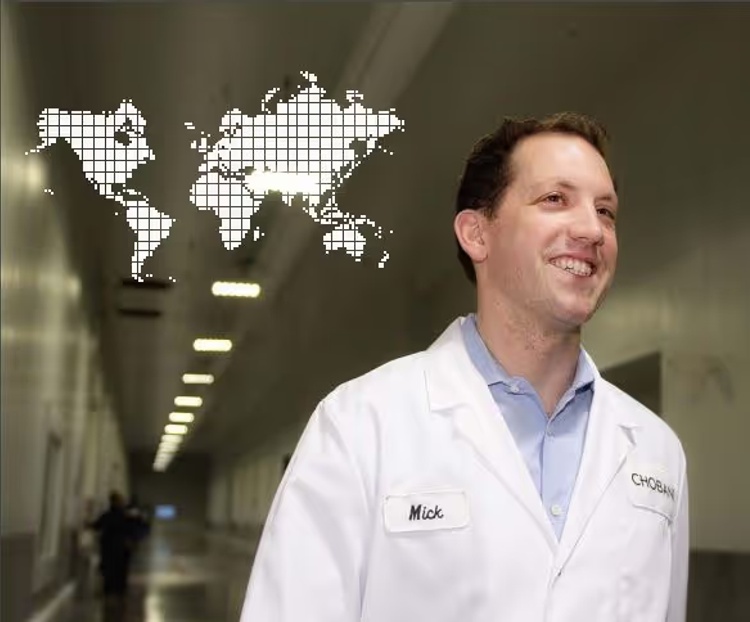
Mick Beekhuizen likes to visit factories. Long before he became chief executive of Campbell’s, he described the pleasure of walking around a production site and understanding how the process worked. An industrial engineering education had given him a way into the machinery. Finance gave him another way into the same building. The interesting part, for him, was where the two met: how something made on a line eventually became something recorded in an account.
It is a useful habit for someone whose working life has moved from Goldman Sachs to Chobani to the company behind Campbell’s soup, Goldfish crackers and Rao’s sauce. Food companies put familiar things on kitchen shelves. Their leaders spend much of their time dealing with less familiar arrangements: capital structures, distribution networks, acquisition integrations. Beekhuizen’s career has brought him into both the financial arrangements and the places where the food is made.
On February 1, 2025, he became Campbell’s 15th chief executive. A title with that much history comes with a crowded cupboard of expectations. The soup can is familiar. The business around it keeps changing. His task is to make those familiar names earn their place in the next shopping basket, while keeping an unforgiving set of numbers in order.
The six-month assignment that ran long
Beekhuizen grew up near Rotterdam and graduated from the University of Twente in 1999. His final thesis project took him to ABN AMRO in Frankfurt. Goldman Sachs followed in 2000. Four years later, he went to New York for a six-month assignment. He stayed eight and a half years. There are temporary arrangements, and then there is the New York rental market’s understanding of temporary.
He eventually became a managing director in merchant banking, working with investments in private businesses. In 2013 he moved to Education Management Corporation in Pittsburgh as chief financial officer. By 2016, he was back in New York, this time at Chobani. The move put him inside a growing food company, with a finance team to build and a business to understand beyond its accounts.
“When I talk to people in finances, I get the story behind the numbers.”
Mick Beekhuizen, 2018
A finance job with the factory attached
At Chobani, his remit included improving the company’s capital structure and supporting expansion. The appeal was partly the experience of working in a younger business. It was also an opportunity to connect financial decisions to production, sales and the practical demands of growth. That combination became a recurring feature of his next few jobs.
Campbell’s hired him as chief financial officer in 2019, effective September 30. His responsibilities covered tax, treasury, audit, investor relations, financial planning and information technology. The IT detail matters. In a food business, the information that travels around the company helps determine what gets made, shipped and counted. His formal brief already reached beyond the finance department.
Then, in November 2022, Campbell’s appointed him president of Meals & Beverages. He initially kept the CFO job while a successor was sought. The division had $4.6 billion in sales when the appointment was announced and included soup, simple meals and beverages sold through retail and foodservice in North America. The move gave him direct responsibility for a substantial operating business.
Mark Clouse, then CEO, singled out his collaboration and team building when announcing the change. Those were practical qualifications for the new role. A divisional president has to bring brand teams, factories, salespeople and financial planners into the same argument about what to do next. Every group can be right about its own problem. The job is to reach a decision the whole business can carry out.
- 2019Finance & IT
- 2022Meals & Beverages
- 2025President & CEO
The jar that changed the assignment
A consequential addition to his division came in March 2024, when Campbell’s completed its acquisition of Sovos Brands. The transaction had an enterprise value of approximately $2.7 billion. It brought Rao’s, Michael Angelo’s and noosa into the portfolio, with Risa Cretella from Sovos leading a new Distinctive Brands unit. Beekhuizen played a key role in the acquisition and integration.
Rao’s gave the story a particularly tangible object: a jar of pasta sauce. An acquisition announcement can explain the price and the anticipated benefits. The shopper’s assessment happens later, at a shelf and then at dinner. For the executive responsible for integration, protecting the reasons people already buy the product is part of making the purchase worthwhile.
Beekhuizen’s comments about Rao’s in October 2024 were notably specific. Sauce had to remain the center of the brand. He saw opportunities in adjacent products, including frozen pizza and entrées, but wanted launches to earn consumers’ approval. Campbell’s expected sauce to account for roughly three quarters of the brand’s sales. The expanding portfolio still needed a clear center of gravity.
That emphasis continued after he became CEO. On May 4, 2026, Campbell’s completed a purchase of a 49% interest in La Regina, the maker of Rao’s tomato-based jarred sauces. The business, founded by Antonio Romano in 1972, operates in Scafati, Italy, and Alma, Georgia. Its relationship with Rao’s dates to 1993. The investment linked Campbell’s more closely to the people and production behind the brand.
By that announcement, Rao’s had passed $1 billion in trailing twelve-month net sales. It joined Campbell’s, Goldfish and Pepperidge Farm as the company’s fourth billion-dollar brand. For Beekhuizen, the sequence connected several jobs he had already done: evaluating a business, integrating it, overseeing its growth and investing in its supply. The next question was how much of that progress the wider company could reproduce.
A promotion, followed by harder arithmetic
His succession had an unusual backdrop. Clouse was leaving to become president of the NFL’s Washington Commanders. Campbell’s announced the change in December 2024, with Beekhuizen taking over the following February and joining the board. At the time of the announcement, he was running a Meals & Beverages division described as a $5.3 billion business. He knew the company from both its finance office and its operating ranks.
The early public assignment included two businesses moving at different speeds. In June 2025, he described stronger consumer demand in Meals & Beverages alongside mixed performance in Snacks. Cooking at home supported the meals portfolio. The snack business required adjustments to compete. By the first quarter of fiscal 2026, he was still describing that split: at-home cooking helped one side while softer snack categories weighed on the other.
By September 2026, the tone had become sharper. Campbell’s reported fiscal 2026 net sales of $9.744 billion, down 5%, with organic sales down 2%. The prior year had an extra week. That distinction helps explain the comparison, though it does not remove the decline. Beekhuizen acknowledged the gap directly: “Our performance is not where it needs to be.”
Reported sales. FY25 had 53 weeks; FY26 had 52. Organic change excludes items such as acquisitions, divestitures, currency and the extra week.
The response included reducing costs, supporting brands, improving execution and strengthening the balance sheet, including a dividend reset. Campbell’s targeted $500 million in cost savings by fiscal 2030. These are commitments whose value will depend on what follows. His experience makes him familiar with the choices. It also makes the next results a test of whether those choices are working.
Philadelphia, with something good in the fridge
Away from investor questions, Beekhuizen lives in Philadelphia with his wife. His family is in the Netherlands; hers is in India. He enjoys cycling and the food in his neighborhood. Asked about favorite Campbell’s products in spring 2025, he named Cape Cod chips and said Rao’s and Pace were fixtures in his fridge. It is pleasingly ordinary evidence of a food executive having dinner.
His early months as CEO also included visits to plants in Wisconsin, Illinois and North Carolina. He described the value of meeting employees and seeing sites exchange ideas about improving performance. In the same employee conversation, he offered a personal motto: “Keep it moving!” The phrase fits the itinerary. Its usefulness at work depends on whether the movement solves a problem.
There was another kind of visit in March 2025. Beekhuizen delivered opening remarks at the H.O.P.E. Summit, held at Campbell’s Camden headquarters. The Hopeworks event brought young adults together with employers for career workshops, networking and interview preparation. Campbell’s relationship with Hopeworks went back 25 years, long before his appointment. Becoming CEO also meant taking a place in that existing local relationship.
In June 2026, Campbell’s was named to the Civic 50, a recognition of corporate community engagement. The company’s responsibility agenda also had a financial mechanism behind it: a scorecard of 15 sustainability, sourcing and community targets tied to its enterprise incentive program. Employees receiving an annual bonus had a stake in those targets. For a former CFO, that is familiar territory. A statement of purpose becomes more concrete when it enters the system used to assess performance and pay people. It also gives a CEO another set of commitments that can be checked, alongside the sales and earnings figures.
He has inherited brands with long memories, employees with detailed knowledge of their work, and customers free to choose something else. His career offers a useful way of approaching that combination: learn how the business works, then go and look at it working. The factory visits began before the CEO title. With Campbell’s under pressure to improve, they have become part of a much larger responsibility.
Follow the work
Company & career
The Campbell’s Company ↗Mick Beekhuizen on LinkedIn ↗The University of Twente conversation ↗The Rao’s interview ↗Fiscal 2026 results ↗Watch: a message from Beekhuizen ↗Investor webcasts & presentations ↗