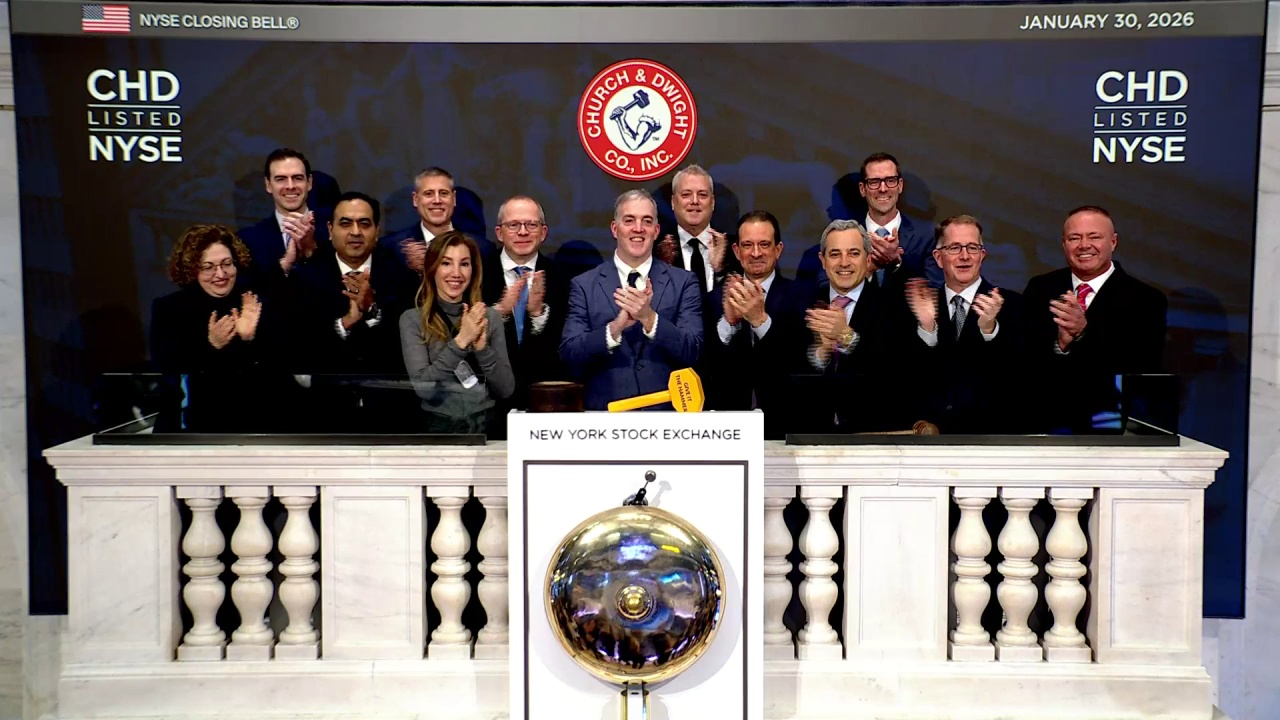
On January 30, 2026, Rick Dierker rang the closing bell at the New York Stock Exchange. Church & Dwight had brought its executives and guests to celebrate Analyst Day. For a company that sells products destined for laundry rooms and kitchen cupboards, it was an unusually ceremonial afternoon. Dierker had been CEO for less than a year.
Afterward, he wrote that the preceding week had been among the most exciting of his almost seventeen years at the company. His explanation had little to do with the bell. The business had weathered a difficult 2025, made consequential portfolio decisions, acquired Touchland and managed its resources carefully. He gave the achievement a starting address: the plant floors.
There is something revealing about where an executive begins a victory speech. Dierker had reached the top through supply-chain finance, corporate finance and business operations. He knew the numbers long before he became responsible for explaining the whole enterprise. His career offers a view of leadership built through accumulating responsibilities inside one company, then deciding what that company should become.
The long way through the numbers
Richard A. Dierker studied finance at James Madison University and earned an MBA at the University of North Carolina at Chapel Hill. Before Church & Dwight, he held financial and business-development positions at Ingersoll-Rand, followed by a senior financial-management role at Alpharma in 2008 and 2009. His route into consumer products came through finance and industry.
He joined Church & Dwight in 2009 as operations controller, leading supply-chain finance. The role placed him at the intersection of what a company makes, what it costs and how those costs travel through the accounts. In 2012, he became vice president of corporate finance. His responsibilities included financial planning and analysis, investor relations and supply-chain finance.
That combination matters. Investor relations requires explaining the business to outsiders. Supply-chain finance requires understanding the machinery behind the explanation. Dierker's growing remit joined those perspectives: the quarterly question from an analyst and the operating decisions that would eventually supply the answer.
In August 2015, Church & Dwight announced that he would become chief financial officer the following January, succeeding Matthew Farrell as Farrell moved into the CEO job. Dierker's response was characteristically collective: he credited the finance team Farrell had built. The promotion gave him responsibility for financial discipline across the company, while keeping him alongside an executive whose own route to leadership had passed through the same office.
As CFO in June 2024, Dierker explained the importance of turning earnings into cash. He pointed to working-capital management and a business model that limited capital requirements, helped by outsourcing. That cash could then be put to work elsewhere. It was a compact account of the company’s financial logic: manage what is tied up in the existing business so resources remain available for the next decision. The later acquisition announcements would give that discussion a more tangible form, with purchase prices attached to brands already familiar to shoppers.
A familiar successor with a larger remit
In April 2022, Dierker added head of business operations to his CFO responsibilities. By the time the board announced his selection as the next chief executive in September 2024, it was choosing someone already involved in both strategy and execution. He became president, CEO and a board member in April 2025.
The selection followed a process that considered internal and external candidates and ended in a unanimous board vote. Lead director Ravi Saligram emphasized Dierker's ability to get to the heart of an issue and carry decisions through. Farrell pointed to strategic thinking and execution. These were endorsements of a colleague observed over years, with the succession resting heavily on familiarity with the business.
Dierker, for his part, described the team through creativity, initiative, curiosity and a desire to win. His ambitions were explicit: innovation, technology and acquisitions that would add value. Continuity supplied the foundation. The incoming CEO still had to decide where to invest, what to buy and what to stop doing.
“That’s our secret sauce.”
Rick Dierker, describing his team’s mix of creativity, initiative, curiosity and desire to win, September 2024
Knowing what to take out of the cupboard
A portfolio is easy to admire when every brand gets to stay. Running one involves less agreeable decisions. During Dierker's first year as CEO, Church & Dwight outlined exits from its Flawless, Spinbrush and Waterpik showerhead businesses. The reviews put the allocation of money and management attention into public view.
In discussing those decisions, Dierker described regular assessments of each brand, with stronger businesses receiving increased investment. The second quarter of 2025 included about $51 million in pretax charges associated with the announced exits, primarily impairments and inventory charges. Those costs were excluded from adjusted earnings. Tidying a corporate cupboard comes with a rather larger bill than tidying the one at home.
The significance for Dierker's story is the willingness to narrow the portfolio while pursuing growth elsewhere. A long-serving executive can inherit attachments as well as assets. His first year required the company to make choices about businesses already inside it, while continuing to search outside for the next addition.
A stain remover with room on the shelf
On May 28, 2026, Church & Dwight closed its approximately $325 million acquisition of Miss Mouth's Messy Eater. The brand had generated about $80 million in net sales during 2025. A household stain remover had become a substantial business before joining the company that already owned OxiClean.
Dierker's explanation focused on repeat use, loyalty and online reviews. The acquisition announcement identified Miss Mouth's as Amazon's number-one stain remover brand. Its appeal to younger parents and its growing retail presence made it a useful fit for the fabric-care portfolio. The criteria remained familiar: a leading position in a proven category, strong margins and an asset-light business.
The next task would be to apply Church & Dwight's distribution, sales, innovation and operating capabilities. Buying a brand secures ownership. Getting more people to encounter it, try it and buy it again requires a different set of skills. Dierker's career had given him responsibilities on both sides of that calculation.
By September, he was showing investors a video of a wedding photographer removing a wine stain from a bride's dress. He said the team had encountered it during diligence. An acquisition discussion had arrived at a scene anyone could understand: an expensive white dress, an inconvenient spill and very little time. Even a finance audience can appreciate suspense without a spreadsheet.
Who owns the next decision?
Some of Dierker's more instructive public comments concern a process that needed changing. On the July 2026 earnings call, he described the early effort to develop international acquisitions. Dedicated deal staff had been added, but the arrangement was somewhat disconnected from local management teams.
The company changed the responsibility: country leaders would own the search, with acquisition specialists supporting them. Managers were expected to identify brands they wanted to pursue, rather than simply consider opportunities brought by bankers or a central contact. Dierker said that giving those teams ownership had helped the process move forward.
It is a concrete example of his operating approach. The problem called for a change in who was accountable. He also discussed reinvesting when performance exceeded expectations, directing money toward marketing and other investments. The ambition was to keep building the business beyond the current reporting period. A stronger quarter could finance work whose benefits would appear later.
The result, and the work still ahead
The second quarter of 2026 supplied evidence of progress. Church & Dwight reported net sales of $1.53 billion, up 1.6%, and organic sales growth of 5.8%. Volume contributed 4.3 percentage points to organic growth, while price and mix contributed 1.5. The company raised its full-year sales, adjusted earnings-per-share and cash-flow outlooks.
Inside Q2 2026 organic sales growth
Total: 5.8%. Organic sales growth is a non-GAAP measure; reported net sales increased 1.6%.
Those are company results, produced by many people, rather than a personal scorecard. They nevertheless establish the context in which Dierker is making decisions. In the first quarter, global online sales had reached 24% of consumer sales. The routes to the shopper now include a considerable digital business alongside the physical shelf.
His responsibilities also extend beyond Church & Dwight. In January 2026, McCormick announced his appointment to its board, effective February 1. He serves on its audit committee. The appointment brought his financial and operating experience into another consumer-products boardroom, this one concerned with the contents of the spice cupboard.
A report card with the misses left in
There is another useful glimpse of Dierker in his message introducing Church & Dwight's 2024 sustainability report. Alongside the progress, he acknowledged missed goals. Water intake per million units shipped fell 4%, against a 10% annual reduction goal. Total waste generation increased 10%, rather than achieving the targeted reduction.
The same message described employee-led giving and the company matching employee donations dollar for dollar. It set community contributions beside manufacturing measures, placing both within the account of how the business operated. The missed targets gave the account something more useful than an uninterrupted procession of good news: a measure against which subsequent work could be judged.
Return to that closing bell. The ceremony made a satisfying ending to Analyst Day; Dierker's account reached back to the people doing the daily work. His next chapters will be measured in similarly practical places: a production decision, a retailer's shelf, a country manager's acquisition proposal. For all the ceremonial noise at the exchange, the everyday things remain the business.
Follow the work
More from Dierker and the companies where he serves.
- Rick Dierker on LinkedIn
- Church & Dwight: leadership and career biography
- The 2015 CFO appointment
- The CEO succession announcement
- His reflection on Analyst Day
- Miss Mouth’s: the acquisition announcement
- Second-quarter 2026 results
- September 2026: the Barclays presentation
- The 2024 sustainability report
- McCormick: board appointment and biography
- Watch: the NYSE closing bell on YouTube
- Church & Dwight corporate website