Chris Peterson had an accounting job at a CoverGirl factory in Baltimore when he asked to try the production line. He had learned the technical demands of his own role. Now he wanted to know what happened elsewhere in the building. The plant manager was surprised. Peterson went ahead, joining the workers whose performance eventually found its way into the numbers he handled.
His assessment of his contribution was admirably economical: “I was not a very good day laborer, by the way.” He came away with more respect for the people who were. The accountant had found a useful way to become a beginner again.
That voluntary demotion offers a revealing introduction to the president and CEO of Newell Brands. Peterson’s career has taken him through investment banking, household products, fashion and beauty. The factory episode gives those job titles a little texture. Before you can improve an operation, it helps to understand what the people inside it actually do.
A career that kept adding rooms
Peterson studied operations research and industrial engineering at Cornell University. He also played varsity golf for four years, and still tries to find time for a Saturday round. There is something pleasingly inconvenient about golf for a person interested in systems: the calculations may be sound, and the ball may have other plans.
His first professional destination was investment banking at Smith Barney. An engineering degree did not oblige him to become a practicing engineer. It gave him a way to examine how things worked, a habit he carried into business. In his later account of the journey, the ambition expanded with the work. Finance led to an interest in becoming a CFO; broader responsibilities eventually made the chief executive’s job imaginable.
At Procter & Gamble, he spent 20 years in roles that culminated in vice president and CFO of Global Household Care. That is a substantial apprenticeship in the business of repeat purchases. A consumer company must arrange the factory, the cost structure, the brand and the retailer around an item somebody may buy almost without thinking.
Ralph Lauren recruited him as CFO in 2012. He later became president, Global Brands, before leaving in 2016. Revlon brought another set of operating responsibilities, including oversight of supply chain, finance and information technology. By the time Newell hired him as CFO in December 2018, his experience crossed several departments that can look deceptively separate on an organization chart.
- Smith BarneyInvestment banking
- Procter & Gamble20 years / finance and consumer goods
- Ralph Lauren → RevlonGlobal brands, finance and operations
- Newell BrandsCFO, 2018 → President & CEO, 2023
He also joined the board of BJ’s Wholesale Club Holdings in 2018. That connection places a retailer’s business alongside his work for consumer brands. Manufacturers and retailers meet around the same purchase, although they arrive with different calculations about price, space, inventory and the customer walking through the door.
The unglamorous arithmetic of a turnaround
At Newell, Peterson accumulated responsibility before acquiring the top title. In February 2020 he became CFO and president, Business Operations. In May 2022 he was named president and CFO. His remit included supply chain, procurement, IT, real estate and global business services. An accountant who wanted to understand the rest of the building had acquired quite a large building.
Some of the results were measurable in days. When Newell announced the 2022 promotion, it said its cash conversion cycle had fallen from 115 days to 68 over the preceding three years. That measure concerns the time money spends moving through the operating cycle. Shortening it can free cash tied up in running the business.
47 fewer days in the cycle, over three years.
The same work involved trimming product complexity, consolidating enterprise software systems and reducing legal entities. These are activities unlikely to attract a crowd at a dinner party. They can determine how much cash a company has available for the activities that do.
Peterson succeeded Ravi Saligram as CEO on May 16, 2023. The appointment followed a board succession process, and it came with a company already engaged in repair. Familiarity with the business gave him a starting position. It also meant the difficulty of the assignment was close at hand.
The costs of changing that business deserve equal space. In January 2024, Newell announced a reorganization that included a planned reduction of approximately 7% in office roles. It expected annual pretax savings of $65 million to $90 million, net of reinvestment. Behind those estimates were people whose jobs would change or disappear.
The reorganization put brand management closer to responsibility for profit and loss, while centralizing several functions and simplifying regional selling organizations. Its practical question was who owned a result, and whether the structure helped that person deliver it. The answer involved difficult decisions as well as a tidier diagram.
The household-name problem
Rubbermaid, Sharpie, Graco and Coleman have an advantage that many businesses would like to buy: people recognize their names. Recognition, however, does not finish a product brief or secure the next order. A well-known brand can still make something a shopper passes over.
Peterson’s strategy, introduced in 2023, concentrated investment on Newell’s largest and most profitable brands, selected markets and stronger commercial capabilities. The priorities included consumer understanding, brand communication, innovation and execution with retailers. The company also chose to emphasize middle and higher price points and younger adult consumers.
Those choices require restraint. A portfolio presents many plausible places to spend the next dollar. Choosing some means other proposals receive less. Peterson’s approach makes the allocation explicit: work out where the business can compete, then develop the capabilities the choice requires.
By September 2026, the product pipeline offered one way to see that approach. Newell expected 25 Tier 1 or Tier 2 innovation initiatives during the year, compared with one qualifying initiative when its tiering system began in 2023. These are the company’s categories for significant launches; the projected total remained a projection.
The examples were tangible: Graco EasyTurn car seats, Coleman Snap ’N Go coolers and Rubbermaid Brilliance glass food storage. They locate the strategy in ordinary gestures: turning a seat, moving a cooler, putting food away. An investment case becomes rather easier to understand when it has a lid.
“What is exciting about last quarter is all of those things came together.”
Chris Peterson / September 2026
Peterson’s September conference discussion also emphasized retail distribution and consumer purchases. Six of Newell’s top ten brands had grown U.S. point-of-sale sales in the second quarter. The distinction matters: shipping products to a retailer and having a shopper take them home are related events, separated by a shelf and a decision.
A new address, a working laboratory
In June 2025, Peterson joined the ribbon-cutting at Newell’s new global headquarters in Sandy Springs. The company moved to the Queen Tower at Concourse Office Park, taking more than 180,000 square feet. It said it employed over 900 people across the greater Atlanta area.
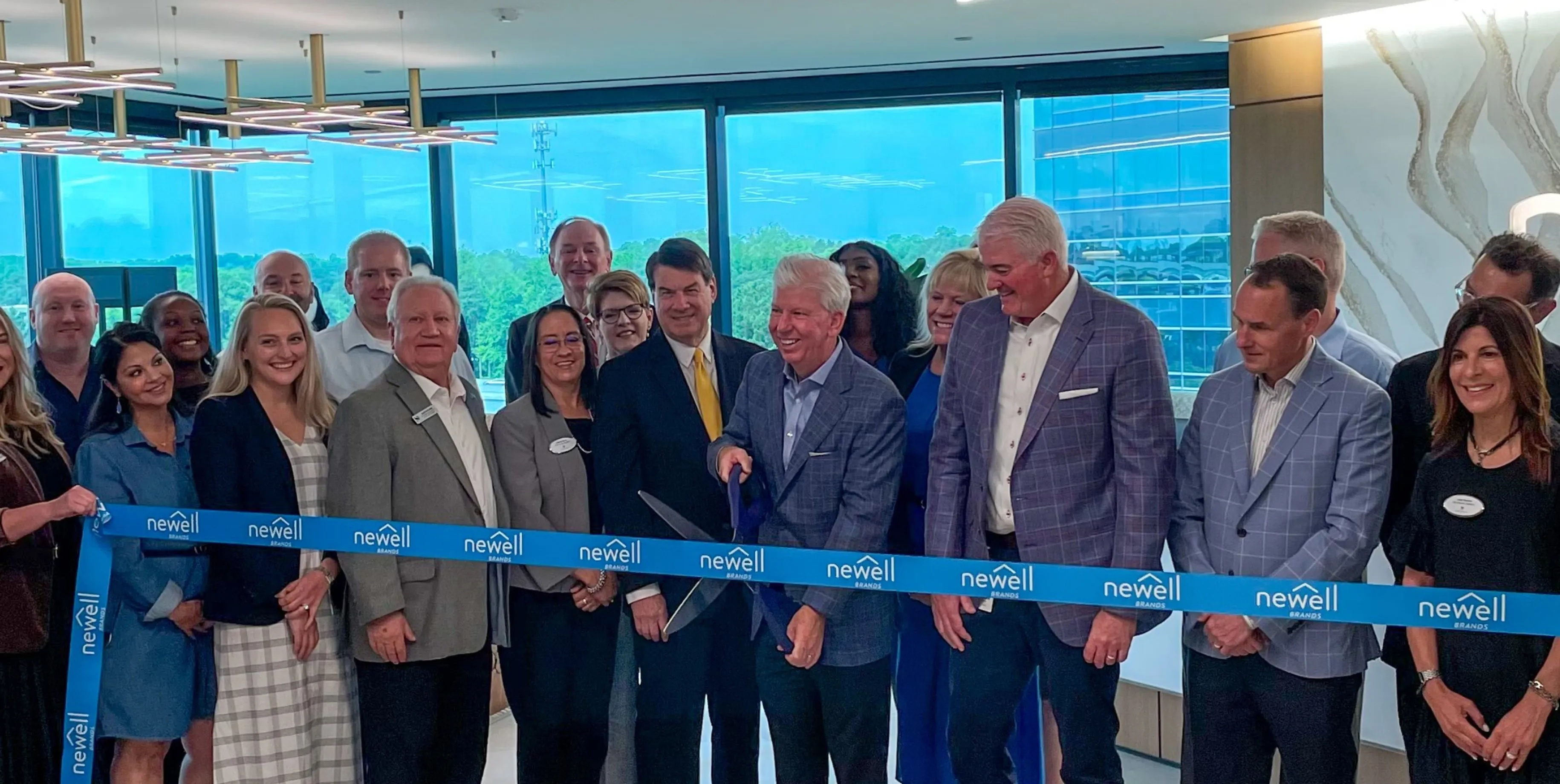
The photograph has the good cheer of a ceremony. The more interesting question is what a shared address makes possible afterward. Newell described the headquarters as a place for collaboration, innovation and employee development. An office can shorten the distance between colleagues; productive conversations still have to happen.
In September 2026, Newell added a more specific investment: an Atlanta Design Center spanning nearly 37,000 square feet across two locations. It connected space at the headquarters with a photography and creative studio at Morgan Falls. Consumer insights, design and technology were being brought closer to business decisions.
For Peterson’s strategy, the significance lies in the connection. A brand needs people who understand the consumer, people who can design the product, and people who can explain why it deserves attention. Bringing those activities together gives the strategy somewhere to work.
The next lesson is coordination
Peterson’s interest in how work happens now includes artificial intelligence. In June 2026, he described Newell’s Quantum Leap program: training employees for personal productivity, asking functions to imagine their work five years ahead, and addressing processes that cross departmental boundaries. The organization had appointed 33 functional “navigators” to help guide the effort.
His account included an accelerated path from ideas to images, design work and a physical prototype. He was careful about the last word: the output was a 3D-printed prototype. Faster early development can make an idea easier to examine. A finished consumer product still has a longer journey to travel.
There was a financial milestone that summer. On July 31, Newell reported second-quarter net sales of approximately $2 billion, up 3.0% year over year, with core sales increasing 2.3%. It was the company’s first return to sales growth in more than four years. The quarter also benefited from substantial tariff recoveries, which helped reported profitability. The sales improvement and the profit benefits need to be read separately.
Then, on October 20, Newell announced Guillermo Beade as chief operating officer, effective October 26. Reporting to Peterson, Beade would oversee central marketing, sales and supply chain globally. The remit puts several of the turnaround’s central activities under one executive, with an explicit assignment to connect them.
That is where Peterson’s story currently stands: a return to growth, another organizational decision, and more work between departments. The factory tourist has become responsible for the whole enterprise. His early willingness to be an awkward novice remains a useful detail to remember. Every function has people who know things the visitor has yet to learn.
Continue the conversation
- Peterson’s official biography at Newell Brands ↗
- Chris Peterson on LinkedIn ↗
- Thirty Minute Mentors: the career and leadership conversation ↗
- Listen: Peterson discusses Quantum Leap with The CPG Guys ↗
- Listen: Engineering a Turnaround with Canaccord Genuity ↗
- Newell’s second-quarter 2026 results ↗
- The October 2026 COO appointment ↗
- Watch: Newell Brands’ corporate YouTube channel ↗