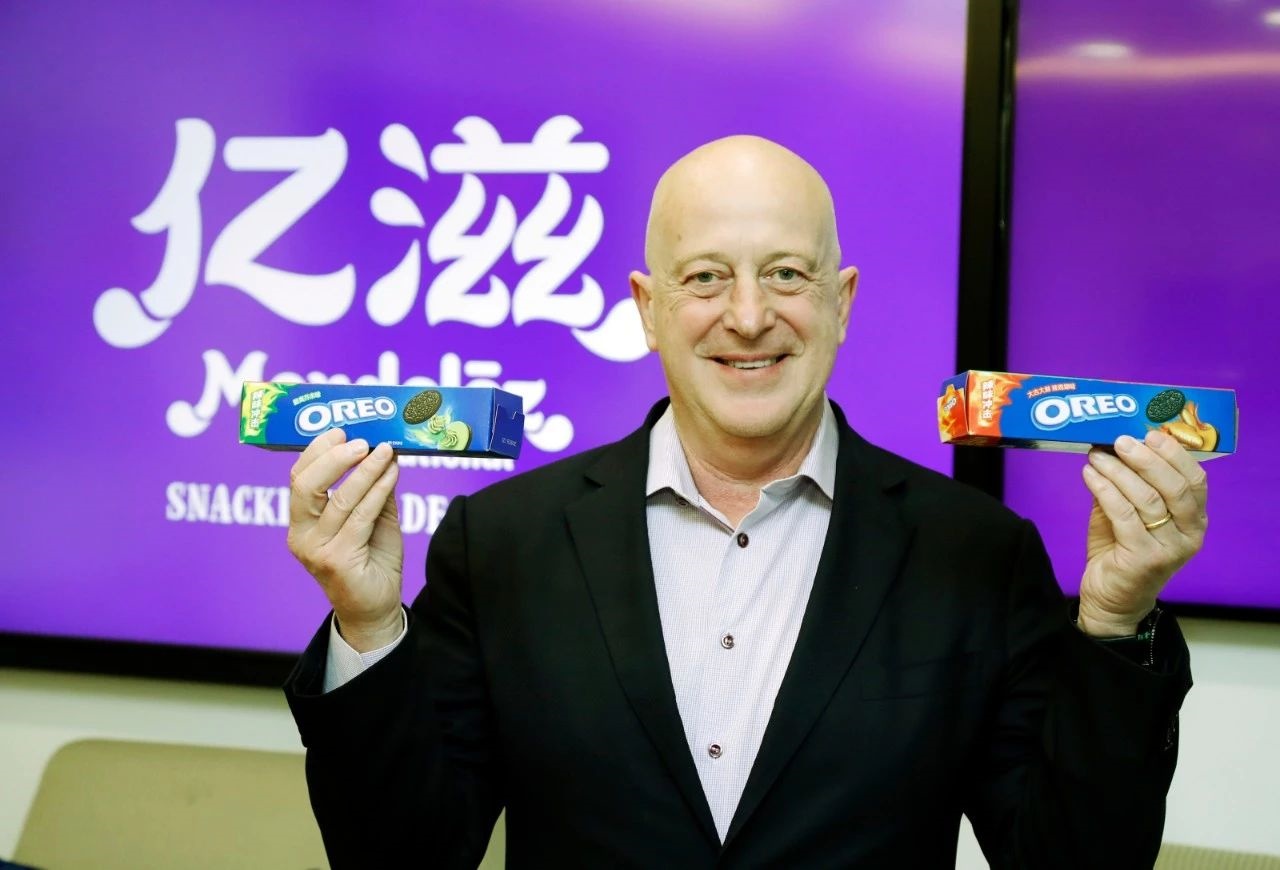
A wasabi Oreo presents a small crisis of imagination. The familiar dark biscuit suggests one thing; the green filling suggests another. For Dirk Van de Put, the interesting question is who gets to decide whether it belongs on a supermarket shelf. An executive in Chicago might find the combination peculiar. A shopper in China has a vote that matters rather more: the purchase.
In 2019, talking about giving Chinese colleagues more authority, Van de Put described the obstacle with some amusement. Headquarters had thought flavors such as wasabi and spicy chicken were strange. The difficult part was persuading people in Chicago to surrender decisions. Here was a chief executive explaining that some of his company's progress depended on his own end of the organization learning to interfere less.
It is a useful entrance into his story. Van de Put runs a business whose products are familiar enough to be taken personally. People have opinions about their biscuits. They have childhoods invested in their chocolate. His job at Mondelēz International involves moving those attachments across borders without assuming that everybody wants the same thing inside the wrapper.
A Belgian education in other people's tastes
Van de Put comes from Mechelen, Belgium. He studied at Ghent University and later took postgraduate business studies at the University of Antwerp. His working education would become considerably more itinerant. Mars employed him from 1986 to 1997, including in Latin American marketing and in the Southern Cone. Coca-Cola followed, with responsibilities in Brazil and the Caribbean.
He then spent more than a decade at Danone, with responsibilities spanning the Americas. These were jobs in businesses where a recognizable name must survive an encounter with a particular shop, distributor and customer. A global presentation can explain a brand's ambitions. It cannot make a retailer give it another shelf.
He speaks Dutch, English, French, Spanish and Portuguese. Five languages are a pleasing detail for a résumé, but the geography behind them is more revealing. His career has repeatedly placed him between a multinational organization's plans and the people expected to carry them out. By the time Mondelēz hired him, he had lived and worked on three continents. Local differences were part of his working life.
The French-fry audition
Before Oreo came frozen potatoes. Van de Put joined McCain Foods as chief operating officer in 2010 and became president and chief executive in 2011. When Mondelēz announced his appointment in August 2017, it supplied a compact argument for the hire: McCain's net sales had risen by more than 50 percent during his six years as CEO. More than three quarters of that growth had come organically.
That distinction mattered. A company can become larger by purchasing somebody else's sales. Organic growth asks more of the business already in hand: its products, distribution, pricing and customers. McCain gave Van de Put a record he could bring to the interview without needing to bring a freezer.
Net sales growth, with more than 75% of that growth generated organically. Figures disclosed when his Mondelēz appointment was announced in 2017.
He succeeded Irene Rosenfeld as Mondelēz CEO in November 2017 and added the chair in April 2018. The assignment involved a pantry full of recognizable names and a less appetizing growth problem. Organic revenue growth had slowed to 0.9 percent in 2017. His arrival brought a renewed emphasis on selling more through the brands and operations the company already possessed.
Let the biscuit travel; let the decisions stay
In China, that philosophy acquired an edible form. Wasabi and spicy chicken versions of Oreo made the argument easier to see than an organization chart ever could. In his telling, giving local teams more freedom also meant requiring them to accept responsibility for results. The permission and the obligation arrived in the same package.
There is an ordinary human difficulty here. People promoted for making decisions are being asked to let somebody else make them. A regional office can always discover another question to ask. An approval process can be exquisitely thorough while the opportunity it was designed to examine quietly expires.
The company's operating model now explicitly gives local teams authority to respond to local trends, supported by headquarters. Its broader strategy concentrates on chocolate, biscuits and baked snacks. That combination sets a boundary around what the business wants to sell while leaving room for disagreement over precisely how to sell it. A biscuit can travel farther when the recipe is allowed to change.
- 01Understand the shopper
- 02Test the product
- 03Give the local team room
- 04Hold it to the results
The rival hiding in the sweet aisle
Van de Put's account of consumer research offers another window into how he thinks. In 2019, he described a snacking database built from interviews with approximately 170,000 consumers. Researchers were looking at circumstances as well as products: whether people were alone or with others, what time it was, how they felt.
One finding concerned the after-school snack. Oreo's competition included gummy bears. A biscuit manufacturer arranging the world into biscuit companies could miss the rival sitting in a different aisle. The shopper had organized the contest around an occasion. Corporate categories had been rather less helpful.
“The competition is gummy bears here in the U.S.”
Dirk Van de Put, 2019
The observation has an appealing lack of grandeur. No elaborate theory is required to picture a child choosing a sweet. Yet it changes what a company might advertise, develop or place near the checkout. Van de Put's public explanations often come back to this level: the occasion, the flavor, the price a person will actually pay.
He has also described a practical limit to novelty. New Oreo flavors are tested; products that fail to sell sufficiently can be withdrawn and replaced. The point of introducing something unusual is to find an audience. A curious biscuit should eventually have to earn its shelf space like everybody else.
A larger cupboard, with a narrower purpose
His preference for growth from existing operations has coexisted with acquisitions. Mondelēz's 2022 anniversary update named Tate's Bake Shop, Give & Go, Chipita and Clif Bar among purchases expanding the business. The additions brought cookies, baked goods and bars into a strategy increasingly organized around snacking.
The Clif Bar transaction closed in August 2022. The company described it as expanding its global snack-bar business to more than $1 billion. Alongside buying businesses, it was making choices about the portfolio's boundaries, including its announced intention that year to divest developed-market gum operations. An acquisition budget and a willingness to part with familiar products were both involved.
For Van de Put, the recurring task is deciding where a large organization can add something useful. Distribution, marketing and manufacturing can help a brand reach more people. Each also introduces more decisions about what to preserve. The personal attachment that makes a brand attractive to buy can make it awkward to change.
When the wrapper meets the household budget
By February 2025, cocoa costs had given his management approach a sharper test. He described expanding chocolate pack sizes and price points to keep purchases within reach. His example was plain: a €2 pack that previously contained 100 grams might contain 90 grams. The ticket price could stay familiar while the quantity changed.
He also contrasted responses to price rises. In the UK, he said, a 12 percent increase had left volume unaffected. In Scandinavia, a 20 percent increase had hurt volume, prompting the local team to adjust promotions and price. These were examples from a particular period, rather than a permanent rule about either market.
From a customer's point of view, the arithmetic requires no presentation. Less chocolate for the same money is still less chocolate. From his point of view, losing a shopper altogether creates another problem. The exchange exposes the tension in running beloved, inexpensive treats when their ingredients become expensive. Delegating decisions makes the response quicker; it does not make the trade-off disappear.
The decisions a global remit cannot soften
His tenure also carries a dispute that sits well beyond flavor and price. Mondelēz continued operating in Russia after the invasion of Ukraine, drawing criticism from employees and investors. In 2022, roughly 130 employees in the Baltic states petitioned Van de Put to stop all business there.
He defended staying, arguing that an exit risked transferring assets to people close to Vladimir Putin. His 2024 remarks about investors' moral concern brought a public rebuttal from the investor Wespath. That May, a shareholder proposal seeking an independent assessment of risks associated with the company's continued Russian operations received more than 30 percent support.
Meanwhile, Mondelēz resumed Oreo production at its repaired Trostyanets factory in Ukraine in 2024. The company said it was increasing investment in supporting and rebuilding Ukraine. Those actions and the objections to its Russian operations belong in the same account of his leadership. A company can defend a decision and still face a substantial constituency that rejects its reasoning.
Another chair, the same question
On June 16, 2026, AB InBev appointed Van de Put chairman, following his service as an independent director since April 2023. He succeeded Martin Barrington and publicly supported the brewer's strategy and ten-year plan. It added a boardroom responsibility alongside his continuing executive role at Mondelēz.
At Mondelēz, the latest reported quarter available on October 21, 2026, supplied a measured snapshot: second-quarter organic net revenue grew 2.2 percent, with volume/mix up 0.7 percent. Adjusted earnings per share declined 2.7 percent at constant currency. Sales momentum and pressure on earnings could occupy the same results page.
His own favorite Mondelēz product is Côte d'Or. After the languages, the continents and the multinational assignments, that preference returns the story to Belgium. The executive who makes room for other people's tastes has a particular one himself. Perhaps that is the most accessible part of his management argument. A familiar wrapper can mean something quite specific to the person opening it. A chief executive can study that attachment, invest behind it and sometimes improve the business by letting somebody closer make the call.
Follow the conversation
More on the decisions, the career and the company.
- Official biography at Mondelēz
- Dirk Van de Put on LinkedIn · Twitter / X
- The China interview: local teams and Oreo flavors
- The consumer research behind the gummy-bear observation
- Chocolate prices, pack sizes and the cocoa playbook
- The 2017 appointment and McCain growth record
- Ukraine production and the shareholder vote on Russia
- AB InBev’s June 2026 chair announcement
- Mondelēz’s second-quarter 2026 results
- Watch on YouTube: CNBC on earnings and snacking trends (2023)
- Watch: the 2019 CNBC interview