Murray Harpole helped start a company whose name promised a future in the air. Pentair’s first business was high-altitude research balloons. Within two years, that future was looking decidedly earthbound. The company had tried canoes, too, with little to show for its efforts. Harpole stayed. The next opportunity was a paper mill in Wisconsin, a considerable change of scenery for an electrical engineer who had already worked on a submarine.
A tidy career would have chosen one of these subjects and stuck to it. Harpole’s career kept acquiring new ones. Across engineering, manufacturing and philanthropy, he became involved in institutions whose eventual shape could hardly have been read from their beginnings. The interesting thread is his willingness to keep working after the original description of the job had ceased to be useful.
A submarine before the startup
He was born on October 31, 1921, at his parents’ farm home near Patterson, Iowa. Country school came first, then Patterson High School, from which he graduated in 1939. He spent a year farming with his father before going to Iowa State College. In 1943, he graduated with a degree in electrical engineering and began his working life on the Manhattan Project.
That sequence puts a farm year beside a wartime engineering assignment without much room between them. It is a reminder of how abruptly the circumstances of a young graduate’s work could change. Harpole subsequently built a research and development career in the Twin Cities. Before he became a founder, he had spent years working inside other people’s companies, learning what technical projects required of an organization.
At General Mills, he was involved in developing Alvin, the research submarine. Project engineer Harold Froehlich later described reporting to Harpole, the manager of development operations. The work brought together oceanographers, engineers and naval safety requirements. Viewing ports, power for scientific instruments and the pressure hull all had to be considered within one functioning vehicle.
It was an assignment with a useful corrective to abstract enthusiasm: eventually, the machine had to work. The development account places Harpole inside a team, with Froehlich and mechanical engineers carrying their own responsibilities. That is a more revealing picture than a solitary inventor at a drawing board. By the time Pentair came along, Harpole had already worked where technical ambition depended on people coordinating very different kinds of knowledge.
A company with an altitude problem
In 1966, five former Litton employees founded Pentair in suburban St. Paul. The name combined the five partners with the air their intended products would occupy. The original venture had a clear enough identity. Customers proved less obliging. A company can be named in an afternoon; persuading a market to cooperate tends to require longer.
The young business bought a neighboring vacuum-forming operation and made Penta Craft canoes. That did not settle its difficulties. By 1968, Harpole was the remaining original founder, with one partner having died and three having left. Investor Ben Westby joined the effort. Their purchase of Peavey Paper Mills gave Pentair a different line of work and a chance to continue.
The mill brought existing production, customers and financial obligations. Harpole and Westby had moved from trying to establish a product business to buying an operating one. The paper operation became profitable within three months. Pentair could begin shedding the ventures that had failed to sustain it. Survival had required a change in what the company actually did.
By March 1969, the turn was tangible enough to appear in the business news. Pentair had signed a three-year, renewable contract, estimated at $20 million, for Peavey to produce a disposable household paper product. The announcement identified Harpole as Pentair’s president. The vocabulary had changed: production, contract, subsidiary. Research balloons were already becoming the opening paragraph of a different story.
Later acquisitions included Niagara, Miami and Flambeau paper businesses. Paper gave the company a substantial base, although some attempts at diversification proved unsuccessful. Harpole’s early years resist the agreeable fiction that persistence means repeating the same move until it works. He remained committed to the enterprise while its products, partners and prospects changed around him.
Make room for the next operator
Gene Nugent joined Pentair as vice president of operations in 1975. He became president and chief operating officer in 1977. Working with Harpole, he helped guide diversification into industrial manufacturing, including the Porter-Cable and Delta tool businesses. The company’s future increasingly involved businesses far removed from the balloons that had supplied half its name.
There is a second kind of adjustment in this part of the story. The founder had to work with the executive who would succeed him. An institution that is going to last needs people capable of taking responsibility after its original organizers step back. Pentair’s history contains acquisitions, certainly, but also that quieter transfer of authority.
Harpole’s chief executive tenure ended in 1981. He continued as chairman for another five years and left the board in 1991. The figures at that final milestone describe a diversified manufacturer, rather than the small venture of 1966. They also encompass years of work by his successors. His achievement includes helping create an organization that other people could continue to run.
His influence extended to the rules under which they ran it. Harpole wrote Pentair’s code of ethics. When the company remembered him in 2011, chairman and CEO Randall Hogan emphasized the persistence of those business principles. Products and ownership structures can change rather quickly. A founder’s expectations about conduct can have a different timetable.
The graduate who kept coming back
In 1992, Harpole published Living the American Dream: Pentair, Inc. - The First Twenty-Five Years. St. Thomas Technology Press brought out the 252-page book. The title supplies the destination; the early history supplies the complications. A founder willing to write a quarter-century account leaves something more useful than a polished anniversary slogan: a sequence of decisions that can be examined.
Iowa State also preserved his account in another form. Its film collection lists two Harpole recordings from 1991, one about how he and four partners built Pentair and another about the company’s first 20 years. His experience had become material for other people to study. The engineer had acquired a further occupation as a keeper of institutional memory.
His connection with Iowa State involved much more than looking backward. He served the university’s foundation and electrical engineering advisory committee. With Ruth, he supported a professorship, a graduate fellowship and the renovation of Coover Hall. He received the university’s Professional Achievement Citation and the Anson Marston Medal. The graduate of 1943 kept finding practical reasons to return.
“Their generosity was to be quiet and understated, he made that clear to us.”Dan Saftig, recalling Murray and Ruth’s giving
In 1986, Harpole and Pentair contributed $500,000 to establish an endowment for faculty development in electrical and computer engineering. The purpose matters as much as the amount. Faculty development is patient work. Its effects emerge through teaching, research and students whose names may never appear beside the original donor’s.
Murray and Ruth received Iowa State’s Order of the Knoll Campanile Award in 2005. Their giving supported the Engineering Teaching and Research Complex as well as Coover Hall and the professorship. Taken together, the projects addressed people and the places where they worked. A university needs both; even an excellent lecture benefits from having somewhere to happen.
The named professorship became part of ongoing research. In 2008, James McCalley, then the Murray J. and Ruth Harpole Professor, led a project to develop better designs for national energy and transportation infrastructure. The connection to Harpole’s earlier life is pleasingly concrete: an engineering education helped launch his career, and his later support helped other engineers examine large, complicated systems.
A fountain, a camp, another summer
At the University of St. Thomas, the Murray J. Harpole Legacy Fountain commemorates another educational relationship. Pentair and five current or former directors gave it in his honor. His widow, Ruth, and family members attended the dedication, along with the chief executives who followed him. A business succession had become a gathering of people with a shared past.
The memorial recognized his early guidance for St. Thomas’s entrepreneurship and engineering programs. Murray and Ruth also became the namesakes of a scholarship. A fountain is a public object, easy to visit and photograph. The guidance behind it was less visible: advice offered early enough to help programs take shape.
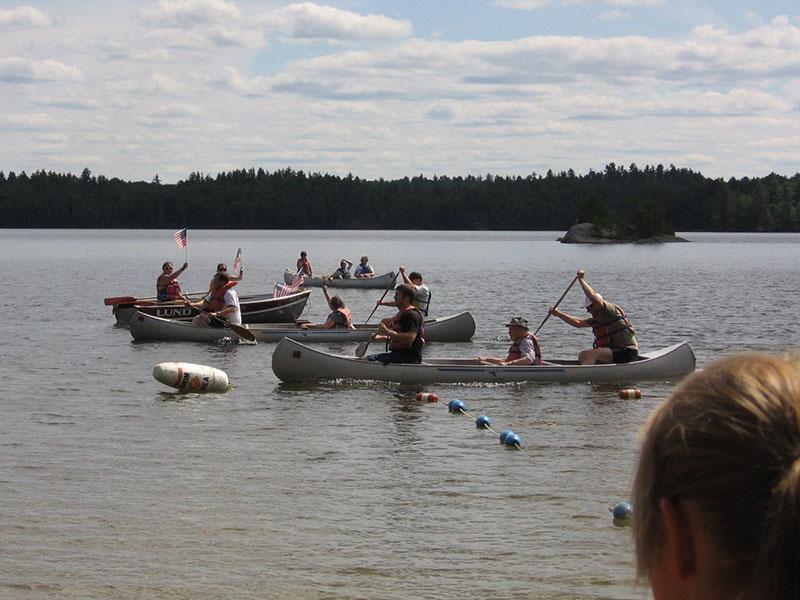
At YMCA Camp du Nord, their legacy took a more outdoorsy form. Murray helped with the purchase and development of Pine Pointe. In 2006, he and Ruth arranged a planned gift that would support the camp’s future, including its infrastructure. His daughter Jan remembered someone who thought ahead to maintenance, when new buildings would need attention.
In 2008, the couple celebrated their 60th wedding anniversary at camp, seated in separate canoes surrounded by family during the triathlon. The later family account leaves the winner unresolved. For once, an enterprise associated with Murray Harpole could finish without anyone needing to produce a performance table.
He died on May 16, 2011, aged 89. His years after corporate leadership had included service to education, the YMCA, Rotary and his church. The range makes a certain sense beside the rest of his life. There was always another institution with work to do, another place where experience could be useful.
Pentair marks its 60th anniversary in 2026. The company’s official history still begins with five founders and balloons before following its later moves toward water. Harpole’s own story continues elsewhere, too: in engineering support, a campus fountain and provisions for future summers. After so many changes of course, he left people several ways to carry on.