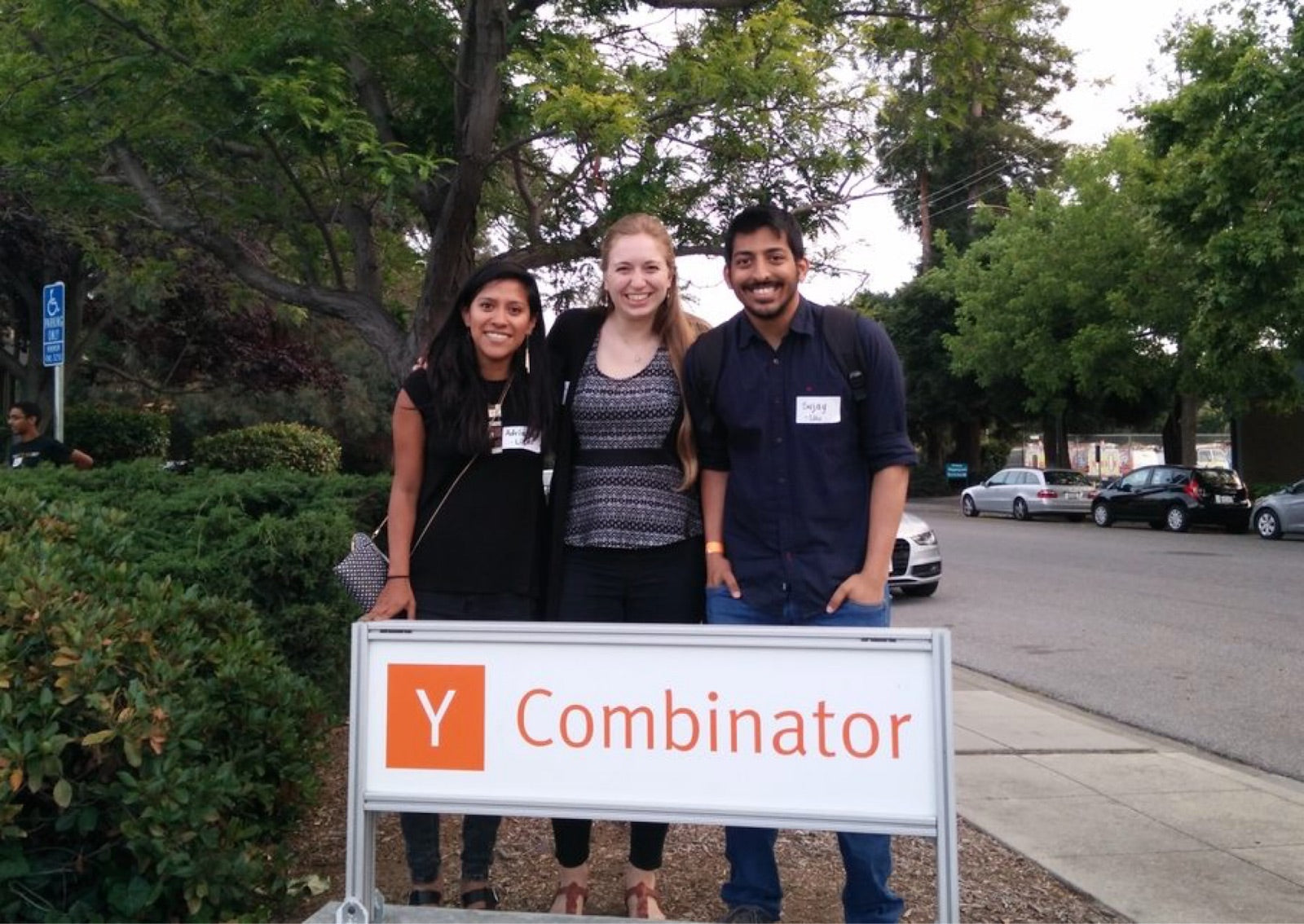
There is a photograph of Sujay Suresh Kumar outside Y Combinator that offers a pleasantly ordinary view of a startup’s early days. He stands beside his co-founder, Adriana C. Vázquez Ortiz, and a fellow founder. There are trees, parked cars, backpacks and name stickers. The sign gets rather more space than anyone’s business plan. Sujay is smiling. Whatever the future holds, it has yet to insist on a proper headshot.
Lilu received a Y Combinator Fellowship in 2016. In the photograph, the company still fits comfortably into a small gathering on a pavement. It is an appealing place to begin his story because so much of what followed involved getting out of the room: leaving the university setting, working with manufacturers in China, and bringing other people into decisions that an engineer might otherwise make alone.
Sujay is now Lilu’s co-founder and co-CEO, alongside Adriana. His career includes electrical engineering, product development, manufacturing and company leadership. Those descriptions sound tidy when arranged beneath a name. The interesting part is the movement between them. A circuit design, a university project and a production operation ask different questions of the person responsible. His working life has taken him through all three.
The two years he spent in Shenzhen give that movement a useful scale. This was a sustained period working closely with manufacturers and evaluating suppliers. An idea can cross a border in an email. Learning how to have it made takes considerably longer. For Sujay, the factory belongs in the biography as much as the university does.
Circuits, a network, and a city called Hyderabad
His formal engineering education began at Osmania University in India, where he studied electronics and communication engineering from 2009 to 2013. He later attended the University of Pennsylvania, completing a master’s in electrical engineering in 2016. Between those institutions lies the outline of a career that became international before Lilu had a finished product.
At Penn’s High Energy Physics Group, he designed circuits for the ATLAS experiment at CERN. That is a specific contribution to a large scientific collaboration: circuit design. It places him among the engineers whose work supports an experiment far larger than any individual component. The distinction matters. A celebrated institution makes a handsome line in a biography; the actual task tells us what he knew how to do.
He also worked at Reliance Jio Infocomm as part of the team involved in launching 4G in India. Here, too, his experience was inside a collective undertaking. Particle physics and telecommunications have different purposes, but both put individual technical work into a wider system. The circuit has neighbours. The network has users. Engineering acquires consequences beyond the desk where it begins.
There was another undertaking in Hyderabad. Before Lilu, Sujay co-founded Jyothi, a nonprofit concerned with women’s rights and safety. His public account describes a platform for anonymous complaints and campaigns and self-defence workshops in schools. It is an early example of his interest in making a practical response to a problem beyond his own immediate experience.
These projects give his later career some continuity without requiring a story of destiny. He had worked on electronics, participated in a large technology rollout and organised around a civic concern. At Penn, those experiences met an opportunity to build with someone whose training complemented his own. The partnership would become the enduring arrangement.
Two graduates, one company, many opinions
Adriana came from Mexico; Sujay came from India. They met during their graduate studies at Penn and worked together on robotics projects. Her background included mathematics with computer science at MIT and a master’s in integrated product design at Penn. His was electrical engineering. In 2016, the shared project became Lilu.
There is a useful difference between having complementary credentials and sustaining a working partnership. Credentials can be written down once. A partnership has to survive the next decision. Their description of working together emphasises candid discussion and a willingness to question assumptions. Ideas are examined before they move forward. That sounds less theatrical than a founder’s flash of inspiration, and rather more helpful on a Tuesday.
The company’s early research included a survey posted to a Facebook group that drew more than 600 responses overnight. Consider that moment purely as a product-development event. Two people had a concept; hundreds of others suddenly had something to say about it. The project could no longer be understood only through the inventors’ own preferences.
Their work also brought advisers from disciplines outside the founders’ training. Lilu’s early circle included design, apparel, supply-chain and marketing experience. Those are different kinds of expertise, and a physical product gives each one a vote. Something must be designed, made, explained and delivered. The technically clever part cannot perform all those jobs by itself.
Sujay has spoken explicitly about the importance of diversity in the room where decisions are made. Read alongside the company’s mixed advisory network, that position has a concrete organisational meaning. A founder chooses who can challenge a plan before customers have to live with it. The people admitted to that conversation help determine which assumptions survive.
He describes the company in communal terms. “It takes a village,” he says. The image is apt for a partnership that expanded into a network of specialists and supporters. It also gives the co-CEO title some texture. Sharing leadership means another person remains beside you when the pleasant simplicity of an early idea gives way to the business of running it.
“It takes a village.”Sujay Suresh Kumar
Shenzhen was part of the job description
Sujay spent two years in Shenzhen working with manufacturers to bring Lilu’s first physical product to market. That is the most revealing interval in his career. It connects the engineer who can design something with the operator who has to arrange for it to exist beyond a single prototype.
Manufacturing gives an invention a second education. A prototype establishes that a thing can work under a particular set of conditions. Production asks whether it can be made repeatedly. A supplier relationship introduces another organisation’s capabilities, priorities and constraints. These are general realities of building hardware, and they explain why Sujay’s time on the ground deserves more than a passing mention.
His own professional description places product management beside microcontrollers and business strategy. It is an unusually compact account of the territory a hardware founder must cover. The component, the customer decision and the company decision sit close together. A change in one can require an answer from the others.
The Shenzhen chapter also changes how the Y Combinator photograph reads. The early fellowship was one stop in a longer process. The company subsequently received support through programmes and competitions, including NSF National I-Corps in 2017. Its history lists NSF SBIR Phase I support in 2021 and Phase II in 2023. The sequence extends across years rather than a single burst of attention.
A timeline makes that duration visible. There is room between the milestones for the work that usually disappears from a short founder biography. The dated entries record participation and support; they do not turn the intervening years into a smooth ascent. Their value is more modest and more useful: they show that the enterprise continued to develop after the first photograph was taken.
Company milestones, rather than personal awards.
A shared title, and a door left open
In 2022, Sujay was named to Forbes’ 30 Under 30 Asia list. He responded publicly by thanking Adriana, describing her as both co-founder and mentor and sharing credit for the recognition. It is a small but telling detail in the way he presents success. The award arrived under his name; his explanation brought another person into the frame.
His career record dates the co-CEO role to January 2023, following a chief operating officer role beginning in May 2020. The progression gives the manufacturing chapter an organisational counterpart. He moved through responsibility for operations into shared company leadership while remaining a co-founder of the same business.
The public-facing work has widened, too. A November 2022 appearance on The CEO Talks gave him a 34-minute podcast conversation rather than a brief biography. In September 2024, he announced a panel appearance at DTC Live NYC about building a consumer business. These are occasions to describe the work to people outside the immediate team, each with a different audience.
He now offers mentoring through MentorCruise in product strategy, hardware development, fundraising and grant writing. His explanation is personal: “I mentor because I know how lonely and overwhelming it can be to build something new”. The sentence leaves the polished titles behind for a moment. It recognises that responsibility can feel rather different from recognition.
That mentoring offer closes a circle visible throughout his career. He has worked inside large teams, built a company with a partner, spent time beside manufacturers and credited others when receiving an individual honour. He now makes his experience available to founders trying to navigate decisions of their own.
Return to the photograph. Sujay has a backpack and a name sticker, and he is standing beside other people. It is a perfectly serviceable portrait of a beginning. The career that followed gives it weight: engineering study in India and Philadelphia, work connected to CERN, an extended manufacturing chapter in China, and a company whose leadership remains shared. The distance between an idea and a factory is measured in decisions, relationships and time. Sujay’s story has room for all three.