James Hu moved to Boston without a winter coat. He was taking two years away from medical school to build a company with a friend from Stanford. The idea had received considerably more attention than the suitcase. There is something reassuring about that detail: a person can contemplate years of engineering work and still overlook the weather.
It is a small entrance to a story that now includes an $8.4 million seed round, a Los Angeles headquarters, and two co-founders on the 2026 Forbes 30 Under 30 list. Those later milestones come with numbers and photographs. The missing coat offers a more intimate measure of the beginning. Hu had made a large decision. He still had ordinary things to learn.
Today, he is co-founder and co-CEO of Illuminant Surgical alongside Eldrick Millares. His educational credentials run through Stanford bioengineering and an MD at the University of California, Irvine. Read them in a line and the route looks orderly. Put the events back in sequence and a different picture emerges: school interrupted by a company, a move across the country, then a return to finish what he had started.
A company before a diploma
Illuminant was founded in 2021. The founders’ full-time commitment began in January 2022, in Boston. Keeping those two dates separate matters. An organization can exist before its builders reorganize their lives around it. For Hu, that reorganization included time away from a degree he had wanted to complete since childhood.
The title attached to him today combines several identities. Engineer. Doctor. Founder. Executive. Each sounds like a completed chapter. His experience shows how much of a career happens while those chapters are still open. The company was already taking shape while his formal education remained unfinished. He would eventually have to make room for both.
A detour is easy to admire once the traveler returns with something to show for it. At the point of departure, it is simply a decision with consequences. Hu’s move meant exchanging a familiar educational timetable for the immediate demands of a young organization. There was no ceremony for that exchange. The graduation ceremony would come later.
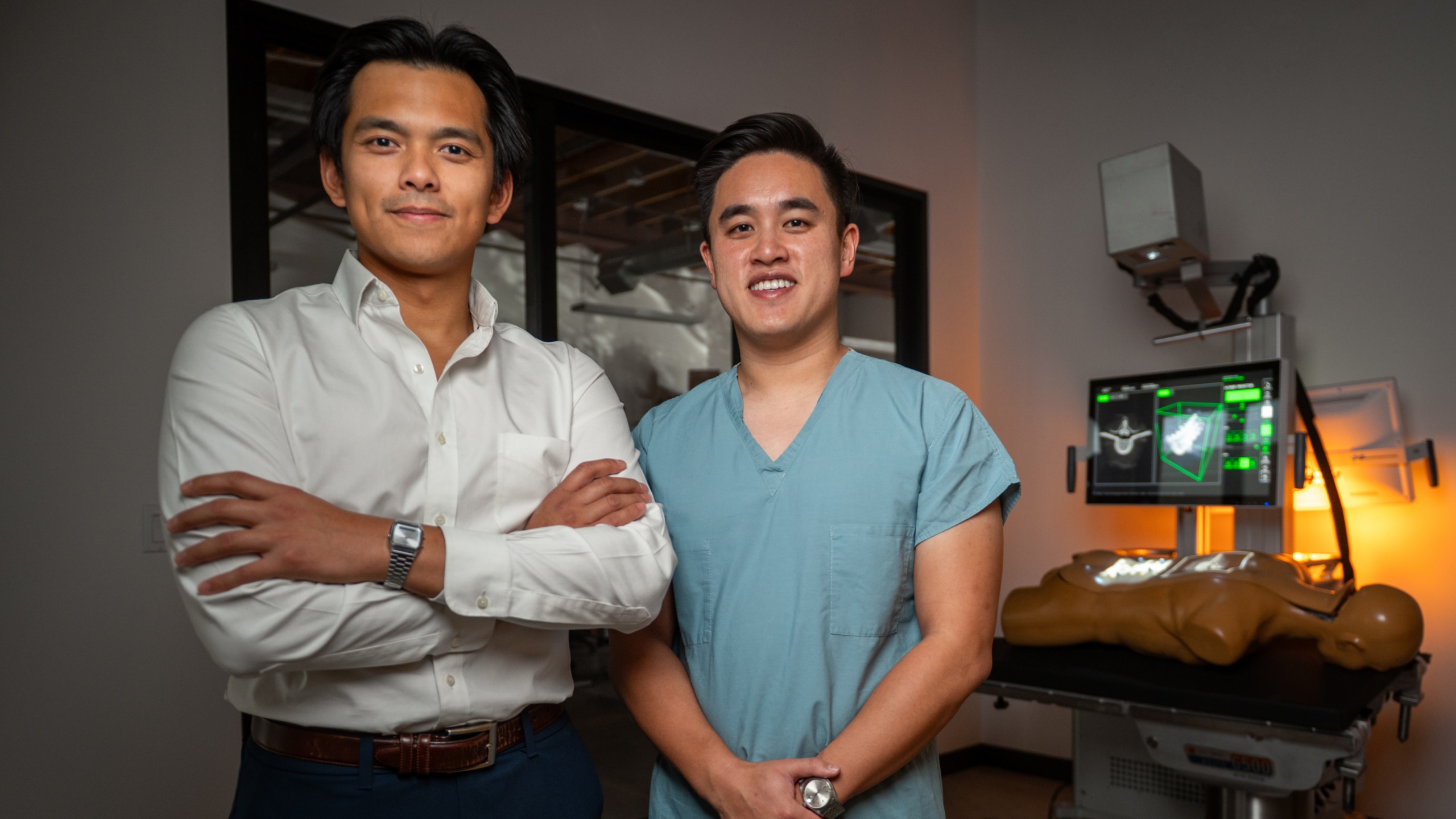
The friendship before the firm
Hu and Millares met as freshman dormmates at Stanford. Long before they shared an executive title, they shared the circumstances of arriving at university. Hu has recalled joking with Millares that they might start a company one day. The joke survived the transition from campus life to professional life.
Their backgrounds gave the eventual partnership different kinds of experience to draw on. Hu studied bioengineering. Millares trained in electrical engineering and went on to work in advanced sensing and at Apple. When they began building together, they brought those histories into the same project. Friendship supplied continuity; their work supplied distinct perspectives.
Millares remembers all-night study sessions and conversations about ideas. He has also described receiving a call from Hu during Hu’s time in school that helped set the company in motion. These are recognizably student beginnings: talking, thinking aloud, seeing whether the other person is interested. The business arrived after a relationship had already had time to develop.
There is a temptation to make the Stanford dormitory sound like an incubator with unusually comfortable seating. It was a place where two people met. The consequential part came later, when a conversation had to become sustained work. Knowing a friend for years and running an organization together are different experiences. Hu and Millares chose to connect them.
A windowless address
By summer 2022, Illuminant was part of Y Combinator’s Summer batch. Hu’s announcement that August thanked early backers, university supporters, and friends who had encouraged him to take risks. It also invited people to see demonstrations at the company’s Cambridge offices, either in person or through a telepresence robot.
That last option has a pleasingly practical eccentricity. An early company needs people to look at what it is building. If they cannot come into the room, perhaps a machine can stand in for them. Even at this stage, the invitation centered on showing the work. The prototype had to carry the conversation beyond an explanation.
Looking back in 2026, Hu described the initial Boston workspace as windowless and scarcely large enough for two desks. He remembered objections about the founders’ inexperience. His account gives that inexperience a complicated place in the story: it drew criticism, but it also allowed them to attempt something they believed they could build.
The room is a useful antidote to the polished language that gathers around young companies. Two desks impose a wonderfully literal constraint. Whatever the ambition, the working day still requires a surface, a seat, and another person close enough to discuss a problem. The earliest version of Illuminant occupied that scale.
“the detours can be where you find your mission.”
James Hu
Finishing what he started
In May 2025, Hu announced that he had completed medical school. He paired the occasion with two photographs taken twelve years apart: an earlier image of himself working in a research laboratory and a later one in his doctoral hood. The distance between the pictures included Stanford, the Boston move, and the years spent building Illuminant.
Returning to California allowed him to resume his degree. He kept working at the company while studying. Millares has described the demanding schedule and the travel between Orange County and the company’s then-offices in Culver City. The geography makes the overlap tangible. These responsibilities did not fit conveniently on the same campus.
Hu’s graduation account included early starts and company calls fitted into breaks. It described the degree as an occasion to recommit to his work. Completing school had become part of the company story rather than a separate achievement parked beside it. He returned to Illuminant carrying the qualification he had left temporarily unfinished.
The episode complicates a familiar entrepreneurial plot. The departure gets attention; the return requires its own kind of resolve. Hu had to reopen an educational commitment after a new organization had begun making claims on his time. The diploma records the fact that he finished. His chronology records the work of coming back.
The distance between two desks and a factory
On April 30, 2026, Illuminant announced an $8.4 million seed round led by Wing 2 Wing Ventures. The company also described its new Los Angeles headquarters: 12,000 square feet, with research space and pilot manufacturing under one roof. The two-desk room had acquired a rather substantial successor.
A bigger address matters here because the work involves physical equipment. Hu’s early account includes sketches on napkins and prototypes made with things available to buy on Amazon. An early version can establish that an idea deserves further work. A manufacturing operation asks how that work can become repeatable, with colleagues responsible for different stages.
The Nexus opening made that transition visible. In its June account of the ribbon cutting, Illuminant described more than 130 guests, including friends, family, advisors, and investors. Alongside the headquarters and fundraise, the occasion celebrated completion of the company’s first production-equivalent units. It was a party with an unusually specific reason for assembling.
The photographs also widen the frame. Hu and Millares stand with colleagues beside the equipment. A personal story about a founder can narrow until every development appears to be an individual accomplishment. This picture restores the people required to carry an organization beyond its first room. The ribbon stretches across a group.
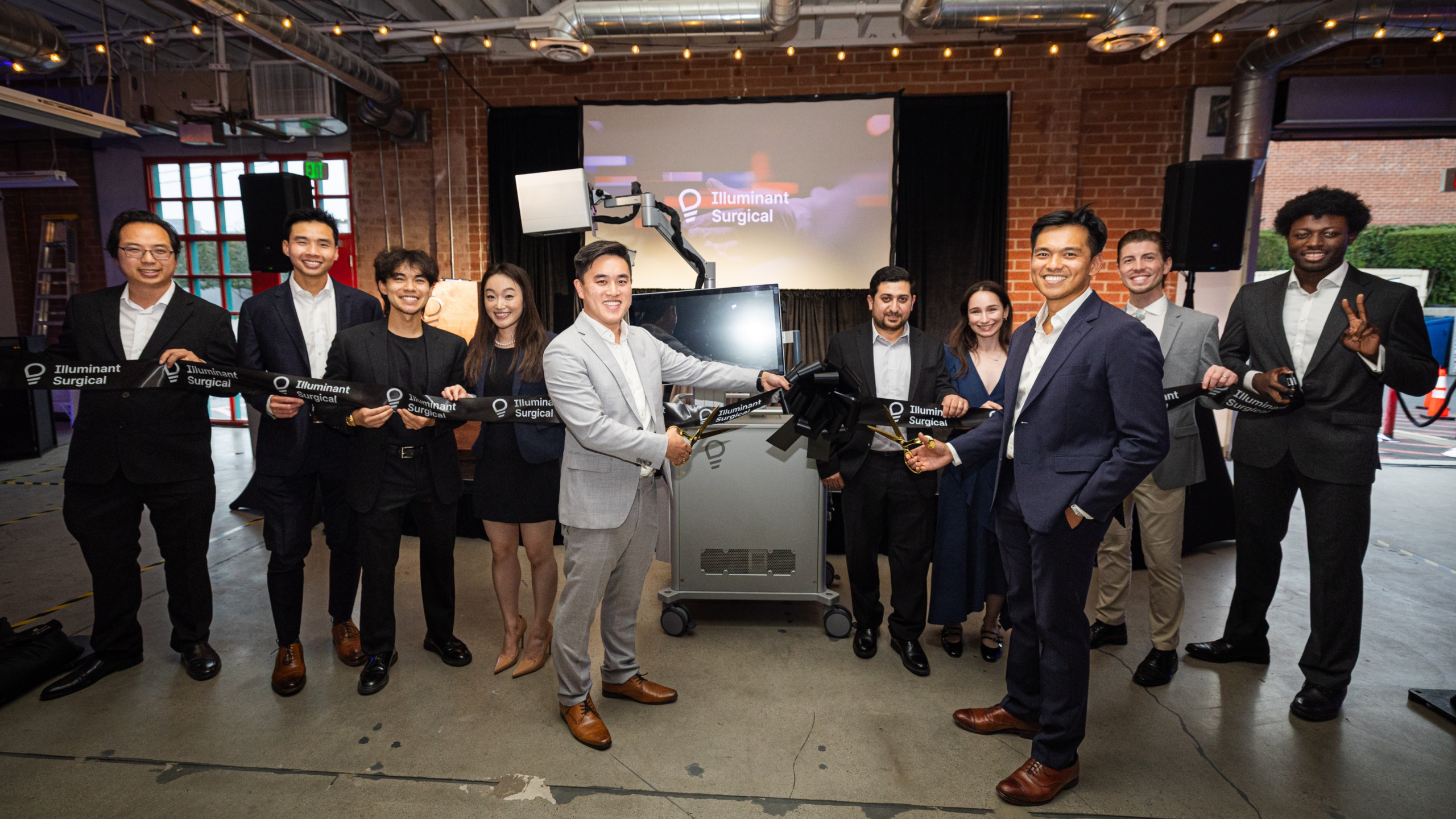
April 2026
Los Angeles headquarters
Back in the rooms where it began
The company’s public milestones have taken Hu into other rooms, too. He presented Illuminant’s work at NVIDIA GTC in March 2026. In December 2025, the company announced that both founders had been recognized on Forbes’s 30 Under 30 list. Such occasions give a young business an audience beyond the people already involved in building it.
There is also a return to Stanford. Its Biodesign technology showcase lists Hu and Millares as former students who came back to give keynote remarks. The setting brings their trajectory into focus: two people who once belonged to the student audience now discussing a company that grew out of their subsequent experience.
For Hu, those appearances sit alongside an older image of himself at a laboratory bench. The boy in that photograph, the undergraduate meeting his dormmate, the founder in Boston, and the graduate in California belong to the same biography. Their activities changed. Some commitments endured long enough to acquire new forms.
His public thanks make the relationships visible as well. In the early Y Combinator announcement, Hu named friends, teachers, and supporters who had encouraged the attempt. The record of the company therefore begins with more people than the two founders. Some offered guidance; others offered encouragement or backing. Their presence helps explain why the later opening brought together a mixture of colleagues, relatives, advisors, and investors. Different people had participated at different points. The shared occasion gave those separate contributions a place in the same room.
The next chapter will have its own dates and measurements. For now, the revealing details are already in the record: the friend who became a co-founder, the school he returned to finish, the cramped room, and the team at the ribbon. Before the larger address and the public recognition, Hu made a decision to go. Boston could supply the weather. He would have to supply the coat.
Follow the next chapter
James’s posts, company news, and campus appearances.
- James Hu on LinkedIn
- Hu’s graduation reflection
- Illuminant Surgical
- Y Combinator company profile
- The Nexus opening
- Seed round announcement
- Co-founder recognition
- A conversation about the early years
- Stanford Biodesign showcase
- NVIDIA GTC keynote video
- Illuminant on Instagram (company)
- Illuminant on X (company)