Matthew Kalmans went back to school with a company for the class to pick apart. In April 2026, he described returning to Harvard Business School, where 140 MBA students were debating the Applecart case. Beside him was early investor Jennifer Scott Fonstad. The subject was a business he had helped start thirteen years earlier, while he was still an undergraduate at Penn.
There is a pleasing reversal here. A student encounters an idea in a classroom, builds a company around it, and eventually becomes part of the assigned reading. The seminar has acquired customers, employees and a financing round. The person who once took notes can now explain which decisions were considerably less obvious before they appeared on a teaching board.
Kalmans called the experience surreal. He also described an almost 300-person company, a long way from the dorm-room beginning. The numbers matter, but the classroom offers a better entrance to his story. Applecart grew from a question about how people influence one another. Kalmans’s own progress has depended on a professor, a fellow student, a durable partnership and people willing to take an early bet.
The summer that supplied a co-founder
Kalmans and Sacha Samotin met one summer as undergraduate research assistants to Penn professor John DiIulio Jr. In an introductory political-science class, DiIulio had introduced research on voter participation. The finding that caught their attention concerned social pressure: people’s behavior could change when the appeal involved others around them.
The attraction was its reach beyond an election. A voter has friends, colleagues and neighbors. So does a chief executive. A formal title does not eliminate the habit of listening to someone whose judgment you value. For two students thinking about persuasion, that was a business question waiting to happen.
Applecart was founded in 2013. Its starting point was political work, an arena where the person being persuaded, the action being requested and the deadline can all be unusually specific. The company would later bring its approach to business decision makers. The continuity was the attention paid to relationships.
Much founder mythology treats education as something to escape. Kalmans’s story gives it a continuing role. Academic work supplied an idea, a collaborator and a way to think about behavior. The company did not require him to forget how it began in order to grow.
“We are constantly reading academic papers to get ideas on how to do things better.”
Matthew Kalmans, 2016
That remark is revealing because it describes work rather than a personality. Reading was part of refining the business. Research could suggest a better method; commercial experience could show whether the method was useful. For a company selling persuasion, the willingness to keep studying is a sensible form of maintenance.
A campaign has names on the call sheet
Early Applecart work made the idea tangible. During the 2016 presidential campaign, the company worked with the super PAC supporting John Kasich. Its approach included identifying people whose connections could help reach persuadable voters. Volunteers received call sheets organized around who people knew.
The premise was easy to grasp without understanding the underlying models. A campaign can tell you its candidate is worth considering. Someone you already know can make the same suggestion, and you may give it a different hearing. The relationship supplies context that a slogan has to struggle to earn.
Kalmans was already discussing a broader version of the problem in 2016. Physical neighbors were only part of the picture. Friends, bosses, colleagues and community connections could matter, too. Applecart’s task was to make those relationships useful to a campaign or organization trying to get a message heard.
The distinction between reaching someone and persuading them remains essential. An advertisement can enter a person’s field of vision without entering their thinking. A mapped relationship gives a marketer another route to attention. The person at the other end still has a choice. The company’s proposition concerns access to that conversation.
The business behind the business idea
A founder can have an elegant theory and still need someone to sell it, deliver it and keep the accounts in order. Kalmans’s role covers that territory. He oversees Applecart’s sales, marketing, client success, finance and business operations. Samotin’s responsibilities include product, engineering, talent acquisition and human resources.
The division gives their shared title some practical meaning. Co-CEO can sound like an invitation to hold every meeting twice. Here, the published responsibilities show distinct areas of work. One side builds and develops the product; the other has to connect it with customers and operate the business around it.
In a December 2021 interview aimed at legal marketers, Kalmans described a concrete starting point: a firm supplies the names of the general counsel at prospective clients it wants to reach. Applecart identifies those people and maps relevant relationships. The audience begins with the business objective, rather than a broad demographic category.
He also recommended promoting credible material, such as coverage of a case, to that audience. For a lawyer hoping to interest another lawyer, an account of actual work offers something to consider. A display ad announcing excellence has rather more competition, including every other display ad announcing excellence.
The same discussion acknowledged the mechanics of advertising platforms. Many require an audience larger than a single individual. Reaching a decision maker and a defined group around that person makes the approach usable within those constraints. It is an operational explanation, and it suits the part of Applecart Kalmans runs.
The early bet that stayed in the room
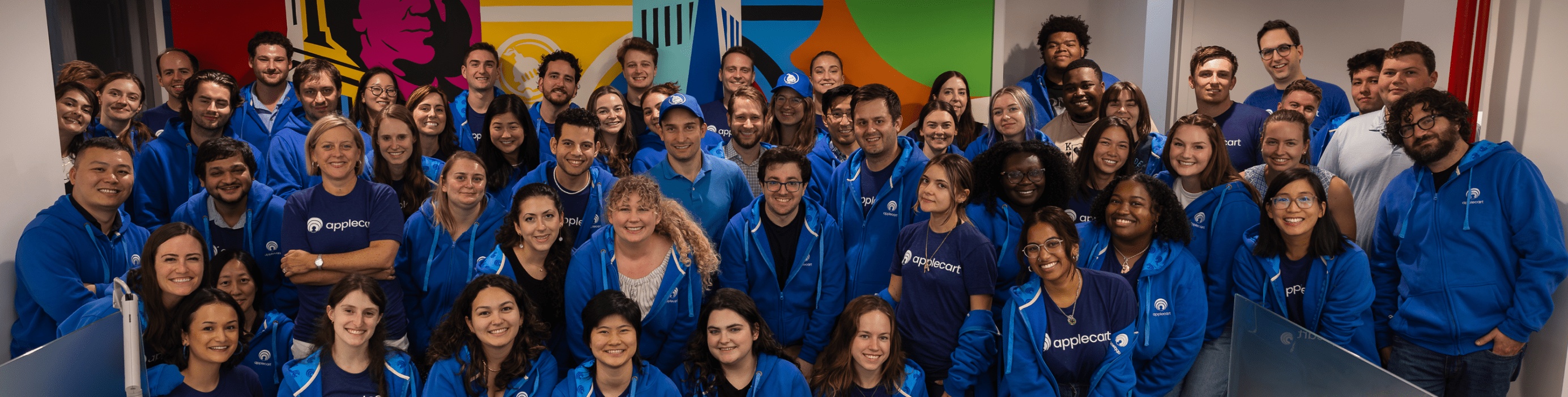
In 2018, Endeavor invested in Applecart and Ariel Emanuel joined its board. Kalmans and Samotin were in their twenties. Kalmans later recalled a company with roughly 50 employees and no enterprise customers at the time Emanuel came aboard.
His 2026 reflection on Emanuel focused on dependability. The entertainment executive had commitments to large businesses and prominent people, yet continued making time for Applecart. Kalmans singled out the habit of doing what he said he would do. In a business built around influence, that is a fairly useful definition of an influential relationship.
Recognition followed. Kalmans and Samotin appeared on the 2021 Forbes 30 Under 30 list for Marketing & Advertising. The profile described a platform helping advertisers reach valuable business decision makers through their personal and professional connections. A student idea had become something corporate clients could buy.
The relationship with Emanuel continued into the next funding chapter. Applecart announced a $100 million Series C minority investment from Blackstone Growth on January 28, 2026. The announcement also brought Blackstone and communications adviser Risa Heller into the board picture. Emanuel remained.
Blackstone Growth minority investment announced by Applecart.
Kalmans’s own announcement supplied a less formal account of the transaction. The founders had known Blackstone for nearly a decade. He credited Alex Katz with the introduction and emphasized the attention Blackstone’s senior leadership gave the company before investing. A financing headline compressed years of acquaintance into one number.
He thanked employees and early investors, including Emanuel and Fonstad. He also thanked clients. A customer bets on a company whenever it gives that company a consequential piece of work. Kalmans’s phrasing made that relationship explicit.
“You are the ultimate investors in our business.”
Matthew Kalmans, addressing Applecart’s clients in 2026
Questions for people who make decisions
Kalmans’s interest in decision making has also produced conversations rather than campaigns. He and Samotin host Decision Makers, a podcast featuring leaders in business, government and media. The opening episode, released in May 2024, featured Sean Patrick Maloney.
Later guests included Ken Mehlman, Kate Bedingfield, Steve Israel and Jim Wilkinson. Their careers cross campaigns, public service, communications and private business. The program’s stated interest is how they reached senior positions and what they learned there about making decisions.
There is an apt pairing between the podcast and the company. Software can map a network; a conversation can ask someone how a career unfolded inside one. The two activities produce different kinds of knowledge. Both keep the human being in view, which matters when job titles make everyone sound like an institution.
Kalmans appeared with Axios co-founder Roy Schwartz on K Street Capital’s High Stakes in May 2023, discussing technology, communications and influence. He and Samotin also joined Morning Joe in May 2021 to discuss New York’s mayoral race. His public work has continued across the political and corporate worlds that shaped Applecart.
A few things outside the pitch
There are quieter details, too. Kalmans’s biography places him on Manhattan’s Upper West Side with his partner Audrey. It describes him as godfather to two goldendoodles and pursuing New York’s pizza joints and Jewish delis. These are excellent subjects on which to accept a trusted recommendation.
His connection to Penn continues through a non-resident senior fellowship at the Robert A. Fox Leadership Program. He is also a member of the Arthur W. Page Society. Back in 2014, he took part in a Penn student program visiting civil-rights movement sites, exploring the relationships between Black and Jewish communities during the movement.
Those details give the story a life beyond fundraising. There is a university he remains connected to, a city to eat his way through, and a working partnership that has outlasted the student years. They are ordinary attachments in a career concerned with unusually consequential audiences.
Back to the board
The Harvard return brings those threads together. In 2025, Kalmans watched students grapple with challenges Applecart had confronted. He joked about the company’s years as an extended MBA. In 2026, he returned with Fonstad and a longer history for the class to discuss.
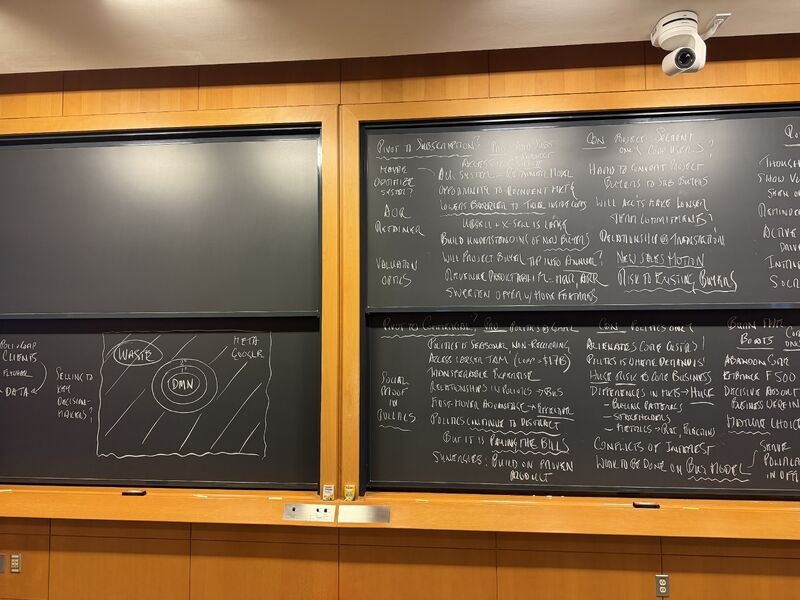
The classroom photograph he shared shows boards crowded with observations. A company that began with students examining research had become a subject for students examining a company. The reversal is satisfying because it leaves the education open. Applecart’s next choices still have to be made before anyone can teach their consequences.
Kalmans and Samotin have said they want the business to become an indispensable resource for executives managing important stakeholder relationships. That ambition will require more of the work already visible in his career: studying a problem, finding collaborators, earning customers and sustaining the relationships behind a business. Somewhere along the way, there should also be time for lunch.