The Sydney lawyer who kept getting the same question in agency meetings, and decided the question was the business.
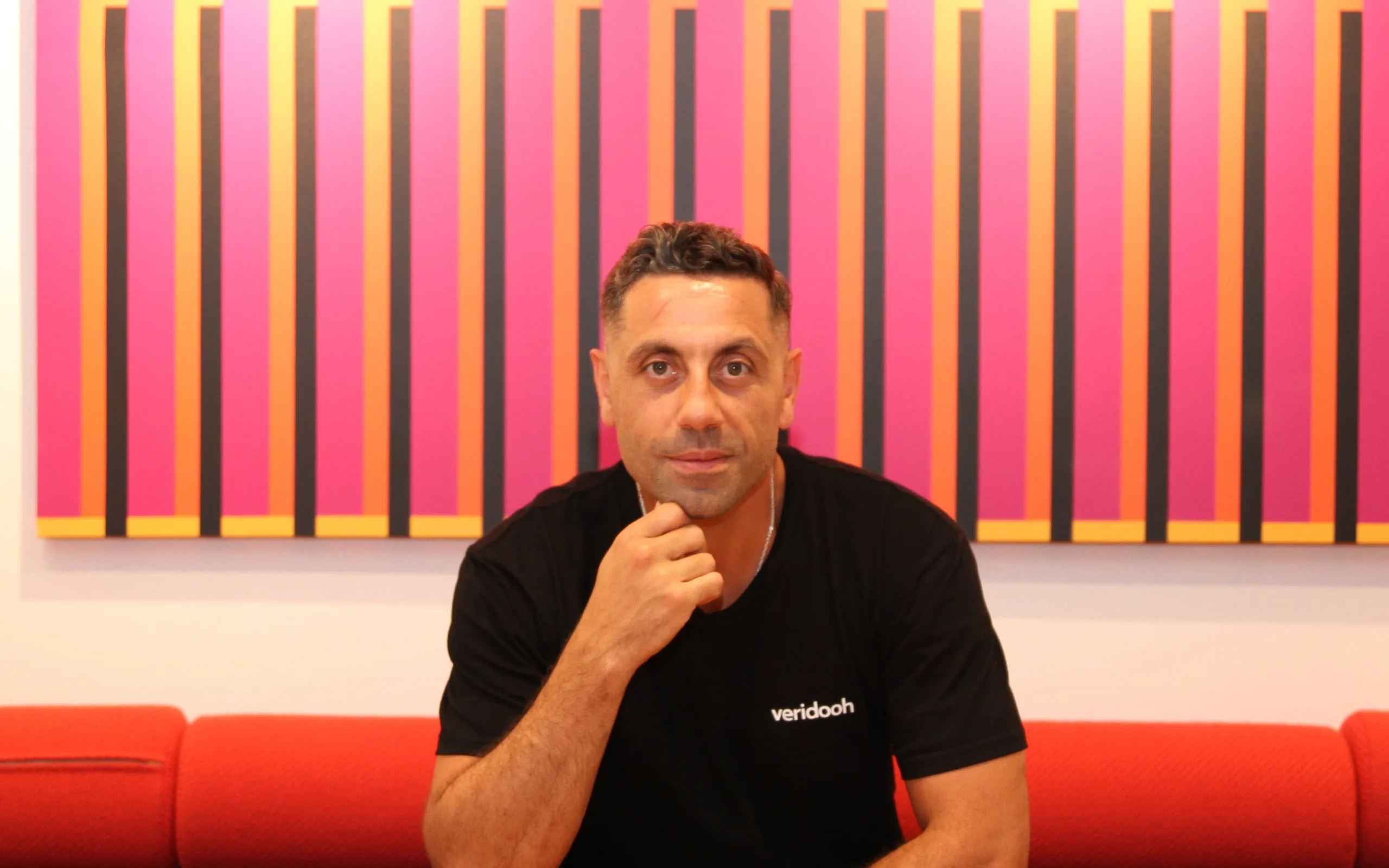
Every out-of-home advertising pitch used to end with the same handshake and the same silence. The brand paid for a billboard. The media owner reported that the billboard ran. Nobody in the room could actually prove it. Mo Moubayed, co-founder and co-CEO of Veridooh, spent enough afternoons inside that silence to build a company that fills it in.
Veridooh was not the plan. In 2017 Moubayed met a co-founder named Jeremy Yang and the two of them started sketching a digital out-of-home network, essentially screens on top of vehicles that would drive around Sydney playing ads. It is the kind of idea that sounds inevitable in a pitch deck and slightly ridiculous in a car park. They took the deck to media agencies. The agencies were polite. The agencies were also confused about something else entirely.
The something else was a question. It came back in every meeting, sometimes phrased carefully, sometimes phrased with real frustration. How do I know if my ad actually played? A media buyer would show Moubayed a spreadsheet of OOH placements the size of a small novella and ask, in effect, whether any of the numbers on the page were connected to physical reality. Nobody had a satisfying answer. There was no independent verification for outdoor advertising, the way there is for digital display, because outdoor was old and outdoor was analogue and outdoor was mostly trust. Moubayed and Yang eventually stopped talking about the screens.
They launched Veridooh in 2019. The pitch was simple and slightly unglamorous. Advertisers pay a company that has no financial interest in the outcome to check whether their out-of-home ads ran, when they ran, and where they ran. It is the kind of product that describes itself in one sentence, then takes six years to actually build. The industry, once it understood what the product was, mostly wondered why nobody had done it sooner.
The bet underneath the company is a media-mix bet. Out-of-home currently attracts about four or five percent of a brand's advertising spend, a number Moubayed talks about a lot. He thinks that with verification, automation, and better measurement, that number can plausibly move closer to eight or nine percent. The mechanism is not clever creative or better inventory. The mechanism is that CMOs will spend more on a channel once it stops behaving like a favour and starts behaving like a receipt.
We're building something that has never been built before: a truly independent, digital and data-driven verification platform for OOH media. — Mo Moubayed, on Veridooh's founding thesis
Moubayed went to the University of Sydney and, on the recommendation of a career path that has produced roughly nine out of every ten Australian founder biographies, went into law. He worked at PwC. It is easy to imagine the version of his life where he stayed there. He didn't. Around 2013 he stepped out of the legal world and into entrepreneurship, a switch he has described as more temperamental than dramatic. The law suited some of his instincts, chiefly the interest in structure and precision. It suited fewer of the others.
The Yang partnership came a few years later. Yang runs the product and engineering side of Veridooh. Moubayed runs growth, strategy and partnerships. The co-CEO structure has held through Series A, through the pandemic, through the UK launch, and through a company move from a single Sydney office to a multi-hemisphere operation. Moubayed relocated to London in 2023 to run the UK expansion. He now splits his time between London and New York. The company is still headquartered in Sydney because the company was born in Sydney and, in Moubayed's telling, the Sydney team is the reason the UK launch worked.
He is, by his own account, unusually deliberate about time. His London workdays run in three timezone slices: an early Sydney window that starts at 7am UK time, a UK standup mid-morning, external meetings and deep-work blocks through the afternoon, and a New York overlap that leaks into the evening. He tries to move exercise, meditation and family time around this scaffold rather than fitting them in afterwards. He has said, in a way that is unusually honest for a founder profile, that the equilibrium is not permanent. Some days lean toward work. Some days lean toward life. He does not pretend the scale is level.
We are all striving for equilibrium, but at any one point in micro time you may be leaning more towards work or life. — On the founder's schedule
Digital display, search, social - they all report back. Outdoor traditionally reports back through the media owner's own system, which is a bit like asking the fox to grade the henhouse. Veridooh sits outside that loop.
Moubayed talks less about winning verification market share and more about growing OOH's overall share of media spend. If OOH goes from 5% to 9%, everyone in the category wins. Including him.
Veridooh has not tried to be the fastest company in adtech. Moubayed prefers a sustainable scale — Sydney first, then London, then New York, one market educated at a time.
The Moubayed-Yang split is real: one runs growth and partnerships, the other runs product and engineering. The company has held that structure through Series A and a global rollout.
The whole moat is neutrality. Veridooh does not sell OOH media. It sells confidence in OOH media. That is a boring line and also the entire business model.
The most useful thing Moubayed did as a founder was stop selling the screen network and start writing down the question the agencies kept asking.
Out-of-home can start to demand more spending from advertisers, rather than just the 4% or 5% we're currently seeing today. — On the media mix
"If we can overcome this minimum standard that CMOs are demanding, be it independent verification, then the out-of-home industry globally could be on a better playing field."
"We're always interested in other markets that are also interested in us. If a market interests us, it might make us move there faster."
"Nick has played an outsized role in bringing this ecosystem together. His passion for innovation is intoxicating." — on Nick Parker, Veridooh's Global President
Asked which author he'd most like to read on the subject of work-life balance, Moubayed picked Muhammad Ali. Not a business book. Not a productivity book. Ali.
A typical day starts with Sydney at 7am UK time, breaks for the UK team at 10, spends the afternoon on external calls, and closes with New York overlap.
He points to Nick Parker, Veridooh's Global President and former Global COO of Kinetic Worldwide, as the person whose network helped make Veridooh's category-building push possible.
Wake at 6am. Meditate or walk. Then the Sydney calls start.
Functional weights or yin yoga tend to close the workday before the second wind of New York overlap kicks in.
Despite Moubayed's move to London and the New York hires, Veridooh's centre of gravity remains its Sydney HQ.
He is the co-founder and co-CEO of Veridooh, an adtech company providing independent verification for out-of-home advertising.
A Sydney-headquartered adtech company that offers the first independent verification and campaign automation platform for OOH and DOOH media, with offices in London and New York.
He splits his time between London and New York while Veridooh remains headquartered in Sydney.
He began his career as a lawyer at PwC before moving into entrepreneurship in 2013.
Moubayed and co-founder Jeremy Yang originally pitched a digital screen network in 2017. Agencies kept asking how they could verify whether OOH ads actually played, so the founders pivoted and launched Veridooh in 2019 to solve that problem.