In 1991, Henry Nicholas and Henry Samueli started a semiconductor company in a spare bedroom in Nicholas’s Redondo Beach condominium. Each put in $5,000. Their intended territory was rather less modest than their office. Broadcom would build the chips that let information travel between devices, through cable networks and into homes. A television cable, previously employed to deliver television, was about to acquire a second profession.
Nicholas’s career is usually told through the money that followed. The more revealing question is what he kept trying to make happen. At Broadcom, he wanted voice, video and data to move through an increasingly connected world. Later, he wanted crime victims’ families to receive information the courts had failed to give his own family. In Santa Ana, he helped fund places where students could get the advice and practical support required to enter college.
These projects differ in their methods, consequences and politics. They belong together in his biography because each begins with people trying to get somewhere and a system standing between them and their destination. Nicholas has spent much of his public life financing a way through. The results include a chip company, a contested campaign for constitutional amendments and an after-school program whose celebrations come with a bell.
Two Henrys, one spare bedroom
Henry Thompson Nicholas III was born in Cincinnati in 1959. He grew up partly in Southern California, attended the United States Air Force Academy and went on to study electrical engineering at UCLA. Before Broadcom, he worked at TRW and then at PairGain Technologies. His route into business ran through engineering workplaces and graduate research, rather than a sudden discovery that computers might be profitable.
Samueli became his doctoral adviser as well as his business partner. That relationship gave Broadcom a particular sort of foundation: two people who understood communications circuitry and had already worked together. Nicholas took the president and chief executive roles. Samueli led the technical work. The partnership combined a shared subject with different responsibilities, a useful arrangement when a young company needs both something to sell and someone determined to sell it.
Broadcom’s opportunity lay inside the equipment people used, largely out of sight. Cable modems, set-top boxes and networking hardware needed chips capable of moving and processing information. The company pursued several communications markets at once. That breadth was deliberate. Nicholas wanted Broadcom to participate across the connected world, rather than wait politely in one small corner of it.
“We bucked conventional wisdom,” Nicholas said in 2000, explaining the decision to enter multiple markets simultaneously. The figures gave the argument some force. Annual revenue rose from $6.1 million in 1995 to $518.2 million in 1999. The company went public in April 1998. By then, the spare bedroom belonged to a founding story that investors could purchase a share of.
The house wanted its own network
Nicholas took the connected-home idea personally. His Laguna Hills house was wired so extensively that even its ordinary domestic functions became part of a network. He could use the kitchen wall to access the internet and order groceries. The house offered a preview of the future Broadcom was selling: appliances and screens communicating with one another, with the internet beyond them.
It also offered a splendidly expensive setting for a familiar domestic ambition. Most people would settle for finding the remote. Nicholas wanted the whole house to cooperate. The point of this extravagance was not merely decoration. He was living among the kinds of connections his company expected other households eventually to buy.
His working reputation was demanding. Samueli later described him as driven and credited his understanding of technology, finance, marketing, sales and manufacturing. That breadth matters. Nicholas was an engineer running a business whose products had to find customers, arrive in usable equipment and justify their cost. A good circuit could begin the conversation; it could not conduct the entire meeting.
In January 2003, Nicholas resigned as president and CEO, citing family matters. Alan “Lanny” Ross assumed the executive responsibilities while Broadcom searched for a permanent replacement. Nicholas’s departure drew a line under his daily leadership of the company. It did not remove his name from its origin.
“We bucked conventional wisdom”Henry Nicholas, on entering multiple communications markets
A sister’s name enters the constitution
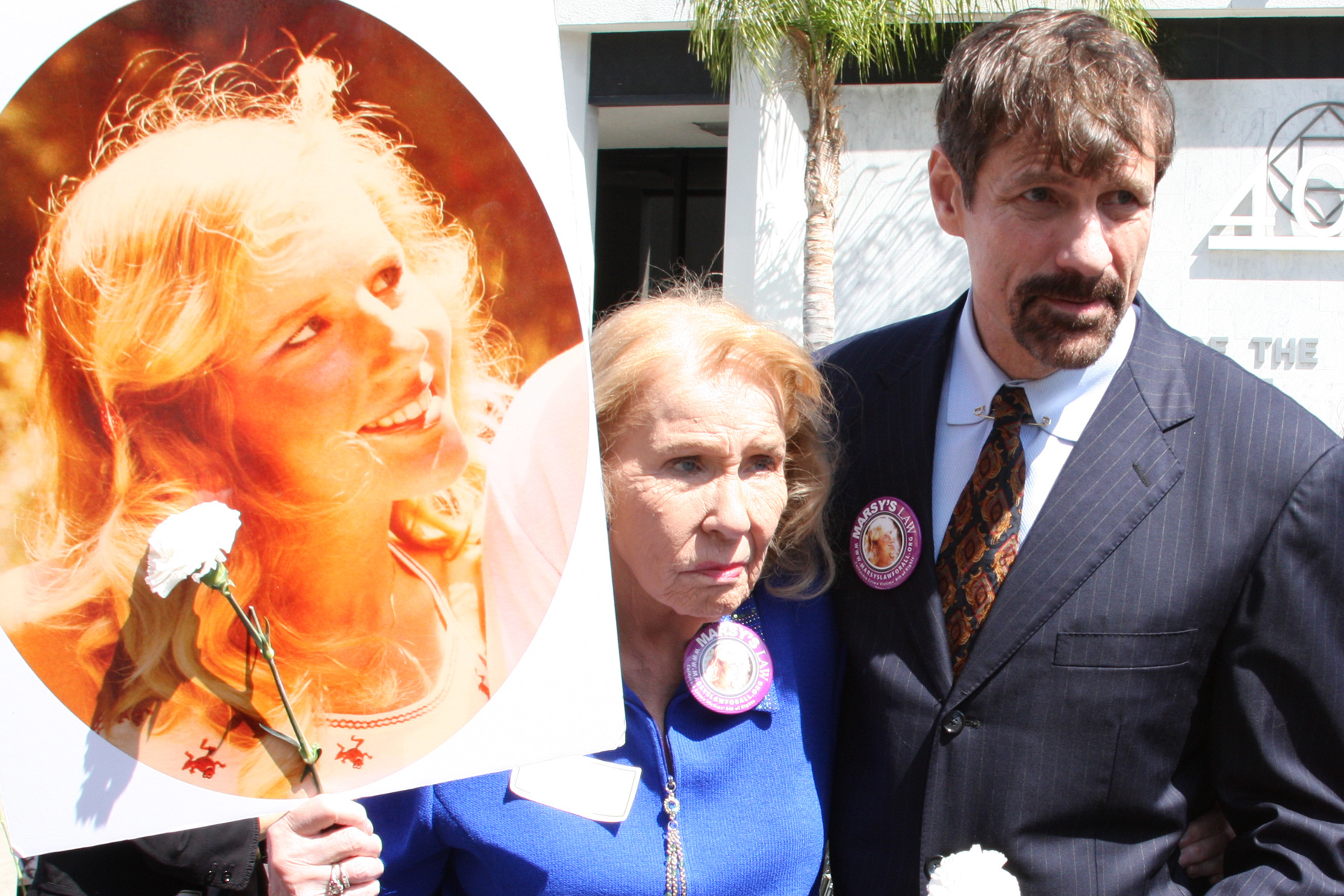
Years before Broadcom, the Nicholas family had suffered a loss that would shape Henry’s public work. In 1983, his sister Marsalee, known as Marsy, was killed by her former boyfriend. She had been a student at the University of California, Santa Barbara. After her funeral, the family stopped at a market. There, her mother Marcella encountered the accused killer, who had been released on bail.
The family had received no notification of that release. The encounter became the central story behind Marsy’s Law: a family could be directly affected by a criminal case yet remain uninformed about a development of immediate importance to them. Nicholas would eventually use his resources to campaign for enforceable rights for crime victims and their families.
California voters approved Proposition 9 in November 2008, placing a victims’ bill of rights into the state constitution. Nicholas founded Marsy’s Law for All in 2009. The ambition expanded beyond California, toward protections in other states and ultimately a federal constitutional amendment. His sister’s first name became the public shorthand for that campaign.
The proposal generated opposition as well as votes. Civil liberties advocates argued that some provisions could conflict with the rights of defendants, particularly access to evidence and the presumption of innocence. Supporters emphasized notification, participation and a voice for victims. The dispute concerns how those protections operate inside a criminal case, where the state has the power to deprive an accused person of liberty.
Nicholas’s family story explains his commitment. It cannot, on its own, settle every question about the law. His political work needs to be understood in both dimensions: the particular encounter that motivated it, and the broader consequences of writing a remedy into constitutions. Campaigns can start with a personal grievance. Once enacted, their language governs people far beyond the family that inspired them.
His own encounter with the courts
Nicholas also became a defendant in the aftermath of Broadcom’s stock-option backdating controversy. Federal authorities brought cases concerning allegations that option grants had been backdated without the required accounting disclosures. Those proceedings put the company’s compensation practices, and the conduct of its former leaders, under scrutiny.
The outcome belongs in the story as firmly as the allegations. In December 2009, the court dismissed the backdating indictment against Nicholas with prejudice. The judge questioned prosecutorial conduct and the sufficiency of the evidence. In February 2010, the Securities and Exchange Commission announced that it would not proceed further with its civil action after the court’s rulings and comments.
A profile reduced to the original accusations would leave out the result. A profile reduced to his charitable projects would leave out the confrontation. Both are parts of the public record. Neither needs to swallow the rest of a career that includes substantial engineering and a lengthy second chapter in education.
The judge’s kids get a place of their own
That second chapter had an experienced partner. Retired Orange County Superior Court Judge Jack Mandel had spent years tutoring and mentoring students whose opportunities were limited by poverty and other restrictions. They became known as “The Judge’s Kids.” Nicholas saw a program worth expanding and partnered with Mandel in 2007.
The first Nicholas Academic Center opened in downtown Santa Ana in January 2008. Mandel entrusted three graduates of his earlier program, Hugo Gutierrez, Rosa Diaz and Rocio Chavez, with creating and launching the centers. Their participation gave the venture a practical inheritance. People who had benefited from the judge’s work helped build its next form.
A second center opened at Valley High School in 2009; a third followed at Century High School in 2016. The work reaches into the details that can determine whether a student’s college ambitions survive an application season. Tutors help with academic subjects. College access staff help match students to institutions, prepare applications and interviews, and navigate financial aid.
The centers also support students after high school. The design recognizes that admission is one stage of a longer undertaking. Arriving at college brings another set of academic and financial demands, and the organization offers services to alumni during their college years. The acceptance letter makes a fine photograph. It also starts another to-do list.
- 2008Downtown Santa Ana
First center opens - 2009Valley High School
Second center - 2016Century High School
Third center
A bell is a rather good progress report
At the centers, students celebrate college acceptances by ringing a bell. During a 2022 visit to Century High School, Santa Ana’s superintendent Jerry Almendarez held it as seniors announced the colleges that had admitted them. Their classmates and staff applauded. This is an unusually direct form of institutional measurement: a student reads the names, then makes some noise.
By June 2025, the graduation gathering had reached its seventeenth year. Nicholas hosted the celebration of 198 graduates, who collectively received 1,736 college acceptances. The organization reported that he had donated $57.7 million to support its three locations. Those numbers describe sustained funding and repeated work across many application cycles, rather than a single ceremonial gift.
The program’s reported results also deserve their proper boundaries. For the class of 2025, it reported that all graduates enrolled directly in college, with 88 percent entering four-year institutions. These are outcomes for NAC participants, not a controlled measurement of what any one donor caused. Students, families, teachers and staff all belong in the account of how they happened.
The connection can last well beyond graduation. Executive director Rodolfo Duarte is himself a NAC alumnus. At the 2025 celebration, alumni Valerie Magdaleno and Lisbeth Rosales addressed the graduates. A program begun with former “Judge’s Kids” helping launch it now has its own former students in leadership and public life. The people served have become part of the people doing the serving.
NAC’s June 2025 report. Acceptances count offers, so one student may receive several.
Later in 2025, Nicholas and the centers redirected resources from their annual Thanksgiving celebration into meal kits for students’ families. The decision was smaller than building a semiconductor company or financing a constitutional campaign. It was also easy to understand: the money could pay for an event, or it could help families have a meal at home.
Nicholas received the IEEE Frederik Philips Award in 2014 for leadership in commercializing communications semiconductors. That recognition fixes one part of his contribution in the engineering record. Another part is recorded in Santa Ana, in applications finished, college places accepted and alumni returning to work with the next class. For a founder accustomed to measuring what gets through a network, the bell supplies a particularly human answer.
Follow the work
Explore the programs, the public debate and the people carrying the work forward.