Nine patents ought to be a satisfying start. For Alok Maskara, they helped produce an awkward question: what good is an invention if it never reaches the customer? Early in his career, the chemical engineer co-wrote patents and watched some of that work fail to reach the market. He described his younger self as a “frustrated scientist.” The problem was interesting enough to change his profession.
“I started thinking about leading a business,” he said. It is a wonderfully practical response to disappointment. Rather than abandon the machinery, he moved toward the people deciding what the machinery would do. His subsequent career took him through consulting, water treatment, advanced materials and, in May 2022, the chief executive’s office at Lennox.
That journey gives the Dallas-based executive a particular relationship with innovation. He knows the pleasure of making something new. He has also spent years dealing with the less glamorous requirements of getting it made, sold and delivered. A patent has a filing date. A customer has a deadline. Much of Maskara’s working life occupies the awkward space between them.
The engineer acquires a second vocabulary
He graduated from IIT Bombay in 1992 with a bachelor’s degree in chemical engineering, then earned his master’s in the same subject at the University of New Mexico in 1994. An MBA from Northwestern’s Kellogg School followed in 2000. The sequence matters: engineering first, management later. The commercial education came after he had learned to think about materials and processes.
His patent record makes the technical background concrete. It includes work on thin-film nanoporous aerogels, silica production and insulation composites. These are fairly unpromising subjects for dinner-party small talk. They are useful evidence that his association with technology began well before it became an executive talking point.
IIT Bombay
Kellogg
Luxfer
Lennox
At McKinsey, where he worked from 2000 to 2004, he advised businesses on industrial turnarounds and growth through customer insights. His work took him to the Chicago and Amsterdam offices. At General Electric, he gained experience in lean manufacturing and later led a water business. The developing skill was translating between the factory and the market, two places quite capable of misunderstanding each other.
Pentair gave him progressively larger operating responsibilities. He led residential filtration from 2008 to 2011, water purification from 2011 to 2012, and thermal management from 2012 to 2014, before heading Technical Solutions. Water, heat, materials: the products changed, while the need to organize people around useful engineering remained.
A customer has no interest in your org chart
In July 2017, Maskara became chief executive of Luxfer, the advanced-materials company. By a 2019 executive interview, he was describing a progression from selling products to supplying solutions and, eventually, organizing around the customer. The language could sound abstract. His examples were anything but: hydrogen systems for London buses and hydrogen applications for forklifts in Amazon warehouses.
The same underlying technology could require very different teams and conversations. He described small groups combining sales, marketing, technical solutions and responsibility for service. Their reporting lines might differ; the customer still expected a coherent experience. Internal efficiency mattered, but a company could scarcely ask its buyers to become experts in its departmental boundaries.
He also placed responsibility for revenue growth with himself. That is a revealing choice for an engineer turned CEO: the commercial result belongs in the chief executive’s job, alongside the technology and the operations. Franklin Electric elected him to its board in May 2021, adding another connection to the water and fluid-systems industries where he had built his operating career.
The eighth name on a long list
Lennox appointed Maskara effective May 9, 2022, following Todd Bluedorn’s 15-year tenure. The company dates to 1895; Maskara became its eighth CEO. That is an unusually short list of occupants for such a long corporate history. The appointment brought an executive from outside HVAC into a business with established products, manufacturing routines and dealer relationships.
Chairman Todd Teske’s recruitment brief combined customer focus, support for employees, technology and innovation. Maskara arrived with nearly a decade of Pentair leadership and five years running Luxfer. He inherited an institution rather than a blank sheet. The work was to decide which habits deserved protection and which were getting in the way.
In his message introducing Lennox’s code of conduct, he links the way employees treat people to the products and services they provide. Integrity, respect and excellence are the company’s stated core values. He also tells employees to raise concerns and describes the company’s prohibition on retaliation for speaking up in good faith. For the engineer now running the institution, the operating system includes how people behave toward one another.
His public description of the early Lennox transformation was disarmingly workmanlike: fix troubled factories, improve pricing, and pay closer attention to quality and the customer experience. Before expansion came repairs. The order is easy to applaud on a presentation slide and harder to maintain when investors would prefer every year to be the expansion year.
“My only goal is to leave Lennox better for the next generation.”
Alok Maskara, 2023
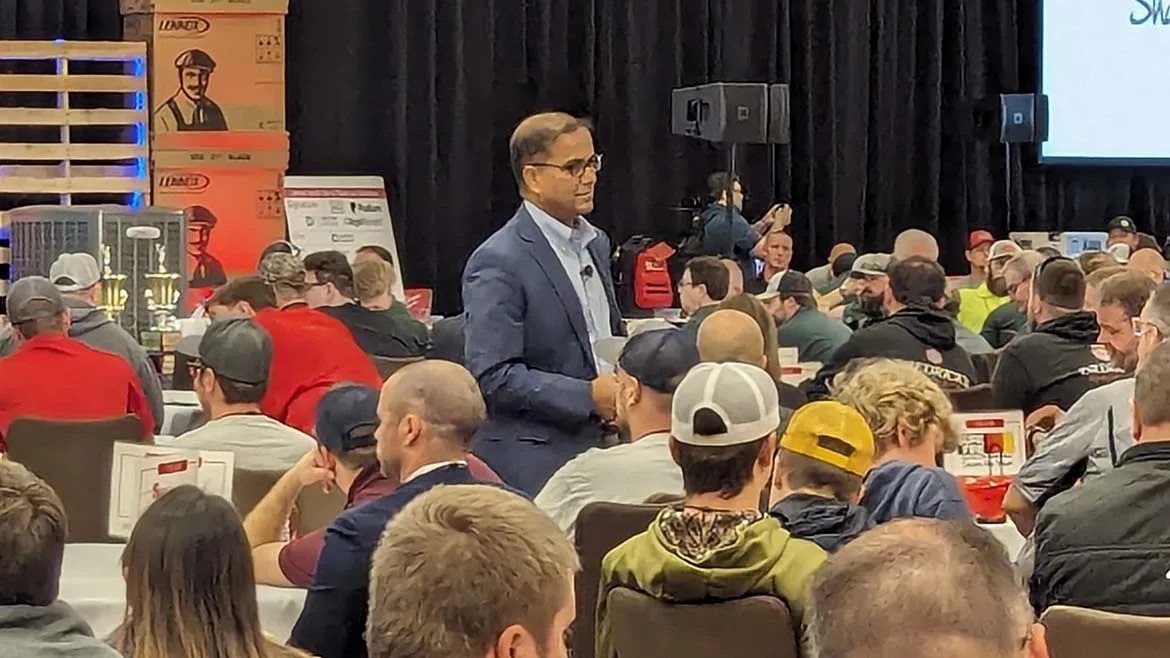
At a 2024 dealer conference in Wisconsin Dells, he addressed around 750 dealers, technicians and students. “One reason I’m here is to establish a mutual trust,” he told them. The accompanying photograph catches him walking through the crowd. For someone whose job includes factories and capital allocation, the room offered a useful reminder of where the equipment ultimately goes.
The distance to the dealer
Lennox’s distribution network is central to the business Maskara is trying to build. Selling through its own network gives the manufacturer a closer relationship with contractors and dealers. In his telling, that proximity helps the company learn what customers need and get technology into their hands. The scientific problem has acquired loading docks, inventory and delivery routes.
The Samsung partnership put a recognizable name on that logic. Announced in May 2024, Samsung Lennox HVAC North America brought together Samsung’s ductless technology and Lennox’s distribution relationships. Samsung owns 50.1 percent; Lennox owns 49.9 percent. Its remit covers ductless air conditioners, heat pumps and variable refrigerant flow systems in the United States and Canada.
The ownership split is less picturesque than a product unveiling, but the arrangement says something about Maskara’s method. An established manufacturer can broaden what it offers by combining capabilities with another company. More choice for the dealer requires an agreement, a route to market and execution after the announcement has ceased to be news.
Lennox joined the S&P 500 in December 2024. Maskara marked the event by crediting employees and partners for their work and adaptability. Index membership was a public milestone. The everyday demands of manufacturing remained stubbornly private: the right part, enough capacity, a dependable shipment, and a buyer willing to order again.
Two markets, one chief executive
By July 2026, those demands were playing out against an uneven market. Lennox reported second-quarter revenue of about $1.5 billion, up 3 percent, and operating income of $355 million. Growth from acquisitions contributed to the sales increase. The total concealed two different experiences inside the company.
Home Comfort Solutions revenue fell from $1,009.3 million to $935.6 million. Building Climate Solutions revenue rose from $491.6 million to $609.7 million. Commercial momentum and acquired businesses helped offset residential softness. Lennox updated its full-year earnings-per-share guidance to $23 to $24. A profile of a chief executive needs room for this part of the job, too: explaining the quarter that refuses to fit a tidy upward arrow.
Expansion continued around that difficult residential market. In June 2026, Lennox announced an agreement to acquire Heat Controller, whose Comfort-Aire and Century brands serve distributors across North America. The July results subsequently described the acquisition as part of the expanded portfolio. Reaching small and midsize distributors adds another route from the manufacturer to the people specifying and installing equipment.
A different kind of long-term investment
In October 2026, Lennox announced that its Feel The Love program had donated more than 500 heating and cooling systems to homeowners and nonprofit organizations. Installation Week reached 47 U.S. states and multiple Canadian provinces. The program predates Maskara’s tenure and depends on a wider network of participants. It is another reminder that a chief executive inherits relationships and obligations as well as a product portfolio.
There is another, quieter timeline in Maskara’s life. In 2023, IIT Bombay announced a scholarship he established to cover tuition, hostel and mess fees for one student per year over 25 years. It bears his parents’ names: the Annapurna and Hare Narain Maskara Scholarship. The commitment measures progress in students and academic years.
His university memories are pleasantly unceremonious: time with wing mates and batchmates, and walks along Powai Lake. His listed hobbies include family time, travel, pickleball and biking. These details offer a welcome change of scale after joint ventures and quarterly operating income. The campus recollection belongs to a former student before it belongs to a chief executive.
The University of New Mexico’s engineering school honored him with a Distinguished Alumni Award in 2022. IIT Bombay recognized him among its 2025 Distinguished Alumnus Award recipients for contributions to the corporate world. Asked for a success mantra in his IIT profile, he offered a plain sentence: “Mistakes are a valuable learning opportunity.” It is a fitting observation from someone whose first professional frustration helped send him toward a different kind of work.
The nine patents remain part of the biography. So do the dealers, the factory teams, the board responsibilities and a scholarship that will outlast many annual plans. His career has steadily widened the circle of people involved in turning an idea into something useful. The young researcher wanted his work to reach the market. The chief executive now has rather more people to bring along.