The first Johnson Controls product did not turn the heat down. It tattled. In 1883, Warren Seymour Johnson, a professor in Wisconsin, patented an electric device that signaled when his classroom had become too warm or cold. A janitor still had to adjust the furnace dampers. The invention simply replaced an interruption with information.
That small separation - sensing a condition, communicating it, then acting - became the grammar of the modern smart building. Sensors notice. Software interprets. Controls respond. Equipment moves air, water and heat. Technicians arrive when the system cannot solve its own problem. Johnson's company has spent more than 140 years adding nouns and verbs to that sentence.
Johnson Controls today is legally based in Cork, Ireland, with deep operating roots in Milwaukee. It employs about 87,000 people and serves customers in more than 150 countries. Its commercial machinery hides in mechanical rooms, on rooftops and above ceiling tiles: chillers, air handlers, industrial refrigeration, fire alarms and suppression, security systems and building controls. OpenBlue, its digital platform, sits across those systems and tries to turn their exhaust of data into lower energy bills, fewer failures and more predictable rooms.
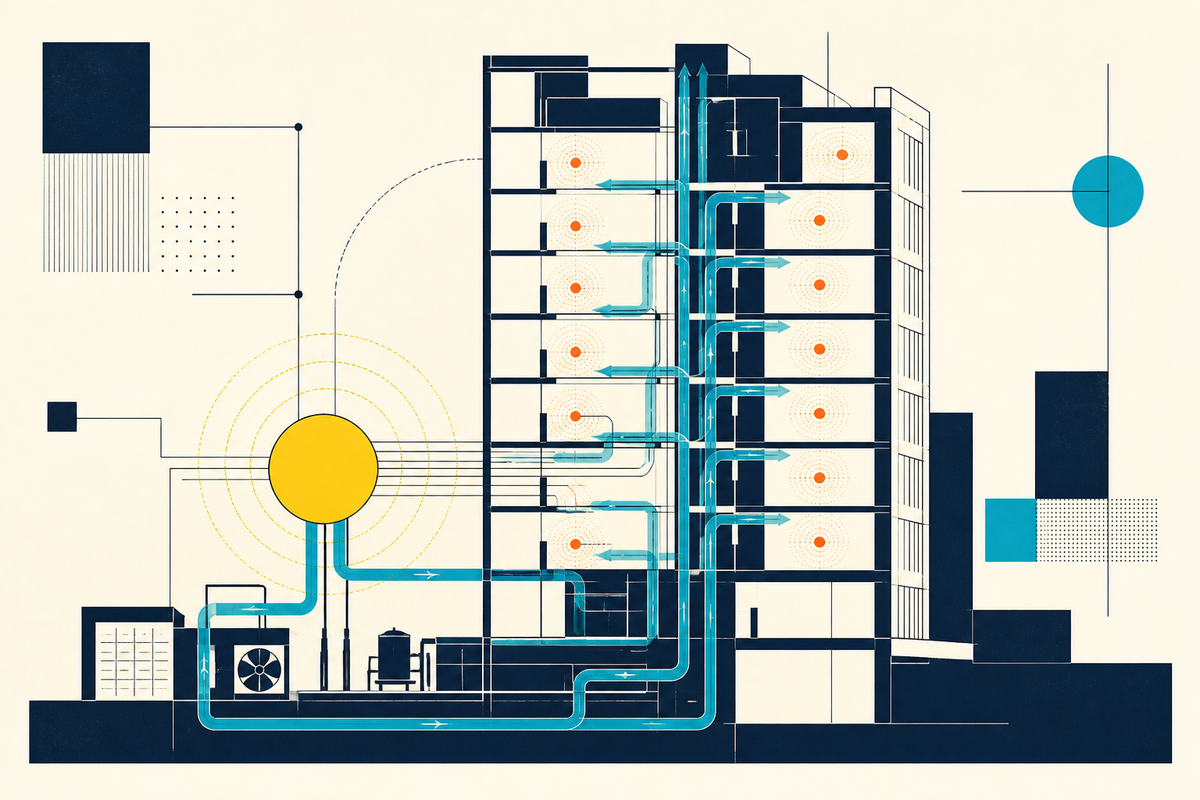
The product is the building stack
Calling Johnson Controls an HVAC manufacturer is accurate in the way that calling a hospital a collection of rooms is accurate. It misses the operating system. A customer can buy cooling equipment, connect it to Metasys controls, add fire and security systems, monitor the estate in OpenBlue, finance a retrofit and hire the same supplier to maintain the result. Each layer makes the next easier to sell.
HVAC + refrigeration
Metasys + sensors
OpenBlue + AI
Service + retrofit
This breadth matters most in complicated facilities. A data center needs heat removed continuously, fire detected early, access controlled tightly and failures handled before racks go dark. A hospital adds pressure relationships, air quality and infection-control demands. A pharmaceutical plant must keep environmental conditions stable enough to protect both product quality and compliance. A university has hundreds of rooms, old equipment, fluctuating occupancy and a budget that rarely enjoys surprises.
These customers are not shopping for delight. They are buying tolerances: a temperature range, a level of uptime, a utility saving, a response time. Johnson Controls can sell a component, but its stronger proposition is an outcome delivered across the building's life.
That makes the sale unusually collaborative. An owner may begin with a failing chiller, a carbon target or a complaint about rooms that are never comfortable. Engineers audit the site, model the load and decide whether the answer is replacement, better controls or simply different operating schedules. Installation is followed by commissioning - the unglamorous proof that thousands of points, valves and alarms behave as designed. Only then does the service relationship begin.
For operators, the practical use is straightforward. A facilities team can compare buildings, spot equipment consuming more energy than its peers and prioritize maintenance before a fault becomes an outage. Executives can track progress against cost or emissions targets. Occupants may notice little beyond steadier temperatures and fewer disruptions. In building technology, invisibility is often evidence that the system is doing its job.
The clever dashboard is only useful if someone can make the physical building obey it.
A software story with wrenches
OpenBlue is the company's attempt to make a building legible. It connects previously separate systems, watches equipment performance and energy use, and recommends or automates changes. Nantum AI, acquired in April 2026, adds algorithms that adjust HVAC airflow in response to occupancy. Microsoft supplies important cloud and digital-twin plumbing through Azure.
Plenty of software companies can produce an efficiency chart. Johnson Controls has a different card to play: it manufactures and controls much of the machinery creating the chart, then deploys a large field organization to change filters, tune chillers and replace failing parts. The loop runs from physical asset to data and back to physical intervention.
That loop also explains the economics. In fiscal 2025, roughly 70 percent of continuing sales came from products and systems and 30 percent from services. Equipment and installation create large, sometimes lumpy projects. Maintenance, monitoring, repair and retrofit can persist for years. Some government and institutional arrangements run for decades. Johnson Controls Capital has funded more than $6 billion in customer projects, helping owners move an energy upgrade from the wish list to the work order.
This is not SaaS with pristine margins and instant deployment. Work happens on construction schedules, across supply chains and inside regulated facilities. Hardware must be commissioned. Local codes differ. Skilled labor is scarce. Yet those complications are also barriers. A buyer entrusting air pressure in an operating room or cooling in a data hall cares about who can install, integrate and service the system nearby.
The model also rewards patience. A controls upgrade can expose an inefficient pump; the pump replacement can justify a new service plan; the service history can inform the next capital project. None of these steps needs to happen at once. Johnson Controls can enter through one subsystem and expand as budgets, equipment age and operating evidence permit. The result resembles account compounding more than a one-time machinery sale.
AI's other appetite
The AI boom is usually described in chips and electricity. Heat is the third term. High-density computing concentrates more heat in less space, while data-center operators are under pressure to conserve both power and water. Cooling is no longer background equipment; it is a constraint on how quickly capacity can come online.
Johnson Controls has reorganized its pitch around that constraint. Its data-center portfolio stretches from thermal management "chip to chiller" through automation, security and fire protection. In May 2026 it completed the acquisition of Alloy Enterprises, whose proprietary additive-manufacturing approach is designed to improve heat transfer in high-performance cooling applications. The same month, it announced a framework agreement with Armada for modular, megawatt-scale data-center production at a planned factory in Arizona.
Fiscal Q3 2026
Year over year
Fiscal Q3 2026
The demand is visible in the order book. For fiscal Q3 2026, Johnson Controls reported $6.6 billion in quarterly sales and a $21 billion Solutions and Services backlog, up 32 percent organically from a year earlier. In the Americas, management tied a 40 percent backlog increase to data centers and other mission-critical environments. A backlog is not guaranteed revenue, but it is a blunt indication that customers are reserving capacity.
The strategic edit
Johnson Controls became sprawling over its history. It built steam vehicles, made automotive batteries and seats, and sold residential air conditioners. The cleaner version emerging now is a commercial-building company. In July 2025, it completed the sale of its residential and light-commercial HVAC operations, including its Johnson Controls-Hitachi Air Conditioning joint venture. The transaction removed familiar consumer equipment and concentrated management on complex, higher-touch environments.
The competitors are formidable. Siemens, Honeywell and Schneider Electric contest the building-automation layer. Carrier, Trane Technologies, Daikin and Bosch sell HVAC equipment. Vertiv, Eaton, Delta Electronics and Stulz pursue data-center thermal infrastructure. Thousands of regional contractors compete for service work. No single category belongs to Johnson Controls.
Its distinction is orchestration at scale. The portfolio spans more of the building than many specialists, and approximately 50,000 field experts give its software a route into the real world. Its installed base produces service opportunities; service relationships reveal retrofit opportunities; retrofits install more connected equipment. That flywheel is slow, local and operational - qualities that make it less fashionable than pure software and harder to reproduce than a landing page.
Where the old company meets the new constraint
The strongest case for Johnson Controls is not that every building will become autonomous. Buildings are too idiosyncratic, too old and too occupied for tidy futurism. The stronger case is that wasted energy, unstable temperatures and unexpected downtime have become more costly. Owners need better instruments and people capable of acting on them.
The risks sit in the same physical complexity. Projects can slip. Supply chains can tighten. Cybersecurity failures in connected infrastructure can carry real consequences. Customers can mix equipment from several vendors, limiting the value of a single ecosystem. And a giant backlog must still be converted into finished work by engineers and technicians.
Johnson Controls' public culture language is unusually practical: focus on what matters, win as one team, own the outcome, improve every day. “Go to Gemba,” its materials tell employees - go to the place where the work happens. It is sensible advice for a company whose cloud ambitions ultimately terminate in ducts, valves, panels and pipes.
Warren Johnson's original device made an invisible condition visible. The company now sells that idea at building scale. It senses more, connects more and automates more, but the commercial promise remains refreshingly concrete: keep the room right, keep the machine running and use less energy doing it. AI has made that old problem urgent again.