The refrigerant of the future might be a solid you squeeze. This Harvard spinout is building the cooling systems to prove it.
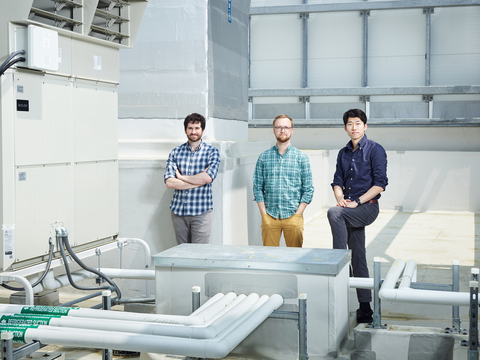
The founders stand where their invention will live - inside the machinery that heats and cools the world. Three chemists, one squeezable solid, and a plan to take the greenhouse gas out of comfort. Cambridge, Massachusetts.
Here is a fact that sounds made up but isn't: the machine keeping your food cold and your office bearable is quietly one of the planet's climate problems. Air conditioners, heat pumps, and refrigerators run on chemicals - hydrofluorocarbons, or HFCs - that are extraordinarily good at trapping heat, sometimes thousands of times better than carbon dioxide. They also leak. So you have a device whose entire job is to move heat around, and it is packed with a substance that, when it escapes, warms the whole planet. That is the setup. Pascal is the punchline.
Pascal is a Cambridge, Massachusetts company that spun out of Harvard in 2023 with an unusual pitch: don't make a better greenhouse gas, get rid of the gas entirely. Instead of a fluid that boils and condenses inside your AC, Pascal's refrigerant is a solid. You squeeze it, it warms up and releases heat; you release it, it cools back down. Cycle that, and you have refrigeration with no gas to leak and, crucially, nothing with any global warming potential. The company is named after the pascal, the SI unit of pressure. When your whole business is squeezing things, you may as well name yourself after the squeeze.
The category has a name - barocaloric cooling - and academics have poked at it for roughly two decades. The problem was always the same: the materials only did their trick at absurd, industrial pressures, the kind you cannot put inside a window unit or a supermarket case. This is the part where most interesting science quietly dies. Pascal's founders spent about two years dragging that operating pressure down by several orders of magnitude, to below ten bar - the same neighborhood where mass-market air conditioners already operate. That single number is the reason there is a company at all.
Heat pumps are crucial for decarbonizing HVAC. But they rely on polluting HFCs and cost more than gas furnaces. Pascal builds better heat pumps using solid refrigerants - higher efficiency, lower cost, and no refrigerant emissions.
The material is a stack of layered crystals threaded with long, floppy molecular chains - the founders describe it as "almost nanoconfined molten wax." Apply pressure and those chains snap into order.
Ordering the chains is a phase change, and phase changes move heat. As the solid crystallizes under pressure, it releases warmth - which you carry away, just like a normal compressor cycle.
Drop the pressure and the chains go floppy again, absorbing heat and cooling down. Cycle it with existing HVAC compressors and you have cooling - minus the gas that leaks and warms the planet.
What makes this commercially interesting, rather than just clever, is compatibility. Pascal isn't asking the world to rip out its factories. The materials run at pressures ordinary compressors already handle, which means the surrounding hardware and supply chains can largely stay the same. You change the working substance, not the whole industry. That is a very different - and much more shippable - proposition than inventing a brand-new machine.
We discovered a new class of solid material ideal for refrigeration, and a novel way to drive its phase transition with pressure. Over two years we cut operating pressures by several orders of magnitude - enough to work with compressors that already exist.
A new class of barocaloric solids engineered to absorb and release heat on demand - low-pressure, wax-like, and carrying zero global warming potential. The core invention that everything else is built around.
Heating and cooling devices designed to be smaller and more efficient than gas systems, aimed squarely at the heat-pump market that's central to decarbonizing buildings.
The same vapor-compression jobs your fridge and air conditioner do today - commercial refrigeration, building cooling - re-engineered without HFCs.
As AI drives data-center heat loads through the roof, efficient, emission-free cooling becomes a business need, not just a climate one. Pascal lists it among its target applications.
Eight million dollars does not build a factory. It buys a specific thing: the leap from a bench proof-of-concept to a demonstration system large enough to convince the HVAC industry that this is real. That is the awkward middle of hard tech - too far along to be a science project, too early to be a product - and it is exactly the gap seed money like this is meant to cover. The investor list reads like a who's-who of people who fund things that take years and involve actual atoms.
Solutions that increase efficiency and reduce HVAC electrical loads and costs are critical to meeting energy-transition goals while addressing HFC greenhouse-gas emissions.
A chemist with a climate-tech bent who now runs the company and makes the case that heat pumps can be both cheaper and cleaner.
Led the materials work that dropped operating pressures by orders of magnitude - the breakthrough that turned a lab curiosity into a product path.
Harvard associate professor whose research group produced the original discovery and continues to anchor Pascal's science.
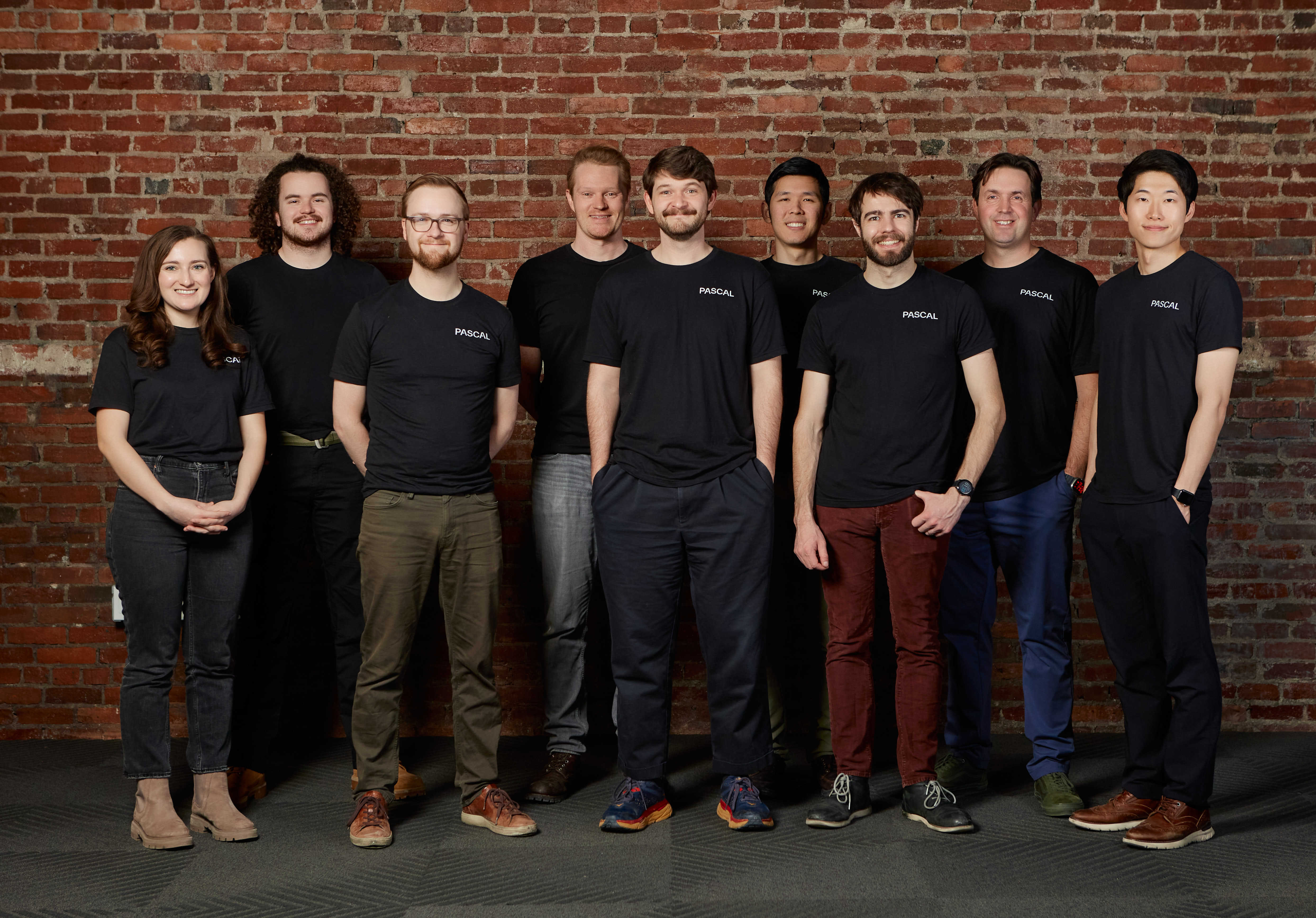
A tight lineup of mechanical engineers, chemists, and materials scientists. The T-shirts are a uniform; the brick is Cambridge. Somewhere in this frame is a plan to take the greenhouse gas out of every air conditioner - one demonstration system at a time.
Slavney, Seo, and Mason take the discovery out of the Mason Research Group and incorporate in Cambridge. Named after the unit of pressure.
Engine Ventures leads, with Khosla Ventures and Blindspot Ventures, to build a commercially relevant demonstration system and grow the team.
Chemical & Engineering News names Pascal to its 2024 list - a nod from the chemistry establishment.
The company aims to place its technology with refrigeration and HVAC partners to prove it in real products.
The goal: solid-refrigerant cooling systems shipping into the market.
The tidy thing about Pascal's bet is that it doesn't require anyone to behave differently. Nobody wants a warmer building to save the planet; they want the same cold air. Pascal's proposition is that you can keep the comfort, keep most of the hardware, keep the supply chain - and just quietly delete the greenhouse gas. If it works at scale, the win is invisible, which is arguably the point. The best climate solutions are the ones nobody has to notice.
The caveats are the usual ones for hard tech. A demonstration system is not a product; 2029 is a target, not a shipment; and cooling is an industry that moves at the speed of building codes and equipment cycles, not software releases. But the core insight - that the biggest lever might be hiding inside the appliance in your kitchen, and that the fix is a material, not a machine - is the kind of idea that either goes nowhere or changes an entire category. Pascal has the science, the money, and a clock. Now comes the squeeze.