A San Jose software company has spent a decade learning what a supermarket sounds like when it's about to break. Now it's selling that intuition - by the megawatt and by the leak.
The aisles are dark. The shoppers are home. The only thing awake is the refrigeration rack at the back of the store - twelve compressors, a wall of valves, and a controller from 2013 muttering to itself.
Somewhere in that mutter, a tiny anomaly. A pressure curve drifts an eighth of a degree off where it ought to be. A defrost cycle runs four seconds long. Nothing a tech walking by tomorrow morning would notice. Nothing a sensor on the wall would flag for weeks.
Axiom Cloud notices. Quietly, from a data center half a state away, an AI flips a flag. By 6 a.m. a work order is on the maintenance team's queue. The refrigerant that would have leaked into the sky - the equivalent, pound for pound, of thousands of pounds of CO2 - never leaves the pipe.
"Refrigerant leaks are accelerating climate change. Typical refrigerants have a global warming potential roughly 3,000 times greater than CO2." - Amrit Robbins, CEO
That is what Axiom Cloud does, in one sentence. The rest of this page is everything that gets you to a software company in San Jose deciding, in the middle of the night, that a particular freezer in Sacramento needs help.
The math here is brutal. The opportunity is brutal in the other direction.
If a single supermarket chain runs 500 stores, and each store leaks roughly a quarter of its refrigerant charge in a year, the climate cost of that one logo on a sign is measured in tens of thousands of cars.
Catch the leak in week one instead of month six and the numbers swing the other way - fast.
Axiom Cloud doesn't ask grocers to rip and replace. The software reads data from existing refrigeration controllers, then layers on the parts the controllers were never built to do.
AI that spots refrigerant escape weeks before a sensor or a technician would. No new hardware. EPA-recognized under the AIM Act.
Treats the cold mass of a store as thermal storage. Shifts compressor runtime to cheaper, cleaner hours of the grid - without melting the gelato.
Continuous AI diagnostics, root-cause analysis, and automated work orders for refrigeration teams stretched thin by a national tech shortage.
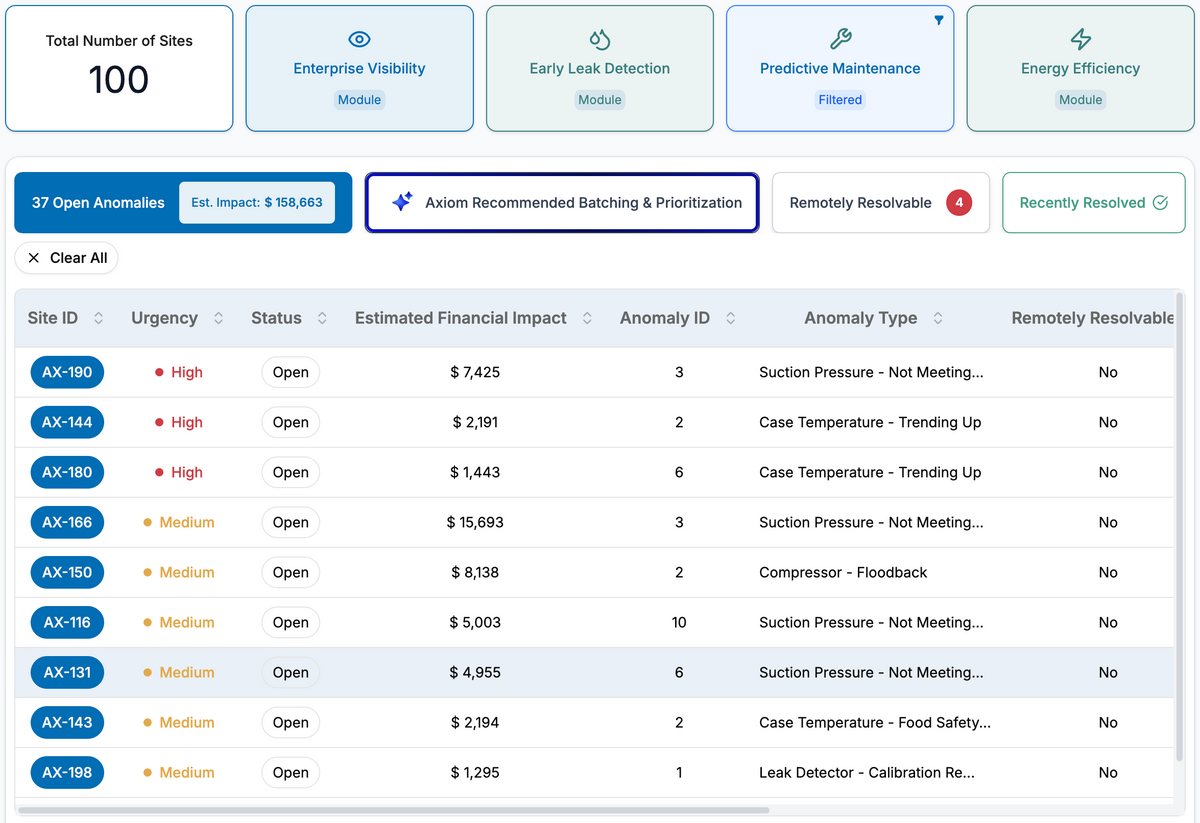
The dashboard. Multi-site benchmarking across an enterprise. Energy, compliance, and asset health for hundreds of stores at once.
Axiom's first product was a thing you could touch - a Refrigeration Battery that turned grocery freezers into utility-scale thermal storage. It worked. It also taught the founders something more valuable than the hardware itself.
What grocers wanted, urgently, was not another box bolted to a wall. It was someone to translate the data their existing systems were already producing. Someone to read between the lines of every compressor cycle and tell them which store needed help today.
So the company rebuilt itself around software. The hardware roots are still visible in the product names - Virtual Battery, Virtual Technician - but the company shipping them now is a cloud platform, top to bottom.
Started on the premise that a clean grid needs storage and flexibility, not just cheaper panels.
Pilot installs at grocery chains. Hardware works. Lessons stack up.
The first pure-software module. Pivot complete - the company becomes Axiom Cloud.
AI-powered ELD module released for grocery and cold storage.
Toshiba Tec and Windsail Capital lead. EPA lists Axiom as a compliant ALD provider.
Make the world's cooling systems sustainable.
Axiom Cloud runs on a list of ten guiding principles: protect people and data, act with integrity, zoom out for scalable impact, move quickly and take calculated risks, delight customers, challenge ideas not people, take ownership, be a team player, focus on doing few things well, and strive for excellence through mastery and growth.
Axiom's first product was a Refrigeration Battery - a literal thermal storage device. The current company is what happens when you pivot from atoms to bits and bring the hardware lessons with you.
The Virtual Battery doesn't store electrons. It stores cold. Same idea, different physics, much lower cost per kilowatt-hour.
The leak-detection AI uses zero new sensors. It reads signals the refrigerator was already broadcasting - just nobody was listening.
HFC refrigerants are roughly 3,000 times more warming than CO2 by mass. Plugging leaks is climate work that looks suspiciously like maintenance.
The lights come up. The bakery starts. The refrigeration tech on shift today opens a ticket queue and sees one item at the top, flagged overnight - rack 3, suspected slow leak, estimated charge loss less than 1%, suggested fix attached.
He doesn't know that the alert was generated by an AI in San Jose. He doesn't need to. He shows up with the right wrench, finds the right fitting, tightens it in seven minutes, and the work order closes.
Multiply that by hundreds of stores. Multiply that by the chain next door. Multiply that by the cold-storage warehouse two exits down the freeway. That is the quiet, unflashy, slightly nerdy way that a software company in San Jose is taking a bite out of the climate problem - one freezer that talks back at a time.
Axiom Cloud started in 2014 by asking what a clean grid actually needs. Twelve years on, the answer turned out to be a software layer that the cold chain didn't know it was waiting for. It is the kind of company that won't be on a magazine cover this year. It will be in your grocery store - whether you notice it or not.