The most revealing part of Tabata Gomez's career may be how often the product changes while the method survives. A cosmetics compact, a power drill and a jar of seasoning seem to belong to different commercial worlds. Gomez has worked deeply in all three. Her answer to the apparent mismatch is direct: understand the person on the other side of the product. Category knowledge can be learned. The discipline of watching people, finding the useful tension and organizing a team around it is the portable craft.
That craft now sits close to the center of McCormick & Company. Since December 2025, Gomez has served as Chief Growth and Marketing Officer, leading enterprise growth strategy, corporate strategy and the global marketing organization. Her portfolio stretches from McCormick herbs and spices to Frank's RedHot, French's, Cholula, OLD BAY, Stubb's, Lawry's, Ducros and Vahine. It is a collection of familiar labels, but the job is not simply to preserve familiarity. It is to notice how culture, cooking and commerce are changing, then turn those signals into products and occasions people will actually use.
“The consumer comes first, always.”Tabata Gomez, 2024
A diplomat's eye for ordinary behavior
Gomez grew up in Mexico City and studied international relations at Universidad Iberoamericana from 1999 to 2003. As a girl, she imagined becoming Secretary-General of the United Nations. The ambition was global and public-minded. Her career took a commercial route, yet the original lens still fits: global marketing also asks how people from different places assign meaning, which habits can travel and which details must stay local.
She joined Procter & Gamble and spent 13 years in roles across the United States, Europe and Latin America. Her brand list became an education in varied human routines: CoverGirl and Max Factor, Braun, Crest Whitestrips, Ariel, Dawn and Mr. Clean. At Coty, she became vice president of Rimmel. Beauty taught one set of rituals, but her next move would test whether her method depended on the category.
Stanley Black & Decker hired Gomez in 2017. Her early assignment was the relaunch of Craftsman, an American tool name loaded with memory and expectations. She did not arrive pretending to know every blade, battery and jobsite. She learned the end user. Her framing was that the marketing approach remained consistent: focus on the person, understand the need and create an experience that addresses it.
Then she made the strategy legible enough for a large organization to carry. Gomez has described the Craftsman work as a lesson in shared vision. When product, retail, operations and marketing could see what the brand was meant to become, each group could move its piece forward. The compact line “We build pride” gave the relaunch an emotional center. It spoke to what the tool enabled, not merely what the tool was.
The stealable idea: When entering an unfamiliar category, separate product knowledge from consumer judgment. Learn the first quickly. Bring the second with you. Then write a vision clear enough that every function can explain its part in one sentence.
The executive in the black dress
Learning the tools business altered Gomez outside work, too. She once described a weekend spent cutting two-by-fours and doing plumbing and drywall at home with her boyfriend. The anecdote is modest, almost domestic, and useful. Consumer empathy becomes more precise when the executive has felt the material, the weight and the awkward first attempt.
Another moment involved no tool at all. Before a major trade show, someone called to ask her shirt size. The expected uniform was a men's shirt and khakis. Gomez said she would instead wear a presentable black dress with a Stanley Black & Decker pin. She treated the request as an inherited default that could be changed. The point was not the dress. It was who gets imagined when an organization pictures its leaders.
During that period, Gomez said the Global Tools and Storage leadership group moved from having one female leader to being 60 percent diverse. She spoke publicly about mentorship, sponsorship, bias training and flexibility, connecting representation to how teams make decisions. In 2022, Helen of Troy appointed her to its board. She now serves on its Corporate Governance Committee and also sits on the board of the World Trade Center Institute.
Her language for inclusion is often grounded in daily life rather than a corporate abstraction. In a 2021 interview, she recalled her young son explaining a classroom lesson about stereotypes: girls and boys can both like any color. Gomez said she wanted him to keep that open mindset and hoped her own career could demonstrate who is able to succeed in corporate America. It is an aspiration with a personal edge. Her path crosses nationality, language and categories where leadership once had a narrower visual template. She lists English and Spanish at native or bilingual proficiency, plus working German and elementary Italian. The languages are a practical record of a career spent crossing borders, but they also point to a habit: listen before translating a market into a plan.
Helen of Troy described her board contribution in similarly operational terms: global marketing, brand leadership, profit-and-loss management and licensed products, backed by experience across Latin America, Europe and Asia. That mix matters because governance is partly the art of asking whether management's story about a business matches the evidence. A leader who has run both the message and the operating unit can test the seam between promise and delivery. She knows what a portfolio slide can smooth over, and how many functions must agree before a consumer ever sees the result.
A career built across categories
Speed, with a reason
Gomez joined McCormick as Chief Marketing Officer in November 2023. Three months later, she gave a crisp report on the new job: she loved the people, the brands and the work. The proof point she chose was an activation for Frank's RedHot tied to football and All-Pro center Jason Kelce. From the initial idea to execution took three and a half weeks.
That clock matters because cultural marketing decays quickly. A clever concept launched after the conversation has moved on becomes an artifact of the approval process. Gomez credited the agencies and the McCormick team, which reveals the less glamorous machinery beneath the sprint: partners who know their roles, leaders who can make decisions and a group aligned enough to execute without serial handoffs.
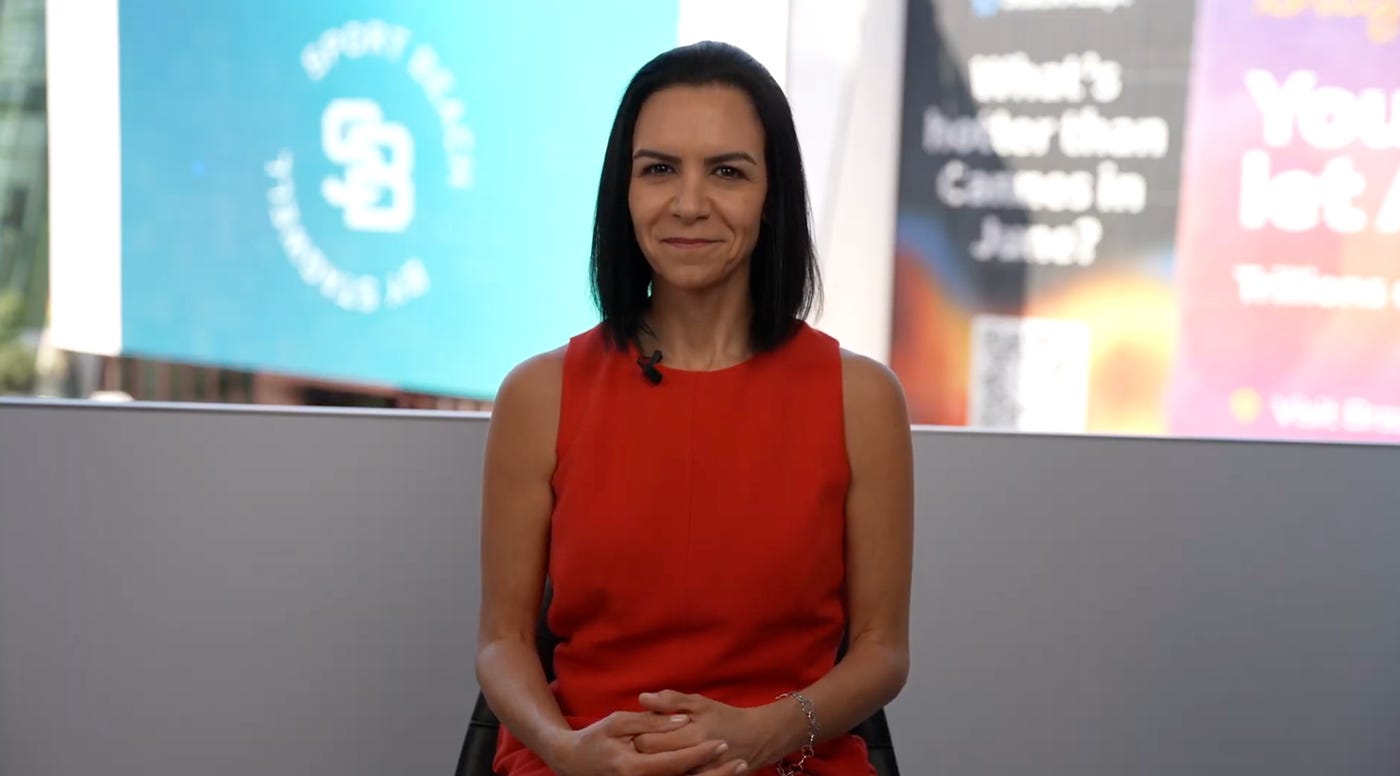
By Cannes Lions in June 2025, she was describing the broader operating system. McCormick had adopted agile sprints for marketing, moving work into cross-functional pods so teams could respond to food trends and learn in shorter cycles. Gomez's phrase for the goal was “empowering through agility.” Speed was not the trophy. Giving people enough context and ownership to move was.
The distinction shows up in McCormick's Consumer Day. Gomez described employees learning trend tools, meeting consumers, then shopping and cooking alongside them. A dashboard can tell a marketer what sold. Standing next to someone choosing dinner ingredients can reveal the hesitation, substitution or small family rule behind the sale. Those observations are raw material for strategy.
Flavor is a cultural signal
McCormick's Flavor Forecast turns that habit of observation into an annual platform. Since 2000, chefs, sensory scientists, marketers and product developers have tracked how tastes move across regions and into everyday cooking. The report has identified ingredients and patterns from chipotle and ube to Korean barbecue and “swicy,” the sweet-spicy combination that became a useful shorthand for a wider appetite.
For Gomez, the forecast sits where brand building, product development and culture meet. Flavor can carry heritage, curiosity, convenience and self-expression in the same spoonful. A trend report becomes more than content when it helps a company decide what to formulate, where to invest and how to explain an emerging taste before it becomes obvious.
In December 2025, McCormick widened her remit from marketing to growth. Corporate strategy joined global marketing under one leader. The change recognized a pattern already visible in her career: Gomez has repeatedly crossed the boundary between telling the brand story and running the business that must deliver it. At Stanley Black & Decker, she moved from marketing into the presidency of a roughly $4 billion hand tools, accessories and storage group, then oversaw a $14 billion Tools & Outdoor brand portfolio as CMO.
“It doesn't matter what you're marketing... as long as you know the insights for your consumer.”Tabata Gomez, on crossing categories
McCormick's planned combination with Unilever's Foods business gives that operating idea a broader canvas. Subject to the transaction closing, Gomez is expected to become EVP Chief Growth & Global Marketing Officer of the combined company. She has written about bringing together insight-led marketing, research, culinary expertise and portfolios that would include McCormick, French's, Frank's RedHot and Cholula alongside Knorr, Hellmann's and Maille.
The scale will be new. The central question will not be. Which signals deserve attention? What remains true about a brand as it enters a new market or occasion? How can a team move before relevance cools? Gomez's career suggests that the answer starts closer to the kitchen than the boardroom: beside the person deciding what to make, what to fix, what to try and what to bring home.