Mayonnaise is not a glamorous procurement decision. It arrives in a kitchen by the gallon, sits within reach of the line cook and disappears into sandwiches that will never credit it by name. But swap the wrong mayonnaise into a restaurant kitchen and, suddenly, the invisible becomes visible. The texture slips. The flavor changes. The customer notices. The chef hears about it.
That was the tension facing Hellmann's in foodservice. Cost-conscious operators had reasons to consider cheaper alternatives. The Food Group, a specialist agency owned by WPP, did not answer with a lecture about ingredients or a glossy picture of a jar. Its “Real Talk” work made the purchase a matter of professional reputation. Chef, restaurateur and The Bear personality Matty Matheson delivered the point with the volume and candor his audience already expected.
It is a neat summary of what this agency actually sells. The product is advertising, research, public relations, media, digital work, sales tools and culinary development. The more valuable thing underneath is translation. The Food Group translates what a manufacturer wants to say into what an operator needs to hear - and then into what a diner might want to eat.
The hidden question in food marketing is not merely, “Will someone want this?” It is, “Who must say yes first?”
There is always another customer in the kitchen
The Food Group dates itself to 1968, when, by its telling, an underserved family business needed marketing help. Nearly six decades later, LinkedIn lists Chicago as headquarters and offices in New York and Tampa, while the agency now promotes a creative presence in Miami. Its public roster stretches across the food system: Campbell's, Unilever Food Solutions, Mondelēz International, Perdue, Mars Wrigley, True Citrus and plant-protein maker Gold&Green.
This is national, B2B-heavy terrain. A consumer agency can imagine a shopper reaching for a product. A foodservice agency must also imagine a distributor presenting it, a buyer approving it, a restaurant operator costing it, a chef testing it and a server explaining it. Each person can stop the sale. Each has a different reason to do so.
The sale before the sale
makes the case
carries the story
tests the economics
judges the plate
The company has organized itself around that chain. Strategy includes category research, go-to-market planning, communications, journey mapping and data intelligence. Creative covers identity, campaigns and in-house photography and video. Activation spans PR, paid media, social, events, email, web and automation. Culinary specialists develop products, recipes and menu concepts. Shopper teams build the final bridge into retail and sales.
Many agencies describe themselves as full service. The interesting distinction here is not the size of the menu; it is that a chef or food scientist can challenge the premise of the brief. If an idea cannot survive prep time, nutrition requirements, ingredient supply or a busy service, prettier typography will not rescue it.
Campbell's had too much fame of the wrong kind
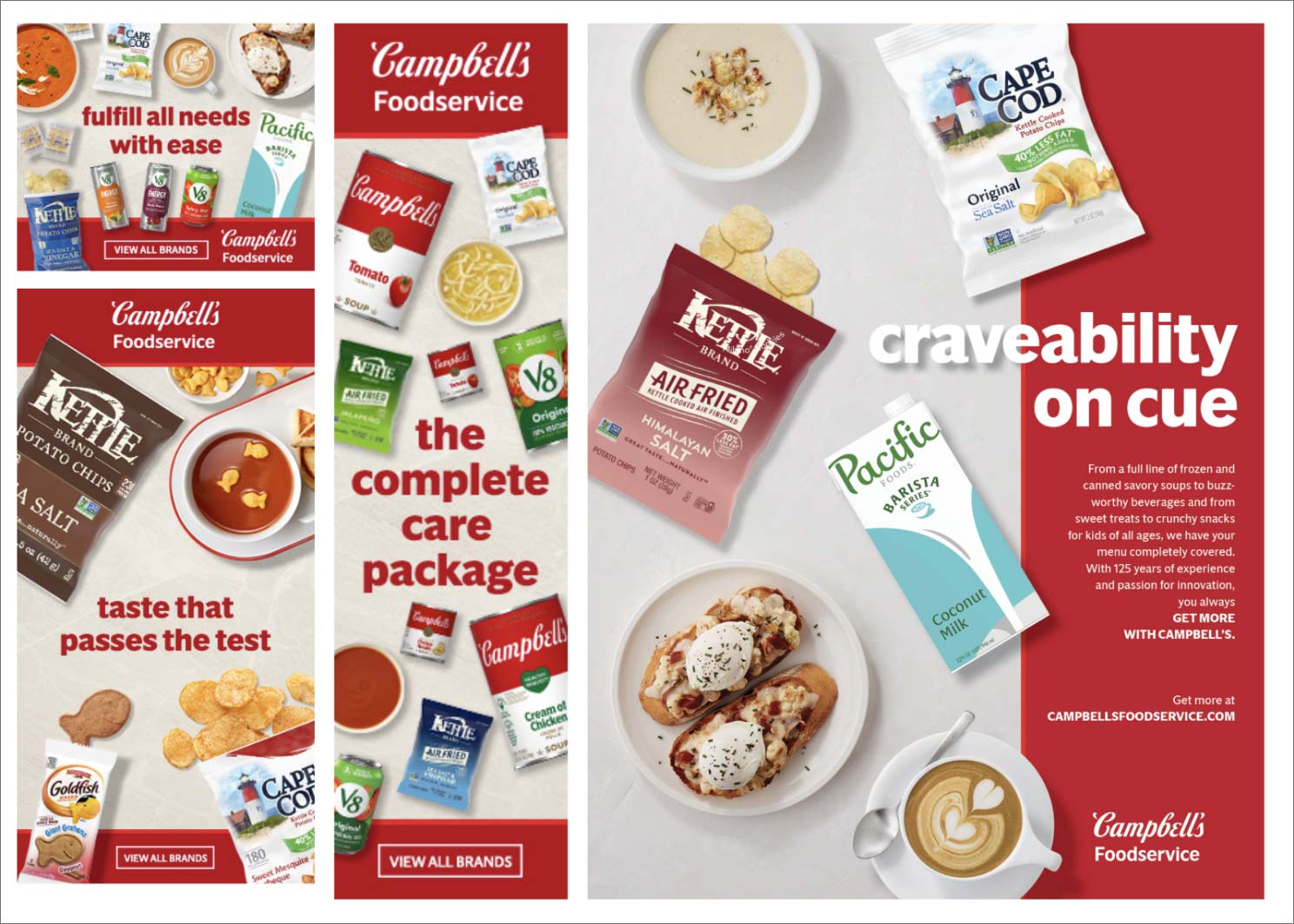
The Campbell's case is more revealing than a collection of service labels. In foodservice, the company needed operators to see a broad collection of front- and back-of-house products. But Campbell's possessed one of branding's stranger problems: an image so famous it crowded out the rest of the business. People saw the red can. They saw soup.
The first thing failing was not awareness. It was mental shelf space. The Food Group's answer was “Get More with Campbell's,” the client's first foodservice masterbrand campaign. New guidelines and a redesigned website established the idea. Advertising, social content and trade-publisher relationships repeated it. Trade-show kits gave salespeople a physical version of the same argument. The campaign did not invent a new Campbell's; it made the existing portfolio easier to perceive.
The agency reports that 75 percent of operators came to see Campbell's as having a broad portfolio, nearly twice the figure from a study one year earlier. The approximate earlier bar above simply visualizes “nearly doubling”; 75 percent is the published result. This is the kind of outcome a specialist shop wants on the wall: not clicks detached from a business problem, but a changed belief among people with purchasing power.
Research changes the shape of the creative
The Food Group's proprietary tfgTOUCHPOINTS platform draws on a panel of more than 4,000 foodservice operators. That matters because food marketing is full of confident assumptions made far from a walk-in refrigerator. Operators can tell you whether labor is the actual bottleneck, whether a menu claim helps, whether a product needs training and whether a rebate is more persuasive than a reel.
Consider Gold&Green's Pulled Oats. The agency paired public relations with a pilot involving the brand's brokerage team. Participating chefs received product and promotional help in exchange for putting it on menus and reporting what staff and customers thought. Sampling became research; research became proof; proof gave the press campaign something firmer than novelty.
Or consider S&D Coffee & Tea. As a large roaster, it risked being treated as a commodity supplier. The agency recast its research and development capabilities as those of a beverage innovation partner, then supported that position with surveys, white papers and social content. The change of mind came before the change of message: stop selling the company as a source of coffee and start presenting it as a source of profitable menu ideas.
The advantage is narrow - on purpose
The Food Group competes with specialist agencies such as Foodmix, quench, Marriner, Edible and Curious Plot; with large integrated networks; and with clients building the same capabilities inside their own walls. Its pitch is a hybrid: the range of a full-service agency, the category memory of a specialist and the production reality of a culinary team.
That fit is strongest when the route to market is messy - foodservice, retail, ingredients, emerging products, trade activation - and when marketing must coordinate with sales. It is less distinctive for a company that needs no culinary work, has a simple direct-to-consumer path or already owns deep operator research and in-house creative. Specialization compounds only while the specialist's knowledge touches the hard part of the problem.
The public case studies do not disclose campaign fees, which leaves the useful economic question at the level where buyers can actually apply it: would reproducing the mix of strategists, analysts, media planners, designers, PR staff, photographers, chefs and food scientists cost more inside? The agency's own answer is yes. Prospective clients should test that claim against scope, speed and measurable change - the same standards The Food Group says it sets before a campaign begins.
The Hellmann's work later earned Silver at The Drum Awards for Marketing in 2025 and, according to the agency, Gold in 2026. Awards are pleasant. The sharper lesson is why the work had permission to be loud. Matty Matheson was not pasted onto a jar as borrowed fame. He dramatized the operator's real anxiety: saving pennies on an ingredient can put a cook's reputation on the plate.
The Food Group's best work begins when a product problem turns out to be a people problem.
Food invites metaphor, and food agencies tend to over-season their copy accordingly. Strip that language away and The Food Group's model is practical. Find the overlooked decision-maker. Learn the constraint. Make an idea that can pass from research to ad to sales conversation to menu. Then measure whether anyone changed their mind. The mayonnaise matters because somebody's name is attached to the sandwich.