There is a satisfying absurdity to the number $22.11. It is too precise to be mythology and too small to be venture capital. In 1987, it was what Lauren Dixon reportedly had when she started an advertising company in her son's bedroom, beneath a flock of wallpaper ducks. Forty-eight hours after incorporation, the new firm had three clients. The room was childish. The proposition was not: Dixon had worked in broadcast journalism and television sales, and understood that businesses did not merely need airtime. They needed a story worth putting there.
Mike Schwabl entered by answering a classified ad. A photojournalist newly cast loose after a newspaper sale, he had started a freelance photography business. Dixon needed creative help; Schwabl supplied it. They married in 1989, and Lauren Dixon Advertising became Dixon Schwabl Advertising. The company grew, but its most revealing early moment was not romantic.
The first thing to fail was the roof
The roof of the agency's first office collapsed. Equipment, files and the comforting fiction that tomorrow resembles today disappeared together. The team rebuilt overnight. More important, the clients stayed. An agency can print “partnership” on a capabilities deck; a structural failure provides the cleaner test.
The episode helped turn culture from an employee benefit into operating machinery. DS+CO later became a repeat Great Place to Work honoree, appearing on the national small-and-medium workplace list more than a dozen times. The rituals can sound like agency camp - chili cookoffs, a kickball team, a large bell rung for victories - but the practical point is retention. Integrated work requires people who trust one another enough to pass an unfinished thought across departmental lines.
“We don't date. We get married to our clients.”Mike Schwabl, describing the agency in 2000
That line is funny because it is a little alarming. It also has receipts. Frontier Communications describes a relationship lasting more than 25 years. Roberts Wesleyan, one of the original accounts, remained a client decades after the duck wallpaper. In a business built around campaigns that vanish after a quarter, duration is its own case study.
While everyone specialized, they assembled the whole machine
The advertising industry spent years taking itself apart. Strategy went to consultancies. Media went to buying shops. Public relations, production, web and analytics each acquired their own contracts and conference calls. Dixon Schwabl moved the other way, bringing more disciplines inside. Today the company sells branding and creative, paid media and direct mail, content, PR, social, video and audio, print production, analytics and web services.
The advantage is not the length of the service menu. Plenty of agencies own menus. The advantage appears when one finding changes everything downstream. For Community Bank, audience research produced distinct customer segments with different financial needs and media habits. Those segments altered the messages, media spend, lead-generation programs, nurture streams and even the website. In a later campaign, modular templates and dynamic tools generated more than 320 ads across five lines of business. Emotional messages were tested against functional ones; live optimization pushed the winners. Click-through rate rose 165 percent.
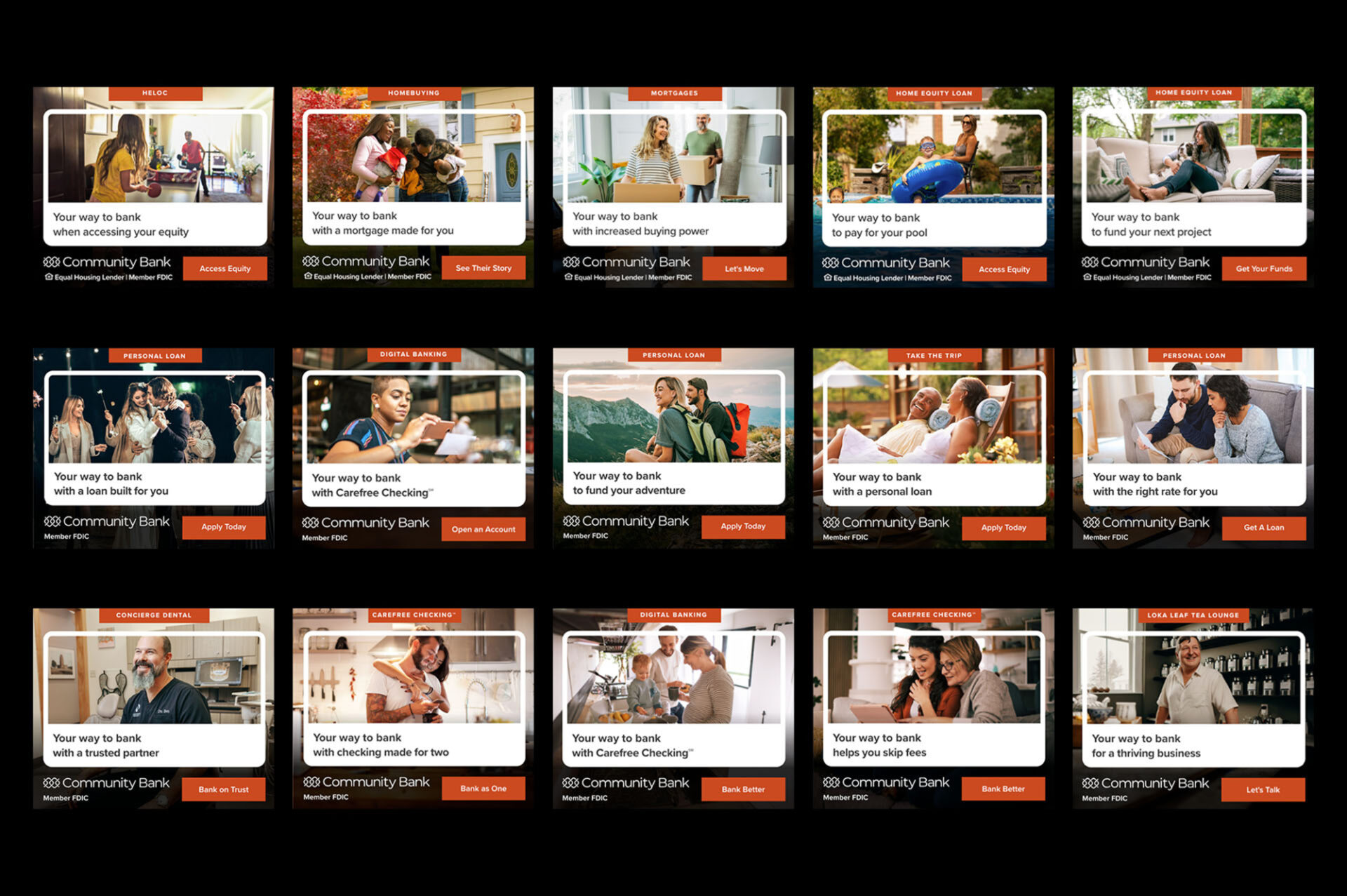
The same sequence shows up elsewhere. Avangrid needed to soften anxiety about electric vehicles. DS+CO researched the misconceptions, built “EVentually Is Now,” put myth-busting messages across PR and paid media, and measured attitudes before and after. The campaign delivered 18.3 million impressions and raised willingness to consider an EV by 19 points. RBC Heritage needed to turn a golf tournament into a continuous fan experience; the resulting mix of social, email, paid search, signage and cultural references finished 24 percent above the ticket-sales goal.
The rebrand that admitted the founders were no longer the whole company
By 2020, the founders had spent 15 years planning to stop running the place. That time horizon deserves attention. The succession elevated Kim Allen and Jessica Savage while Dixon and Schwabl moved to the board. A year later, the name became Dixon Schwabl + Company. The two added words did more than freshen an old agency mark. They distributed authorship.
The change also forced an argument about what the business was for. The agency initially organized its work under Intelligence, Strategy and Amplification and adopted “provoke progress” as a promise. Its current language is more direct: “bring clarity to marketing's chaos.” Jessica Savage became president and CEO in 2024, after joining as an account manager in 2002. Malorie Benjamin became chief transformation officer, overseeing the connective tissue among media, technology, data and AI.
This was the change of mind: being able to do everything was not, by itself, a useful position. The useful position was helping a client determine what should be done, then connecting the people capable of doing it. Full service became a method rather than a boast.
The product is not more marketing. It is agreement about the right problem - followed by the ability to act on it.
What another team can steal
DS+CO's playbook is most useful when a brand has multiple audiences, channels and internal owners. It works when research can influence the brief, creative can respond in modules, media can shift spending, and reporting arrives soon enough to change something. It is less convincing for a tiny one-off deliverable, a client unwilling to share data, or an organization that wants the appearance of transformation without changing its workflow. Integration needs authority as much as talent.
Borrow the sequence, not the wallpaper
- Describe the business problem before choosing a channel.
- Segment people by motivation and behavior, not merely demographics.
- Build a creative system that can produce meaningful variations.
- Join media and creative reviews so placement changes the idea early.
- Measure while the campaign can still be improved.
There is no public rate card for that work; engagements are scoped around the problem, production, media and measurement involved. The more instructive cost remains $22.11. It reminds us that the scarce input was never money. It was nerve: first to begin, then to rebuild, then to hand over control, and finally to revise what a full-service agency ought to sell.
The ducks are long gone. The instinct behind the bedroom operation remains. Find the story, understand the audience, and make the useful thing. Ring the bell when it works.