There is a peculiar problem with advertising agencies. They are hired for what they know, yet most of what they know walks out of the building every evening. A strategist's knack for spotting the honest problem in a brief, a creative director's instinct for the sentence with voltage, a media planner's feel for the moment when an audience will listen - these assets rarely appear on a balance sheet. They live in people, notebooks and conversations that everyone meant to document.
Laughlin Constable has been accumulating those conversations since 1976. It began in Milwaukee as the gamble of Steve Laughlin, Dennis Frankenberry and John Constable, three ad people who quickly built a reputation as a creative shop. It added public relations in 1978, expanded into Chicago through the acquisition of N.W. Ayer's operation in 1998, and spent the following years buying capabilities: PR, digital, production and specialist boutiques. The company now works from Chicago and Milwaukee, with roughly 170 people listed on LinkedIn, serving brands such as Master Lock, QuikTrip, Fleet Farm, Jewelers Mutual, ASPCA and Northwestern Medicine.
That is the conventional biography. The more revealing story is about what the company learned to retain.
The first system was candor
The agency's earliest operating lesson arrived as a crisis. In the early 1990s, it lost significant Miller Brewing business. Around the same period, co-founder Dennis Frankenberry died. Years later, Steve Laughlin recalled that leadership stopped pretending to have a clean answer for employees. They told people they were confused, too. The room exhaled.
That moment changed management's mind about internal communication. Talent could tolerate bad news better than polished uncertainty. Keeping good people meant keeping them informed. It is an unflashy insight, and therefore the sort that survives: before a company can preserve expertise, its people have to trust the place where they leave it.
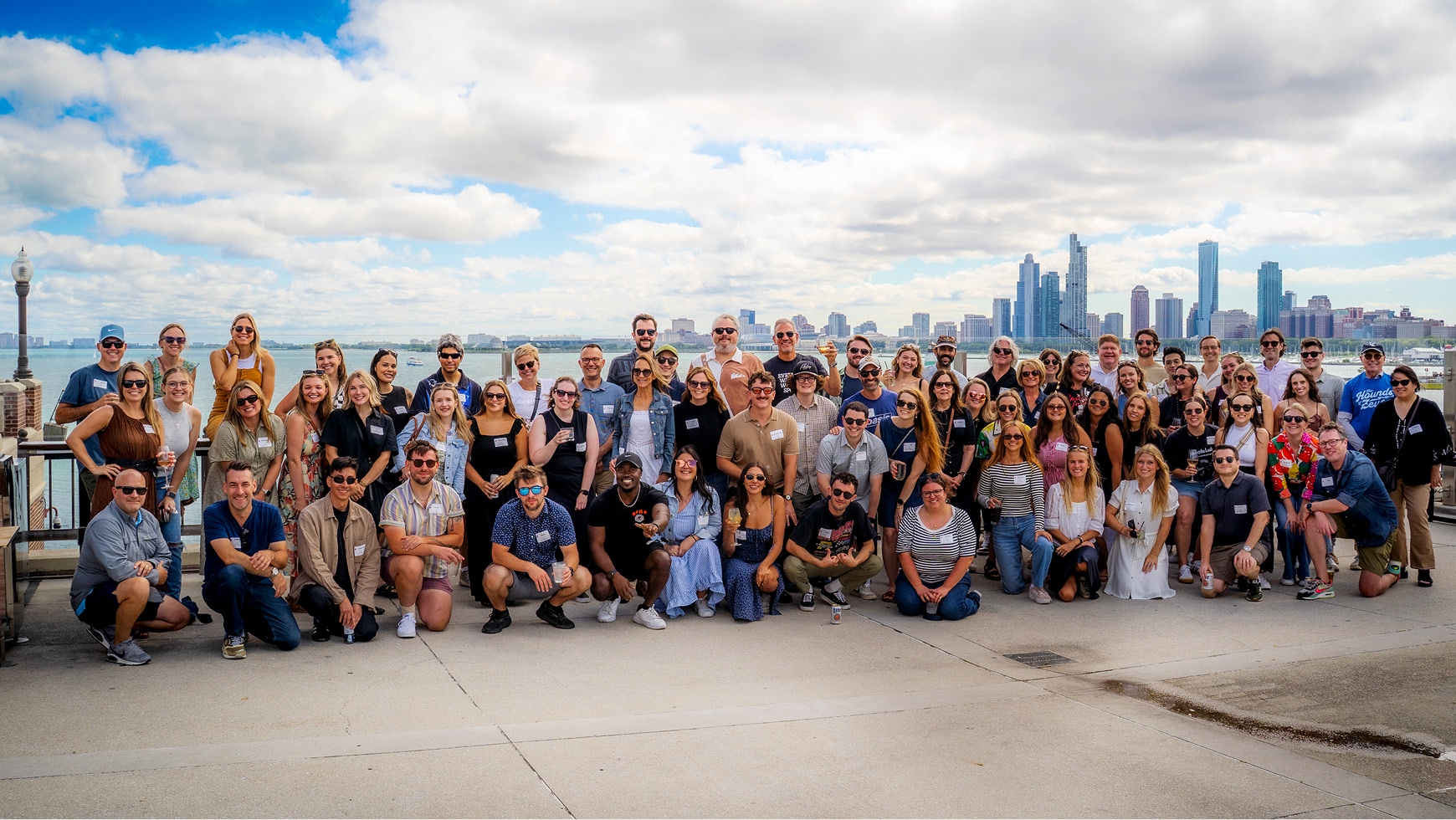
Today employees are called Griffins, after the creature in the company mark. The culture page can be playful - the annual Griffin of the Year gets a vacation - but its practical benefits are specific: flexible work, parental leave without gender distinctions, volunteer time and mandatory paid time off. The agency's independence is not merely a cap-table fact. It is the promise that decisions can still be made by the people in the room.
A family firm invites an outsider inside
By 2022, the founder's sons Jon and Pat Laughlin were co-chief creative officers. The family then made the counterintuitive move of hiring Anthony Romano as CEO. Romano had run BBH New York, led U.S. client services at R/GA and served as Wunderman Thompson's Midwest president. He knew the machinery of big agency networks. He also knew what their layers cost.
His bargain with the family was unusually clear. He would bring an outsider's view; they would keep the founder's appetite for reinvention in the room. Romano described his first year as one of “rethinking and rebuilding”: connecting disciplines, strengthening proprietary media tools, diversifying social capability and making the operation more agile.
“Small” is useful only when it shortens the distance between a problem and the person able to solve it.Laughlin Constable's operating bet
The reorganization produced a sharper offer. Laughlin Constable would help brands at an inflection point through four connected crafts: strategic intelligence, brand creativity, human context and connected experiences. In plainer English, it would diagnose the business problem, make the idea, place it intelligently, and build the digital experience around it. Clients could buy one discipline or the combination. The business runs on the familiar agency mix of retainers, projects, media, production and consulting fees. Campaign costs are private, but its case studies make the economics visible in another way: reuse.
Eleven shoots become 112 commercials
Fleet Farm had a name problem. Shoppers associated the Upper Midwest retailer with a few obvious seasons - planting, harvest, deer - rather than the hundreds of ordinary projects its stores could supply. Laughlin Constable invented more seasons: Strawberry Jam Making Season, Teaching Your Kid to Ride a Bike Season, Pass the Mustard Season.
The clever part was not just the copy. HIVE, the agency's production studio, ran 11 mini-shoots and turned the library into more than 112 television spots, 15 outdoor executions, seven grand-opening social and programmatic campaigns, plus store and sponsorship material. A search-bar device held the system together, allowing old footage to carry new messages later. In the first year, the agency says brand awareness doubled, consideration tripled and online sales more than doubled.
The repeatable move is worth stealing: start with a durable organizing idea, shoot components rather than finished monuments, and give the client rules sturdy enough to make the next execution. It works when a brand has recurring occasions and enough media frequency to reward variation. It weakens when every message is a one-off, when approval systems punish improvisation, or when modularity becomes an excuse for generic work.
Jewelers Mutual shows the same logic at a different scale. The insight was obsession: owners fixate on a new ring; the insurer has fixated on jewelry for more than a century. That thought traveled through video, print, social and dynamic ads triggered by context. The agency reports aided awareness up 25 percent, unaided awareness up 33 percent, display conversion up 115 percent year over year and average premiums up 8 percent. One emotional premise, many precise expressions.
Make “personal” pass a test
Agency positioning is usually atmospheric. Laughlin Constable's line, “Make It Personal,” risked becoming another agreeable sentence until the firm gave it a ruler. In August 2023, it studied 25 prominent brands and created the PXB Factor, a score from zero to 100 across five dimensions: inspirational, human-centered, contextually useful, culturally connected and dynamic.
The measurement became a product ladder. A client can commission stakeholder comparison, deeper consumer research, a half-day Spark Session or Hive Five - five tactical ideas in 15 days. This is where the company fits in the market. It is not trying to outspend a holding company or behave like a tiny design atelier. It packages the range of a network with the directness of an independent, then wraps that range in named methods a buyer can understand.
Now the agency is trying to remember on purpose
In 2026, the logic reached its most ambitious form. Laughlin Constable and Universal Agents introduced Interplay, an AI operating system built around “living blocks” of agency intelligence. Imagine a strategist working on a Texas beer brand aimed at Gen Z. Instead of beginning with a blank prompt, she can combine blocks containing the brand's DNA, a maintained Gen Z persona, Texas market dynamics and beer-category analysis. The machine assembles a stronger starting point. The team argues with it.
This is a more interesting AI proposition than speed. Every agency can rent the same large language model. If each asks it to summarize the same internet, sameness is not a bug; it is the likely result. Interplay attempts to put proprietary judgment between the commodity model and the answer.
“All that is, ultimately, is an input to our human process. That's where the debate begins. That's where we bring soul to it.”Anthony Romano, CEO
The condition is upkeep. A living block that nobody tends becomes a confident archive of yesterday. Client permissions, sensitive data and intellectual-property boundaries also have to be designed, not assumed. Laughlin Constable's own PR guidance warns against placing confidential information into open systems. Interplay works only if the agency treats knowledge maintenance as paid craft rather than administrative leftovers.
There is also the matter of people. Romano's sharpest instruction is aimed at leaders tempted to use AI as a head-count lever: invest in junior staff; do not divest from them. That is not sentimentality. Junior people become senior people by seeing how judgments are made. A system that supplies answers without exposing argument produces efficiency and, eventually, an agency with nobody left who knows why the answer was good.
The work has earned proof points. Laughlin Constable won Gold in Ad Age's 2024 Small Agency of the Year category for shops with 76 to 150 employees. In 2026 it reported a No. 4 ranking among ADWEEK's fastest-growing agencies of its size. Awards do not settle the business question, but they suggest the outsider-family bargain and the “personal” operating model did more than refresh a website.
The part anyone can copy
The useful lesson is not “build an AI platform.” Most companies should not begin there. Begin with the chain Laughlin Constable followed: name the belief; turn it into observable dimensions; test it on real work; create reusable components; preserve the human debate around them. Fleet Farm's footage library, the PXB score and Interplay's living blocks are versions of the same idea. Good work compounds when its ingredients can be found again.
In advertising, institutional memory is often mistaken for a portfolio. A portfolio remembers what the company made. A functioning memory remembers how people noticed the problem, what they tried, what failed, and what changed their minds. One is a gallery. The other is an engine.
Laughlin Constable remains privately held. The company received a reported $3.6 million Paycheck Protection Program loan in 2020; its then-CEO said the program helped protect jobs. Public references to roughly $225 million describe gross billings rather than net agency revenue.