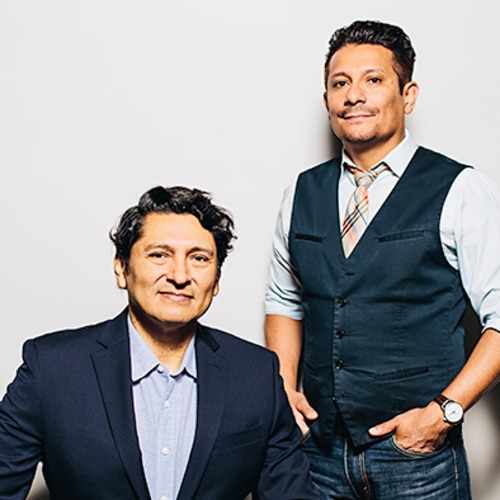
The first piece of equipment PACO Collective did not own was a projector. This was inconvenient because, in the fall of 2006, its two founders finally had something worth projecting: a pitch to Harris Bank. Ozzie Godinez and Pablo Acosta had spent spring and summer working contacts, cold-calling prospects and living with the long silence that follows a new company into the room. A local pastor lent them the machine. They won the account. Soon afterward, they bought a projector of their own.
There is an origin myth hiding here, but the useful version is less polished. Godinez and Acosta had left comfortable agency careers because the work had started to feel insulting. Hispanic advertising too often arrived as a bag of props: mariachi music, a grandmother, a bullfight, a telenovela. Acosta, a Peruvian immigrant, was tired of designing messages for Latinos in rooms where the audience itself was missing. Godinez, born in Mexico and raised on Chicago's South Side, had walked away before lining up another job.
The expensive part was not money
The pair made their plan at the Green Door Tavern, one of Chicago's oldest bars, and wrote a mission on a cocktail napkin. Their startup inventory was short: business cards, a borrowed laptop, relationships, a few hundred dollars and no clients. Godinez made chilaquiles to keep lunch cheap. The agency still serves them at its anniversary, a corporate ritual with enough hot sauce to discourage revisionist history.
So what did it cost? In public, no tidy startup total survives. The honest number is “a few hundred dollars,” plus foregone salaries, months without a client and a surprising quantity of chilaquiles. What failed first was sales. The proposition existed; demand had not yet returned the call. Harris Bank changed that. Tampico followed, and its local work traveled around the world. Retainers paid for an office, employees and, finally, presentation equipment.
“We were too naive to realize that we could fail. We had no business succeeding.”Ozzie Godinez, co-founder and CEO
That first win explains the business model that followed. PACO sells expertise and execution to organizations with consequential audiences: utilities, banks, health companies, educators, sports teams and public agencies. A client can hire the shop for one discipline or for the chain from research to distribution. Publicly named customers have included ComEd and Exelon, BMO, Blue Cross Blue Shield, NIPSCO, Cargill, EDUCAUSE, Takeda's BioLife, Amazon, the Illinois Lottery, the Chicago White Sox and the Chicago Bears.
Four rooms, one brief
PACO's offer is easiest to understand as four rooms with the doors left open. Research finds the cultural truth. Creative gives it a shape. Community work lets people encounter it off-screen. Media makes sure the right audience actually sees it, then measures what happened. The agency's difference is not that it owns these capabilities - large agencies own all of them - but that cultural interpretation is supposed to enter before the campaign hardens.
Cultural strategy
Audience research, market opportunities, brand positioning, personas and trend intelligence.
Creative and content
Brand platforms, integrated campaigns, social storytelling and production.
Community and experience
Activations, public relations, partnerships and programs built around real communities.
Media and performance
Planning, buying and optimization across social, streaming, outdoor, search and the full funnel.
Consider a bank trying to grow with multicultural customers. A translation-only assignment begins with finished English creative and asks how to adapt it. PACO's version begins earlier: Which communities matter in which markets? What financial progress means to them? Which media suppliers already hold trust? That is the logic behind the BMO assignment announced in 2024, joining multicultural strategy to planning, buying, targeted campaigns and community initiatives.
The audience moved; the agency followed
PACO's most revealing decision was to admit that its original category had become too narrow. The agency began as a Hispanic-focused shop. Then its founders watched the audience change: immigration slowed, cultural identity became more bicultural, and more Hispanic consumers became English-dominant. A firm founded to reject stale depictions of Latinos risked becoming stale in a more flattering way.
In 2015, PACO became PACO Collective. The extra word carried the strategy: insight would come from a team varied by ethnicity, generation, geography, lifestyle and background, not from a lone cultural oracle. Today its stated growth audiences include general and multicultural consumers, Latino and Hispanic communities, Black and African American communities, Asian Americans, Gen Z and LGBTQ+ people.
The move also placed PACO in a useful middle of the agency market. It can challenge general-market firms that treat culture as a late-stage adaptation, and it can challenge narrowly defined specialist shops with integrated strategy, creative and media. Its client list suggests where that proposition travels best: regulated industries, institutions and national brands that need both audience nuance and operational scale.
A cultural lens only works if the client lets it into the room.
This model is a poor fit for a buyer seeking cheap translation, a preapproved idea dressed in representative casting, or a quick cultural post without long-term permission to speak. It also weakens when the agency cannot reach customers, community partners, media data or decision-makers early enough to alter the brief.
Proof in long relationships, not adjectives
Awards are the agency world's preferred confetti, and PACO has plenty: a Gold ADDY for animated ComEd work in 2017; 10 Telly Awards in 2024; seven Summit Awards across the “Time Is Money” plasma campaign and ComEd's “A Little Assistance.” Ozzie Godinez received the Chicago Latino Network's Latinx Entrepreneur Award in 2023. PACO also says it earned Great Place to Work recognition seven years running, from 2018 through 2025.
The more persuasive signal is duration. Public agency records list ComEd and the White Sox relationships from 2011 onward, Blue Cross Blue Shield from 2012, NIPSCO and Cargill from 2019, EDUCAUSE from 2022, and BMO and BioLife from 2023. Creative novelty can win a pitch. Repeated knowledge of legal review, media performance and the audience's memory keeps an account.
The parts worth borrowing
PACO's story is charming because the props are good: napkin, projector, chilaquiles. Its actual lessons are procedural. A company cannot copy the founders' backgrounds, nor should it cosplay their scrappiness. It can copy the decisions that made those backgrounds useful.
- Put lived knowledge upstream. Invite cultural expertise into audience definition and strategy, before the idea becomes expensive to change.
- Watch the segment change. A successful niche can become a comfortable blindfold. Revisit language, identity and behavior, not merely population size.
- Join relevance to distribution. A perceptive campaign unseen by its audience is still a failed media plan.
- Keep one honest ritual. Chilaquiles cannot run an agency, but they can remind a growing staff that scarcity once forced clarity.
The borrowed projector is funny because it now feels antique. Yet its lesson survives every platform change. PACO had something specific to say before it had the machinery to display it. Later, when the market moved, it changed what it was saying rather than mistaking its first success for a permanent truth. Plenty of companies can afford the projector. Fewer know when the slide itself is wrong.