In the Toledo office of Hart, there is a sentence that has outlived the man who wrote it. Tom Hart, the agency’s founder, once put it on a scrap of paper for his son Mike: “The easiest way to lose success is to believe you are successful.” Decades later, the note was enlarged and placed on a wall. This is either excellent advice or a very efficient way to make an office full of advertising people nervous.
It also explains the company. Hart began in 1965 as an art studio in Tom’s basement. His knowledge of local politics became political advertising, and political advertising became an integrated marketing firm. The company moved out of downtown Toledo in 1992, when downtown was the place businesses were leaving. It returned in 2018, when its suburban office no longer looked like the company it wanted to be. Then came Columbus, Washington, D.C., and Detroit - each added largely through acquisition, each kept inside an independent agency whose name still belonged to the founding family.
Today, Hart is close to 100 people working across four offices. It sells research, strategy, design, advertising, media, public relations, social, digital products, production and measurement. Its customers range from hospitals and airports to liquor agencies, beef brands, sports conferences and government bodies. “Full service” is the standard agency phrase. Hart’s more interesting promise is what all that service is meant to do: move an audience from apathy to advocacy.
Apathy
The audience sees a category, a hospital, an airport or a bottle - and keeps moving.
Advocacy
The experience gives people a reason to notice, act, return and sometimes tell someone else.
The apostrophe was the campaign
Consider Ohio Liquor. The organization was bringing the largest curated collection of Irish spirits in its history to Ohio for St. Patrick’s Day. Hart could have made a handsome poster featuring a green bottle and an old stone wall. Instead it inserted one apostrophe. OHLQ became O’HLQ for March. The temporary identity ran through the website, social channels, retail displays, brochures and distiller stories.
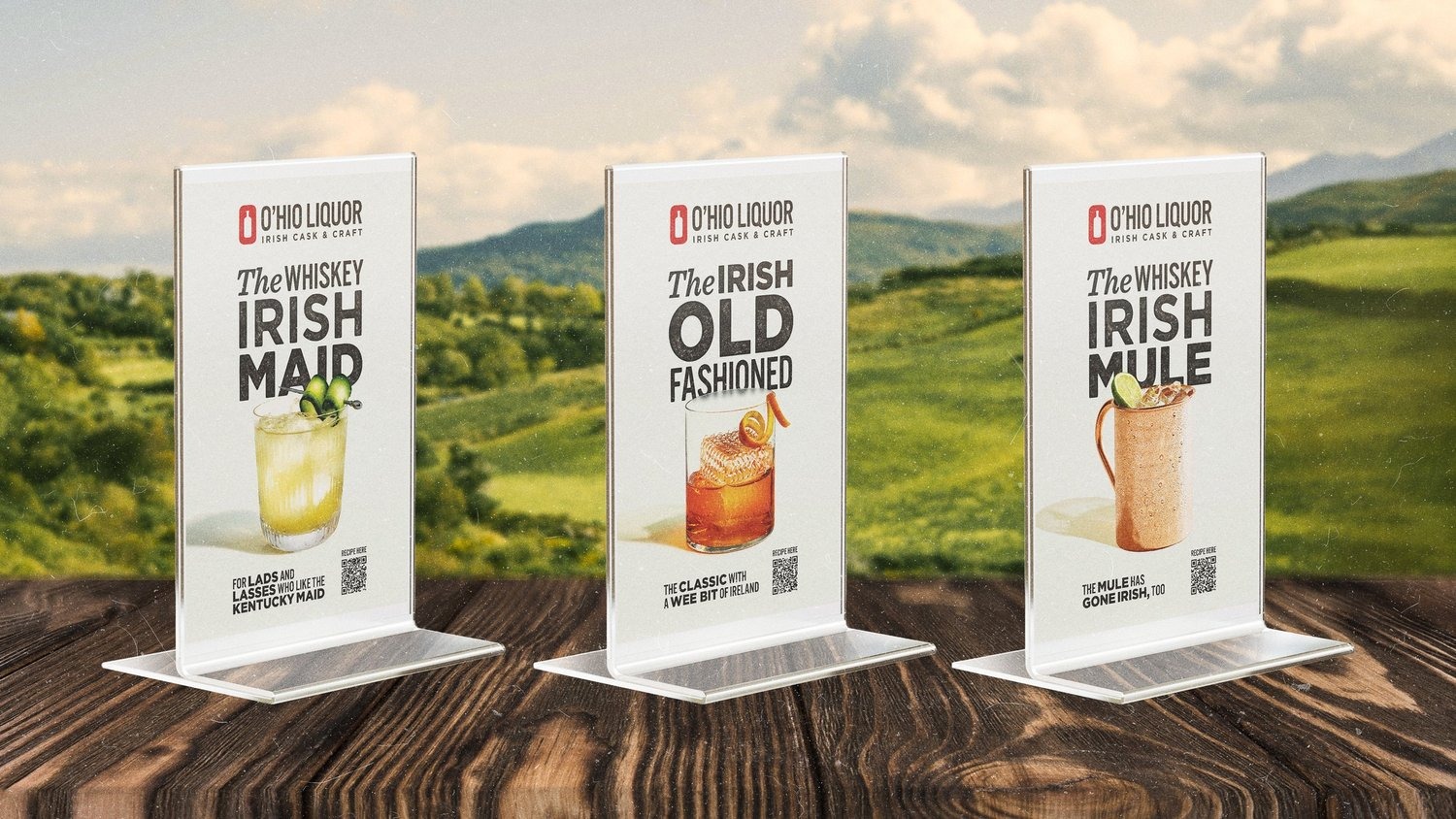
The useful lesson is not “add punctuation.” It is that an integrated campaign works best when the central idea can survive every handoff. O’HLQ made sense on a shelf, in a feed and at the top of a webpage. Hart then added the heavier machinery - interviews with Irish distillers, media placement, analytics and production - without asking the machinery to become the idea.
“Great brands don’t just get noticed, they create belief, action and advocacy.”Marc Paulenich, CEO
Make the invisible thing visible
For Nationwide Children’s Hospital, the problem was almost the opposite. Donating is consequential but visually dull: a number changes on a screen. During a period of financial uncertainty, the hospital needed more energy around its annual holiday appeal. Hart borrowed the butterfly from the hospital’s logo and installed more than 100 oversized butterfly sculptures on the front lawn. Each gift illuminated the display. A live stream let donors - and children who were too sick to leave their rooms - see the response.
The campaign exceeded its fundraising goal and returned for a second year. It later won Gold at the ANA REGGIE Awards. But the award is less instructive than the mechanism: Hart gave private generosity a public consequence. A donation was no longer only a receipt. It altered the night outside the hospital.
The same pattern appears in its work for Washington Dulles International Airport. “Because Reasons” treated the airport as the friend who is always trying to persuade you to take the trip. Nostalgic travel posters and luggage tags supplied the charm; situational media supplied the nudge. Digital messages shifted with the weather and the season. The campaign recorded 2.6 million completed streaming-video views and 700 percent growth in its engaged audience. In 2025 it received a national Silver ADDY.
The portable Hart method
- Name the audience movement in plain language.
- Find one device people can understand before the copy explains it.
- Make every channel express the same device in its own way.
- Measure response - attention, action, favorability, giving - not just output.
A very deliberate middle
Hart’s market position is less romantic but just as carefully designed. A specialist boutique can be nimble but narrow. A global network can field almost anything, though the client may have to navigate the network to find it. Hart wants the ground between them: enough capability to manage the customer journey, few enough layers for senior people to remain accessible.
That middle position produced a specific growth strategy. Hart bought Columbus-based Conrad Phillips Vutech in 2016. In 2022 it acquired MDB Communications in Washington, adding full-funnel and public-sector experience. In 2025 it bought Rebuild in Detroit, whose digital strategy and omnichannel work expanded Hart again. The Detroit deal took the combined staff to nearly 100.
Acquisition usually promises synergy and produces a new email signature. Hart and Rebuild talked instead about location, values and keeping the Detroit team together. That is not sentimentality. The thing Hart was buying included relationships with a city and the judgment of people who worked there. Strip those away and the spreadsheet may survive while the asset disappears.
Tom Hart turns an art studio and political know-how into an agency.
The acquisition of CPV broadens Hart’s footprint and capabilities.
MDB brings Hart into the capital and deeper into national work.
Rebuild joins Hart, taking the agency to four offices and nearly 100 people.
Marc Paulenich becomes CEO; Mike Hart moves to executive chairman.
The cost of coherence
In January 2026, Marc Paulenich became CEO after serving as strategist, president and chief operating officer. Mike Hart shifted to executive chairman. The transition had been underway for years, with Paulenich taking on more of the operating future while Mike reduced his day-to-day client role. For a company that sells transformation, this was a nicely untheatrical transformation of its own.
The model does carry a condition. One idea across research, creative, media, PR and technology demands internal coordination and a client willing to share the problem, not merely commission the artifact. O’HLQ works because the brand could briefly tolerate a wink and because stores, social and web could change together. An organization with rigid channel owners, no measurement discipline or no permission to play would reproduce the surface and miss the result.
That is why Hart’s old wall sentence matters. Believing you are successful encourages repetition. Treating success as provisional encourages the next question: did the audience move? The company has changed its address, its service mix, its geography and now its chief executive. What it has not changed is the conviction that useful creative work begins with somebody else’s problem.
The name on the door is a family name. The better inheritance is a habit of doubt.