Sea otters have a pocket of loose skin under each forearm. They use it to store food and, charmingly, a favorite rock. This is an excellent fact and a peculiar way to sell a checking account. Crawford, the Greenville advertising agency, put the otter on bank collateral anyway. Beneath the animal sat the line that made the strategy click: we did not know that, but we do know banking.
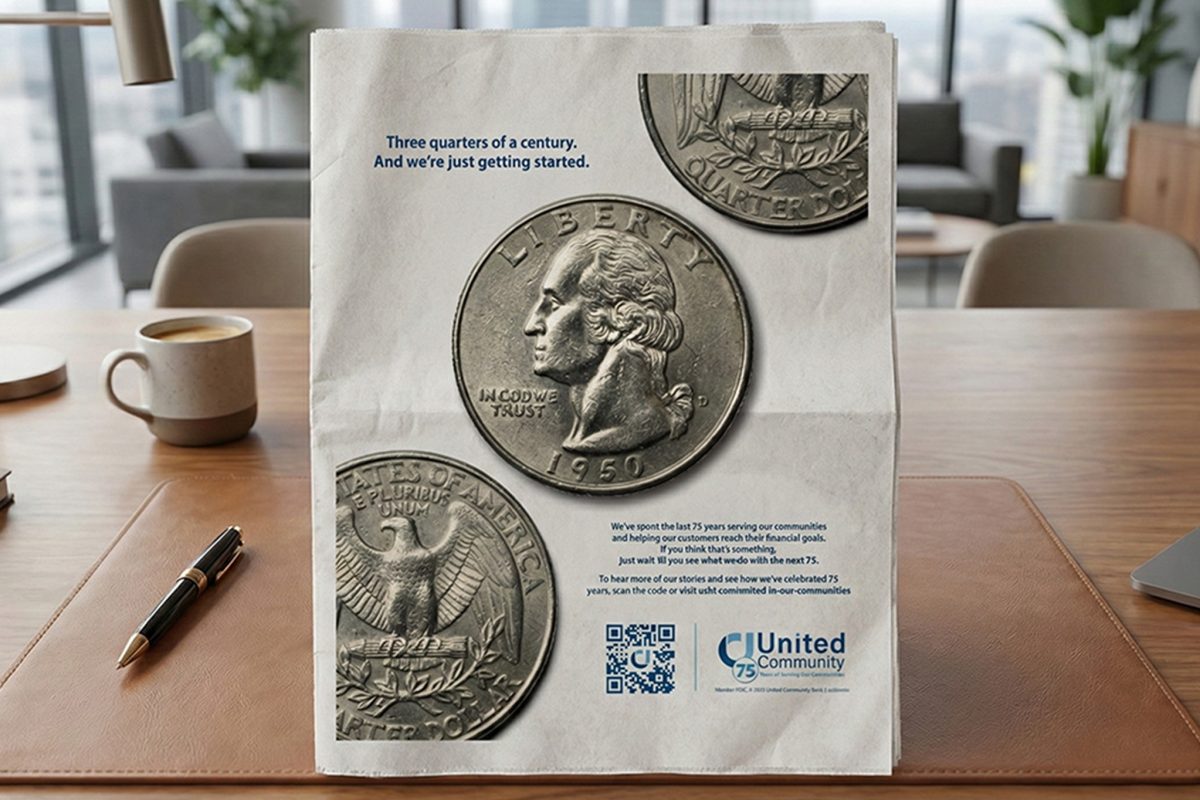
United Community needed its branches to start conversations. It also wanted more checking accounts and mortgage production. The first thing that had failed was attention. Traditional bank advertising had become so well behaved that it was easy to ignore. Crawford answered with “Just the Facts,” pairing strange, repeatable trivia with product information. Branch employees reported customers talking about the work. In the months after launch, the bank opened roughly 6,000 checking accounts and produced nearly $200 million in mortgages.
“At the heart of everything I’ve done has been the role of communications. I have always loved the idea of sharing important stories.”Marion Crawford, founder and CEO
The campaign is a pocket-sized explanation of Crawford itself. Find the overlooked human truth. Give it a verbal or visual handle. Put it in the places where it can travel. Then count what people did, not merely how politely they applauded.
The reporter’s reflex
Marion Crawford did not arrive from the usual agency conveyor belt. She worked on NBC’s nightly news desk in New York, then wrote and reported for television affiliates in Spartanburg and Asheville. She taught Spanish. At ScanSource, she moved into business. In 2010, she started Crawford Strategy with three people. The firm later dropped “Strategy” from its name on its tenth anniversary, when the word no longer contained everything the agency had become.
Today, Crawford puts four disciplines on its public menu: strategy, creative, media and communications. In practice that means audience research and brand positioning upstream; identity, campaigns, content and video in the middle; media buying, search and measurement around them; and public relations working beside paid reach. Its clients include banks, universities, health systems, tourism destinations, manufacturers and consumer brands. United Community, Prisma Health, adidas, Nothing Bundt Cakes, North Carolina’s Brunswick Islands and the University of West Georgia all appear in its public portfolio.
That combination places Crawford between two common alternatives. A client can assemble separate specialists - a research consultancy, design shop, media buyer and PR firm - and become the person responsible for making them agree. Or it can hire a large network agency with deeper global machinery and more layers. Crawford’s pitch is the independent middle: the major functions in one Greenville shop, close enough to argue productively.
Three problems, three memorable handles
The otter solved boredom. A zinc plant required a different kind of work. American Zinc Products was restarting a recycling facility in Mooresboro, North Carolina, and inherited the previous operator’s damaged reputation. Recruiting was inseparable from trust. Crawford’s social and PR teams shared information about safety and management, gave residents a place to ask questions, and used a 3D animation to explain a process that was hard to picture. The program helped the company hire more than 400 people.
Haywood County presented the opposite temptation. Its “Hay Now” tourism campaign already had years of recognition. Starting over would have been the showy move. Crawford kept the line and its logo, then built “Haywood you...” headlines around outdoor and in-town experiences. The refresh increased digital click-through rates, lowered cost per click, and accompanied rises in website traffic and occupancy-tax revenue. What changed the decision was not a sudden affection for puns. It was the value already stored in the existing brand.
2026 Great Place To Work survey
Share of employees saying their organization is a great place to work.
The price of putting the rooms together
Crawford does not publish a rate card. One public procurement exhibit does offer a rare peephole: it lists a three-month engagement at $150,000. That is a single scope, not a universal quote. Still, it makes the business model legible. Clients buy projects or continuing agency relationships that can move through several rooms without a new vendor search at every door.
One disclosed example.
A public bid document valued a three-month engagement at this amount. Actual cost depends on scope, media, production and duration.
The economics only make sense when integration removes friction or improves the result. A local business needing a logo and three social posts may be buying too much machine. A global launch requiring dozens of languages and markets may need a larger network. Crawford’s strongest fit is the organization with a complicated story, several channels and enough access to decision-makers for research to affect the offer. Clever facts cannot rescue a weak product, and transparency cannot rebuild trust if operations remain opaque.
What to steal (legally)
The useful lesson is not to put wildlife in your next bank ad. It is to make strategy portable. “Why I SWU” turned Southern Wesleyan University’s name into a verb while real adult students explained why they pursued degrees online. “Haywood you...” made a destination appear in every invitation. “We do know banking” let trivia perform as proof rather than distraction. Each device could survive a billboard, branch card, social post or video because the idea was smaller than the media plan.
A five-question Crawford test
- What has failed first - attention, trust, comprehension or relevance?
- What does the audience already believe that should not be discarded?
- Can the strategy be repeated in one clean sentence?
- Does that sentence still work across paid, earned and owned channels?
- Which behavior will prove the idea worked?
There is another, quieter operating lesson inside Crawford. Advertising has a deserved reputation for burnout. The agency was named among South Carolina’s best places to work seven years running through 2024. In its 2026 Great Place To Work survey, 97 percent of employees called it a great workplace, compared with 57 percent at a typical U.S. company. Crawford describes “kind candor,” asks employees for process improvements, and points to an unproductive recurring meeting that was simply deleted. Culture, in this version, is partly the absence of a calendar invitation.
Fifteen years after opening, Crawford’s most persuasive product may be its habit of beginning before the deliverable. The question is not “Should this be a video?” It is “Why is nobody listening?” Sometimes the answer is distrust. Sometimes it is category sameness. And sometimes the answer is that your bank ad does not yet contain a sea otter with a good rock.