There are two people in every national advertising campaign. The first sits at headquarters and worries that the logo is three pixels too far left. The second runs a dealership in a town where the high-school game, the first hard freeze and the county fair may matter more than the national media calendar. Both are right. This is the inconvenient fact on which Strategic America has built a business.
The West Des Moines agency calls the category multi-location marketing. In plainer language, it is the art of making one brand useful in many places. Strategic America handles the familiar agency work - strategy, creative, media, public relations, web design, search, social and analytics - but its most revealing work begins after the brand book is finished. Someone still has to help a local operator choose the right message, market, budget and week.
That is a less glamorous problem than filming a television spot. It is also the one that determines whether the spot, the search ad and the direct-mail offer ever agree with one another.
The lawn-mower paradox
Consider Exmark, the Nebraska maker of zero-turn lawn mowers. Its dealers had old or off-brand assets, scattered vendors, inconsistent messages and shrinking corporate support. Campaign requests were handled manually. The national plan lived in one place; local activity happened in hundreds of others. More money would not, by itself, repair the handoff.
Strategic America built a dealer channel program: one platform for approved assets, adaptable local creative, vendor management and media options tied back to national goals. The agency says dealer budgets can range from $500 to $250,000 a month. That range is the point. A system designed only for the largest operator is not a channel system. It is a velvet rope.
Exmark dealer participation
Participation rose from 300 dealers, less than 20 percent of the network, to more than 1,500, above 75 percent. That result suggests a useful interpretation: the creative breakthrough was ease of participation. The platform gave a dealer fewer ways to go wrong and more sensible ways to say yes.
What looks like an advertising problem is often a workflow problem wearing a campaign brief.
A related partnership with programmatic specialist Goodway makes the machinery visible. Strategic America's buyers had been fielding requests from 20 or more dealers a week, then assembling planning grids with Goodway. The partners isolated the variables that truly changed - dealer, tactic, market concentration, budget and geography - and put them into a Sigma-based planning tool. The published case study says requests can now be handled within 24 hours.
The slowest two weeks on the calendar
Systems create consistency. They do not excuse dullness. Pella's Louisville and Lexington branches had a different problem: the two weeks around the Kentucky Derby were historically the slowest sales period of the year. Previous agencies had not made much of the event. The obvious explanation was distraction - everyone was thinking about horses, hats and mint juleps, not replacement windows.
Strategic America changed the premise. If the whole city was paying attention to the same thing, the Derby was not competition for attention. It was the available language. For the race's 150th anniversary, the agency built a localized offer across paid social, connected television, search, direct mail, email and a landing page.
The agency reported April sales up 211 percent year over year across the campaign, May opportunities up 37 percent and appointments from paid social up 70 percent from the previous month. The numbers belong to one campaign, in two Kentucky markets, under one unusually useful anniversary. They are not a universal promise. But the move is portable: look for the period everyone has accepted as dead, then ask whether its apparent weakness contains a local story.
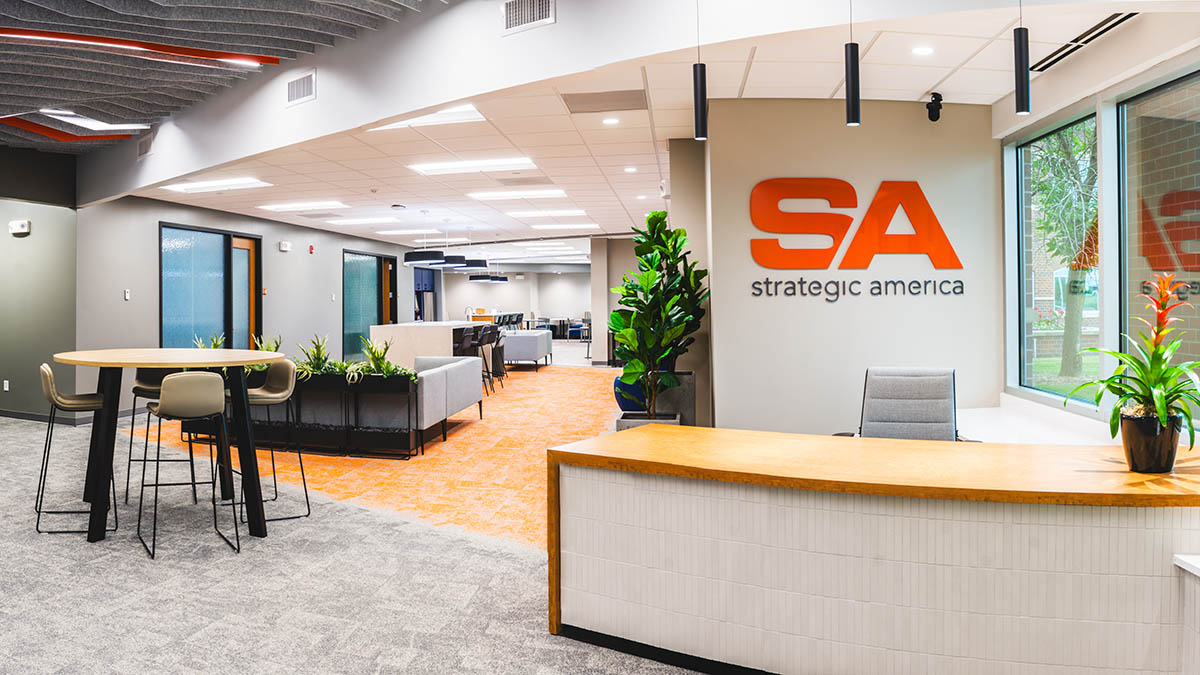
The agency that owns itself
Mike Schreurs founded the agency in Waterloo in 1980, opened a Des Moines office in 1987 and moved the full team to the capital region in 1994. The company became employee-owned through an ESOP in 2021. Public recruiting materials say employees build equity each year and vest fully after six years. They also mention employee resource groups, volunteer hours, wellness programs and 3 p.m. Friday closings.
This could be filed under culture, a word agencies often use when they mean snacks. Here it also supports the business model. Strategic America sells the attention and accountability of an independent shop. Employee ownership gives that claim some structural weight: the people doing the client work have an economic interest in the place staying independent and the relationship lasting.
In June 2026, Matt Strawn became president and CEO, succeeding John Schreurs after a 43-year career at the agency. Strawn arrived from the Iowa Lottery, where he had overseen a network of more than 2,500 retail outlets and chaired the Powerball Product Group. The resume is unusually on-theme. A lottery is also a centrally managed brand that must perform through thousands of local counters.
The last mile is where a brand stops being a presentation and meets a person with a budget.
What to copy, and what it costs
The reusable part of Strategic America's method is not its software stack or a particular media vendor. It is the decision to standardize the repetitive work. Put approved assets in one place. Identify the few variables that genuinely change by market. Offer plans that make sense at several budget levels. Keep local paid media from bidding against the national campaign. Then send performance data back into the next decision.
The public numbers reveal some of the cost envelope, but not a standard agency fee. Exmark programs are described as accommodating local monthly budgets from $500 to $250,000. A Pella partner page describes an eligible pay-per-performance package with a 9 percent base compensation arrangement. Those are examples, not a rate card. The deeper cost is operational: centralized tooling, clean data, approved creative, media expertise and people who can answer the local call quickly.
The approach has conditions. It works when headquarters can define the non-negotiables, local operators have meaningful choices and enough comparable activity exists to justify a shared system. It becomes less useful for a single-location business, a brand with no central standards, a network that will not share performance data or a category where every market requires a wholly bespoke offer. Standardization creates leverage only after someone decides what should remain different.
Where the Iowa agency fits
Strategic America sits between three common alternatives. A global network can supply reach but may feel remote from a $500 local budget. A specialist platform can automate distribution but may not supply the brand thinking, PR, web or creative around it. An in-house team knows the business but can struggle to staff every media and production discipline. Strategic America's pitch is integration with a particular bias toward the field.
Its portfolio ranges from Exmark and Pella to Lennox, the Iowa Lottery, Nebraska Corn, ISave 529 and the American Heart Association. The agency has won Telly recognition for client video work for 11 consecutive years. Those awards prove it can make polished things. The more interesting achievement is less photogenic: it has made a repeatable practice of translating from the conference room to the dealership, from one promise to many zip codes.
Advertising loves the big idea. Strategic America offers a useful amendment. The idea has to survive the trip.