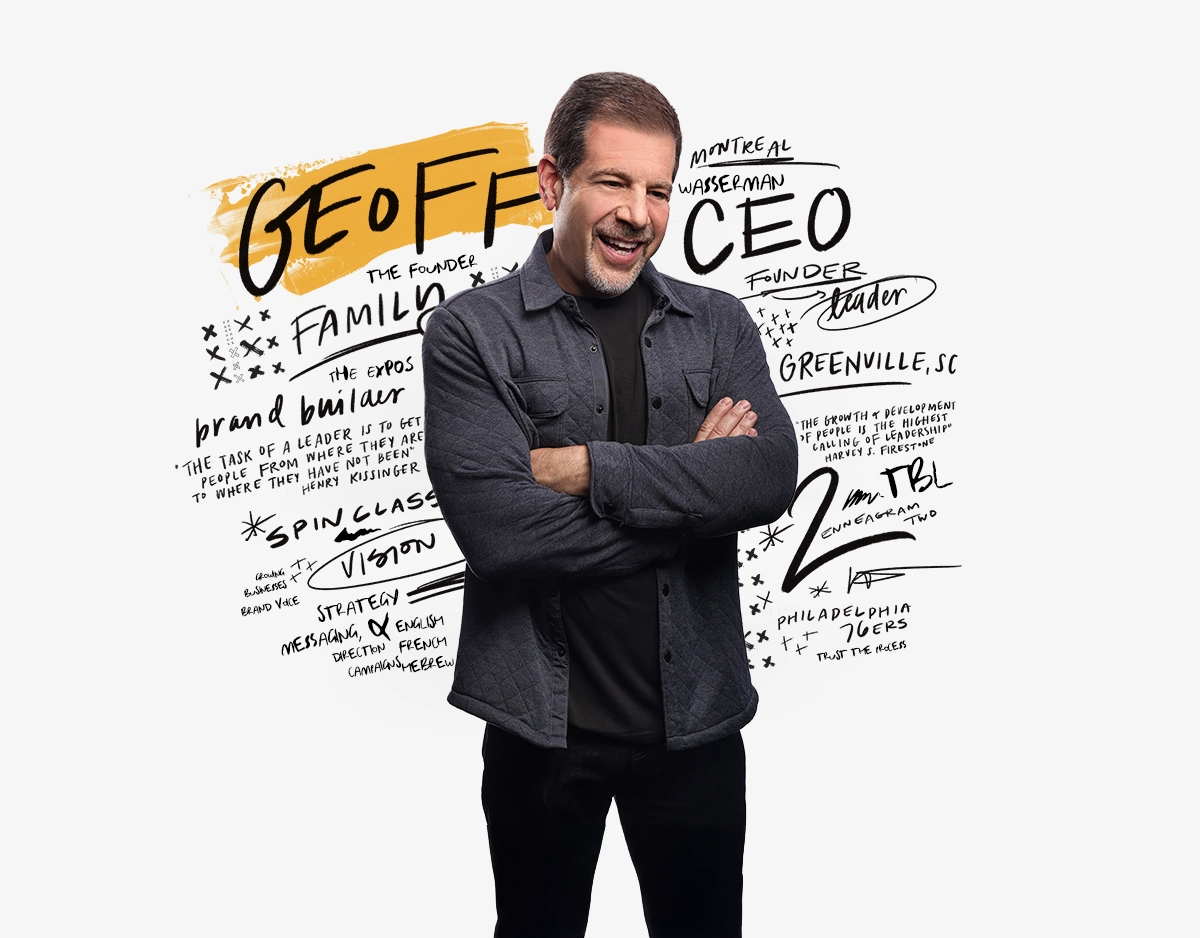
The best story The Brand Leader can tell about branding begins with an embarrassment. For nearly two decades, Geoff Wasserman's Greenville agency was called Showcase Marketing. It was competent, busy, and apparently difficult to describe. It could make things, place things, write things, and advise on things. This is a familiar agency ailment: the more services you add, the less obvious it becomes why anyone should remember you.
So Wasserman did to his own company what consultants routinely prescribe to everyone else's. He narrowed it. He moved away from work he was good at to concentrate on the smaller set of things at which he believed the firm could be unusually useful. The team chose a positioning line - “The Brand Leader” - and then spent nine months trying to find a company name. One day, while talking through the stalemate with his wife, Wasserman noticed the answer had been sitting in the strategy all along.
“We had to first break out of who we were to find who we really wanted to be.”Geoff Wasserman, founder and CEO
In 2017, Showcase became The Brand Leader. The name is cheeky enough to risk an eye roll, which may be part of its usefulness. It makes a claim and then forces the firm to live under it. More important, the episode contains a piece of strategy founders can actually copy: do not start with the naming workshop. Start with the sacrifice. Decide which profitable, respectable capabilities should no longer define you. The words tend to improve after that.
A brand is a series of choices
Today, The Brand Leader is an independent integrated agency headquartered at 920 Wade Hampton Boulevard in Greenville, with an office in New York and team members around the United States. Its client list moves comfortably from PowerBar and Denny's to Biltmore, Rudy Project, Panzura, Spero Financial, Ventura County Coast, healthcare startups, technology businesses, and wineries. The company says it has served thousands of brands internationally over more than 25 years.
The service menu is broad again, but the organizing idea is clearer. Brand and strategy establish the position. Creative and content make it visible. Paid media, search, PR, social, and influencer work distribute it. CRM and loyalty programs try to keep the customer. Websites, ecommerce, integrations, and automation make the promise usable. This is less a collection of studio departments than a loop, with the brand position meant to police every handoff.
The operating argument
Strategy + research
Identity + content
Media + web + retention
That structure solves an expensive corporate problem. A company can hire one consultancy to determine what it means, another shop to design how it looks, a third to buy attention, and a fourth to build the website. Each handoff introduces interpretation. By the time the campaign reaches a customer, the sharp thought that began the process may have been sanded smooth. The Brand Leader sells fewer handoffs and one accountable partner. The tradeoff is obvious: the client must want an integrated relationship, not a quick logo or an isolated media buy.

The purchase that made specialization scalable
The revealing corporate move came in February 2023, when The Brand Leader acquired Benson Marketing Group, a New York wine-and-spirits agency founded in 2000. The deal terms were not disclosed. The combined business was described at announcement as a 37-person agency, and Benson's client-facing staff stayed in place. The attraction was not mysterious. Benson brought category fluency, press relationships, and a roster built over two decades. The Brand Leader brought design, advertising, digital marketing, and development.
In agency arithmetic, one plus one often produces a larger org chart and a worse client experience. This combination had a more specific thesis: deep vertical knowledge makes broad capabilities more credible. A wine marketer needs to understand distributors, critics, scores, events, and the peculiar theater of the shelf. General creative talent helps, but ignorance of the category is expensive. Benson supplied the vocabulary; The Brand Leader supplied more ways to use it.
The same pattern now appears in healthcare and medical technology, finance and fintech, travel and tourism, outdoor and active lifestyle, and technology. In 2024, the agency hired former healthcare and medtech marketing executive Rachael Sparks to lead that practice and expand fractional CMO services. In 2025, Patricia Gallardo joined senior leadership with a brief covering operations, digital execution, and AI-enhanced services. Michael Catanzaro arrived that December as president and chief brand officer, bringing brand-side and agency experience. Brent Campbell returned in 2026 to develop business across the Southeast and beyond.
What it costs - and what fails first
The Brand Leader does not publish a rate card. A public agency directory lists a $75,000 minimum project and an hourly range of $150 to $199. Treat those figures as a buying signal, not a quote: this is positioned as a senior, multi-disciplinary engagement. The Benson acquisition price remains private. The more important cost is managerial. An integrated rebrand asks executives to settle questions they may have successfully avoided for years: Who is the priority customer? Which promise is actually defensible? What work will we stop doing?
A public directory's reported minimum engagement. The practical implication is clearer than the exact number: The Brand Leader is built for consequential brand and growth work, not an inexpensive one-off design task.
What fails first is usually not the font. It is consensus. Safety Plus came to the agency needing differentiation in a crowded safety-management market; the work began with competitor analysis and positioning before moving into identity, voice, and a rebuilt website. Hahn Family Wines wanted to move perception from a $12-$15 mid-sized producer toward a luxury Pinot Noir and Chardonnay specialist selling above $30. That required a reputation strategy, not a prettier bottle alone. The public case study reports more than 100 media placements at a CPM below $10. In both examples, design followed a commercial change in mind.
The agency's own rebrand makes the lesson less abstract. Wasserman changed his mind about breadth. He concluded that doing many things well was not the same as occupying a useful place in a buyer's memory. Later, the Benson acquisition complicated that neat story in a productive way: the firm expanded, but around a specialized customer problem. Narrowness created the permission to grow.
The useful thing to steal
Copy the sequence, not the surface. First, choose what the company should mean before debating a new name. Second, audit competitors for empty territory rather than visual inspiration. Third, make the operating system match the position: hires, service lines, acquisitions, and measures of success should all reinforce it. Finally, keep execution close enough to strategy that the original idea survives contact with ads, software, packaging, and customer service.
Culture belongs in that sequence too. The Brand Leader's published values - people first, exceptional work, honor and integrity, meaningful connections, boundless collaboration, and going the extra mile - sound conventional until they acquire odd, observable details. Its Greenville office has used Enneagram-specific nameplates. A local business profile described an employee fetching a Diet Coke for a leader and receiving an unembarrassed “Love you, brother.” The agency says it collected eight workplace awards in four years, including recognition from Ad Age, Outside, and South Carolina's Best Places to Work.
None of this is a universal prescription. The model is a poor fit for a buyer who already has excellent internal strategy and needs only specialist production, for a small company whose budget cannot support a multi-disciplinary team, or for a leadership group unwilling to make exclusionary decisions. Integration cannot rescue indecision. A name cannot either.
But for companies that have grown into an untidy collection of products, audiences, and messages, The Brand Leader offers a persuasive proposition. The firm has sat in the client's chair. It knows that the frightening part of a rebrand is not changing what the world sees. It is admitting, among yourselves, what the company has become - and what it is prepared to leave behind.