A billing company has a peculiar branding problem: its best work is the trouble nobody sees. Claims get processed. Payments arrive. The machinery keeps moving. For CodeMax, which serves behavioral health providers, SPEEDXMEDIA’s assignment was to make that competence visible. The agency says it took twelve weeks to turn a positioning problem into a new identity, website and campaign plan.
That is a useful introduction to SPEEDXMEDIA, a Los Angeles-area agency whose website speaks fluent racetrack. There are pit crews, fuel strategists and a founder styled as the chief engineer. Underneath the automotive vocabulary sits a familiar business frustration: a company wants to launch something, but its strategy, design, advertising and website are moving on separate calendars.
SPEEDXMEDIA offers to put those disciplines together. Its proposition is easiest to understand through the work: define the message, make the materials, build the destination and run the marketing. For a buyer, the appeal is having one team responsible for the connections between those jobs. A handsome campaign still needs somewhere useful to send people.
The twelve weeks had jobs attached
The CodeMax case study dates the launch to January 21, 2026. It describes an old identity built around generic blue and undifferentiated messaging, then a replacement designed to emphasize established expertise. Green and gold supplied the visual vocabulary. Strategy, identity, website design and development each received a place in the schedule.
The diagnosis was a mismatch between the company’s experience and its presentation. That distinction matters. A rebrand cannot create operational competence; it can help a prospective customer recognize competence that already exists. The agency’s account presents the choice as a move toward authority in a field crowded with similar-looking businesses.
Agency-reported project phases. Bar lengths represent time allocated, not performance.
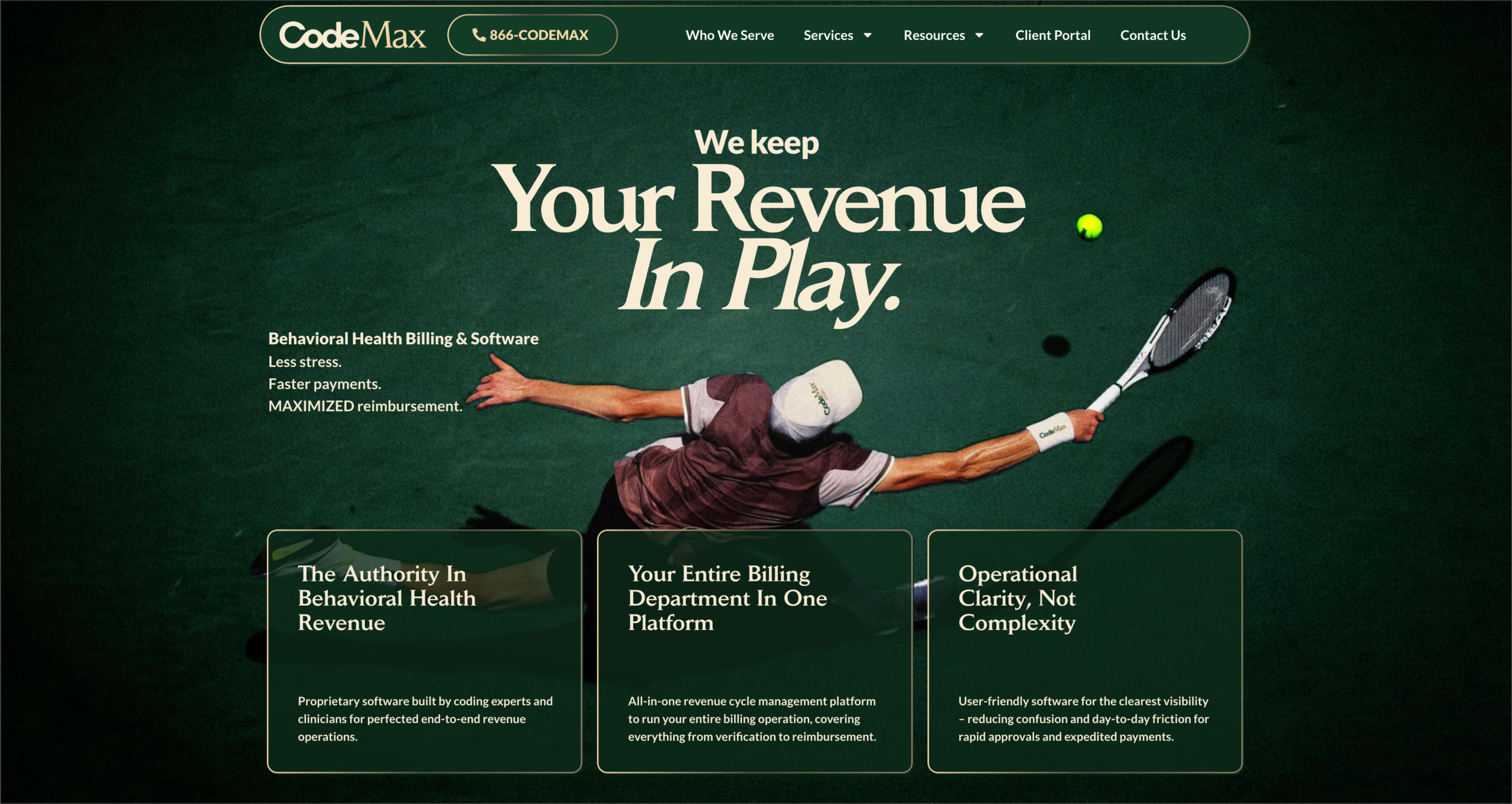
The resulting website image gives the positioning a surprisingly sporting expression: a tennis player stretches across a green background beneath a revenue-focused headline. Medical billing receives the visual treatment of a service with confidence. The useful lesson is the relationship between the argument and the execution. Color is carrying a business idea.
Five disciplines, one purchase
The agency divides its offer into creative, strategy, marketing, production and development. Those labels cover very different kinds of labor. Research can establish who a business should address. Copywriting can express the offer. Design can make it recognizable. Paid advertising can put it in front of a chosen audience. Development can make the next action possible.
Its strategy service includes brand positioning, marketing plans, research, media planning and consulting. That puts decisions about audience and channel before execution. The value of such a service depends on whether the resulting choices constrain the work. A strategy that approves every audience and every channel leaves the client with the same difficult decisions it started with.
Creative services extend from visual identity and art direction to copy and motion graphics. Development adds websites, applications, commerce, hosting and platform management. A business commissioning a campaign could therefore buy both the message and the site that receives the response. That arrangement is particularly relevant when a website rebuild and a marketing launch need to happen together.
Production fills another practical gap. SPEEDXMEDIA lists video, podcasts, photography and e-commerce photography, alongside editorial and post-production work. In its explanation of the production process, scripts and shot lists follow discovery and research; editing then adapts the material for different screen formats. A shoot becomes a collection of usable campaign assets instead of a single file awaiting distribution.
The portfolio has a healthcare accent
CodeMax is joined in the agency’s work directory by Solero Health, a healthcare workflow platform assignment covering design and development. The same directory names Empower Supplements, with Shopify, search and advertising work; Scars and All, with a podcast identity, a WordPress site and merchandise; and La Sol Athletics, with branding, web and social work.
Those assignments suggest several kinds of customer: an established service company reconsidering its presentation, a commerce business connecting its store to acquisition channels, or a new media brand assembling its first public presence. The common purchase is a group of connected deliverables. The company’s sector matters, but so does the number of specialties the assignment requires.
Website credits provide another view of the agency’s footprint. Pyramid Legal and Uplift Recovery Center credit SPEEDXMEDIA for design and development; Margarian Law carries a SpeedXMedia credit too. These are service businesses whose websites introduce an organization and help visitors take a next step. They make the agency’s web offering more concrete than a list of capabilities does.
There is room for a different aesthetic as well. A June 2026 Behance project by Hovhannes Osipyan credits a Doenara jewelry identity to work completed at Speedxmedia. Its emphasis on family heritage and craftsmanship shows a design assignment outside the healthcare and lead-generation work. The portfolio is broader than its most detailed case study.
A pit crew with actual job titles
The official team page identifies Dave as creative director and founder. It also names leaders for marketing, content, strategy and ads, art direction, project management and sales. The racing nicknames add personality, but the conventional titles do the explanatory work: different people own different disciplines.

The company describes a working culture of shared accountability and direct discussion. “Problems are named early and directly,” its team page says. That is a sensible standard for a business selling speed: a delayed decision in one discipline can leave several others waiting. The promise rests on making responsibility visible while keeping the work coordinated.
Its stated ambition is to combine agency disciplines through better systems and processes, with speed and moderate pricing among the goals. For a client, those aspirations become meaningful in ordinary details: who can approve a design, who resolves a conflict between copy and layout, and who is responsible for getting the final version live.

“Problems are named early and directly.”
SPEEDXMEDIA / TEAM PAGE
Put the fee beside the work
SPEEDXMEDIA’s marketing FAQs publish indicative comprehensive retainers of $5,000 to $25,000-plus a month. SEO is listed at $3,000 to $15,000 monthly, while project work spans $5,000 to $50,000. Those are broad scope-dependent ranges. A proposal is where a buyer learns which people, channels and deliverables the money actually covers.
Per month, depending on scope. An indicative service range, not the CodeMax project price.
The creative page describes project, retainer and hourly options. This is an agency services business: clients pay for work and access to expertise, with the structure depending on whether the need is a defined assignment or continuing support. The range of billing methods allows a small creative task and a sustained marketing program to be scoped differently.
A buyer can make those ranges more useful by attaching them to an explicit brief. For example, a website assignment needs an agreed number of pages, a decision about content, a testing stage and a definition of completion. A recurring program needs an agreed reporting rhythm and clarity about revisions. These are practical implications of buying connected services: the proposal has to describe the connections as carefully as the individual tasks.
Its September PPC guide also distinguishes the management fee from the money paid to advertising platforms. That separation makes a quote easier to understand. Increasing the media budget buys more exposure; increasing the management scope should buy identifiable work. The article describes that work through recurring account reviews, testing, budget decisions and attention to landing pages.
Fast delivery still needs slow enough thinking
The agency’s September conversion-optimization guide puts measurement ahead of cosmetic changes. It recommends diagnosing where visitors leave, forming a hypothesis and evaluating changes against the desired action. It also advises low-traffic sites to use qualitative research and fix evident usability problems instead of forcing experiments that cannot produce reliable conclusions.
That advice sets a useful boundary around the speed pitch. A team can finish a page quickly. Evidence that the page works better requires enough relevant activity to judge it. SPEEDXMEDIA’s marketing guidance similarly assigns different timescales to paid advertising and search visibility. Delivery speed and the speed of a business result are separate matters.
Its August strategy guide offers a compact approach readers can borrow: choose a measurable business goal, identify the audience, prioritize channels, allocate resources and establish a review routine. The practical discipline is subtraction. Deciding where effort belongs also means deciding which tempting activities will wait. Otherwise, a full-service offer can become a full calendar without a clear priority.
There is a useful tension in the agency’s own hiring advice. A company selling multiple specialties tells buyers to examine specialist expertise, speak with client references and begin with a bounded assignment or trial period. Breadth makes an agency convenient; the people assigned to the work determine whether that convenience is worth buying.
For someone choosing among an agency, freelancers and an internal hire, the scope is the starting point. A continuing need concentrated in one discipline presents a different staffing problem from a launch requiring several. SPEEDXMEDIA’s strongest fit is the latter kind of coordination challenge. Its CodeMax schedule gives a buyer something specific to discuss: the decisions, deliverables and approvals between an initial brief and launch day.
Follow the work
Explore SPEEDXMEDIA, its project portfolio and marketing journal. Follow the agency on LinkedIn, Instagram, X and Facebook.