Before Candy Schibli had a coffee company, she had a small machine in a quiet house and a long commute to learn what it could do. The one-kilo roaster sat in her great-grandmother’s home in Isle of Wight County, Virginia, on land her family had held for more than a century. Her classes were across the James River in Williamsburg. She rose before dawn, caught the ferry, trained at the Academy of Coffee Excellence, then made the return trip through the woods after dark. In that rural silence, coffee announced itself with a tiny commotion: the first crack of a bean, an exothermic pop that reminded her of Rice Krispies.
There are louder ways to begin a company. Schibli’s way required listening. She was entering the trade without the standard route through cafe shifts or years at a producer. What she possessed instead was a chemical engineering degree, graduate training in international affairs and sustainable development, and a career that had moved through corporate engineering, business consulting and international-development work. Coffee looked less like an escape from that history than a place where all of it could finally occupy the same table.
Heat transfer mattered. Agricultural livelihoods mattered. Logistics mattered. So did the simple civil pleasure of giving someone a good drink. A cup could be technical without becoming cold, global without becoming abstract. Schibli had found a product whose chemistry was alive enough for an engineer and whose supply chain was human enough for a development specialist.
“I wanted to do something that was more directly impactful.”Candy Schibli
An old career, poured differently
Schibli was born in Lawton, Oklahoma, and lived for years around Washington, DC. She earned a bachelor’s degree in chemical engineering from Florida A&M University. Later, at American University and the University for Peace in Costa Rica, she studied international affairs, natural resources and sustainable development. The dual master’s program moved between Washington and Costa Rica, widening her view of conservation, conflict and the social consequences of resource decisions.
After graduating in 2008, she worked in microfinance and microenterprise, including government-contractor work supporting USAID. Some projects touched small coffee farmers. Earlier engineering work had shown her a gap between industrial decisions and their consequences; graduate school supplied the language of systems and policy. Eventually, she wanted work whose effects felt closer to hand.
Her interest in agriculture was already visible on paper. In 2012, while working at the World Resources Institute, Schibli co-authored an account of how biofuel investment threatened local land rights in Tanzania. The subject was far from the pleasant shorthand of a tasting note, but it sharpened a lesson that would follow her into coffee: commodities have biographies. A crop is never only a crop. It is also land, labor, policy, transport and power. Later, when she began selecting green coffee and talking with producers, she was not discovering a social dimension that had been absent. She was giving an old concern a new, daily form.
In 2016, coffee became that work. It met a basic ritual shared across borders, yet demanded exact control of heat, airflow and drum speed. It also gave Schibli a way to encounter other cultures through food and beverage. She used savings to take roasting classes and launched Southeastern Roastery late that year. The company’s name did not come from a marketing workshop. It came from southeastern Virginia, where the first batches turned in the family house.
The first commercial proof arrived quickly. Within a week of finishing her initial studies, Schibli secured an account with Duality Wine and Coffee Bar, a pop-up on U Street in Washington. In 2018, she partnered with Songbyrd Record and Music Cafe in Adams Morgan, housing the roaster there and selling directly to customers. This was infrastructure by relationship: a young company borrowing a corner, earning accounts and learning what demand actually sounded like.
The work was still exacting. Green beans had to be bought in meaningful quantities, stored correctly and roasted before age softened their character. One missed variable could flatten a flavor. Yet the pleasure was in the small discoveries. Schibli did not pretend to arrive knowing the trade. She approached the drum like a laboratory instrument, willing to be taught by the process.
“I focus on making good coffee first and foremost.”Candy Schibli
A lab with a front door
By late 2019, the borrowed-corner model had done its job. Schibli searched the I-95 corridor between Richmond and Baltimore for a permanent site that would stay close to her Washington customers. Locust Point offered space and proximity to a major coffee warehouse. In early 2020, she moved a used 12-kilo Samiac roaster to Baltimore. Southeastern Roastery Coffee Lab opened that May, an awkward moment for any room intended to gather people.
She adapted. The cafe leaned into takeout while the roastery continued wholesale, retail and toll-roasting work. Products traveled across the DC, Maryland and Virginia region. The new machine could roast far beyond the tiny Virginia setup, yet the word “Lab” mattered as much as the increased capacity. Schibli wanted a place where coffee could be tested, stretched and noticed.
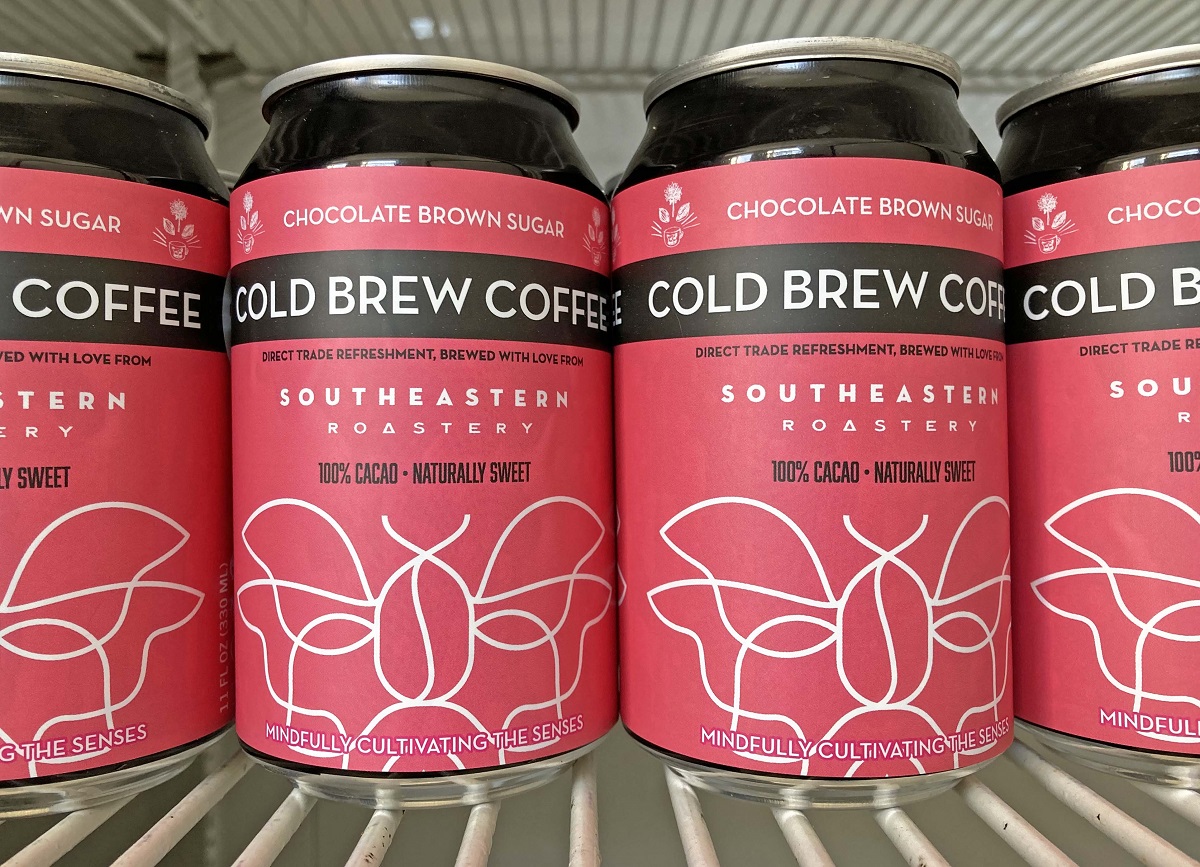
One cold-brew experiment combined chocolate, brown sugar and a little jalapeño. Another line of inquiry asked whether flavor might be experienced through senses beyond smell and taste. In 2022, Schibli presented “Alternative Sensory Methods for Experiencing Coffee” at the Specialty Coffee Expo in Boston and published related work in Roast magazine. The question suited her unusual toolkit. Coffee became material, medium and method.
In 2026, the experiments reached World of Coffee in San Diego, where she showcased a carbonic-macerated fermented decaf at the Coffee Coalition for Racial Equity booth. Soon after, Southeastern Roastery published its first Substack post about the roaster-driven process. The progression is telling. Schibli did not build a laboratory as theater. She kept producing questions, sharing methods and inviting feedback.
Traceability is a relationship
A bean can carry an origin name and still conceal almost everything about the people who grew it. Schibli’s international-development background makes that opacity difficult to accept. She has traveled through coffee-producing regions in East Africa, Southeast Asia and Central America, using relationships formed during her Costa Rica studies to connect with agricultural producers. Seeing farms in person altered the distance between a Baltimore roast and a harvest abroad.
Southeastern Roastery prioritizes direct-trade relationships and gives customers ways to find origin information through its website and QR codes on coffee bags. But traceability, in Schibli’s practice, is not merely a longer label. It is a set of operating questions. Do producers support the people doing the work? Are services available that allow women to participate fully? Can a purchase create a stronger relationship rather than a prettier claim?
The same instinct applies close to home. The company has worked with women-owned importers, farms and producers with programs supporting women, female bakers, and a designer who turned burlap coffee sacks into bags. At its Cedar Hill cafe, it has stocked goods from other small local businesses. This is not philanthropy attached after the sale. It is procurement as a form of community design.
Schibli’s network also extends into teaching and advice. She speaks with American University classes, exchanging ideas with students, and serves as a technical advisor to Grow to Market, bringing years of agriculture, logistics and systems thinking to the organization. Her route through engineering, policy and coffee now runs in both directions: experience enters the roastery, and lessons from the roastery travel back into classrooms and food-enterprise work.
The cup as a small piece of time
Founders often speak about scale as though bigger were a moral category. Schibli’s ambitions are concrete: stronger wholesale and white-label operations, equipment that reduces labor per pound, more room for production, durable relationships with producers. In August 2026, she offered the 12-kilo Samiac roaster for sale, a practical signal that the equipment chapter was turning again. Machines are not monuments. They are tools for the work that comes next.
Still, the most distinctive part of her business may be its insistence on slowness. Coffee is famously used to hurry people up. Schibli keeps asking it to make them notice. Hear the crack. Read the origin. Taste without immediately covering the bean. Consider why one preparation feels different from another. Follow a flavor beyond the tongue. The experiment is scientific, but the invitation is almost literary: recover the details habit edits out.
This makes Southeastern Roastery a curious hybrid. It is a manufacturer that thinks like a studio, a cafe that behaves like a lab, and an international supply chain organized around a daily household ritual. Schibli did not abandon the systems of her previous career. She made them tactile. The policy question became a sourcing decision. The engineering problem became a roast curve. The aspiration to connect people became something warm enough to pass across a counter.
The tiny roaster in Virginia could not have predicted all of this. It only offered a sequence of signals: heat, motion, scent, sound. Schibli listened closely enough to hear a company forming inside them. Ten years on, she is still listening, still adjusting the variables, still leaving room for the next crack to reveal what the coffee might become.