- The proposition: reliably good coffee and matcha, served quickly in dense urban neighborhoods.
- The machine: small shops, automated espresso, mobile ordering and a menu engineered for repetition.
- The surprise: flavored matcha grew to roughly half the business and exposed how little room those original shops had.
- The reversal: Blank Street is now opening larger cafes with seats, social zones and camera-friendly handoff counters.
In August 2020, when New York had more empty tables than customers, two former investors placed a pale-green coffee cart in the garden of the Wythe Diner in Williamsburg. Issam Freiha and Vinay Menda had an argument about the coffee shop, and the argument was mostly about square feet. The familiar cafe was too large, too expensive and too dependent on a few skilled hands moving very quickly. What if you took one big shop, broke its capacity into several small pieces and scattered them around a neighborhood?
The cart was a prototype with wheels. The shops that followed were often around 500 to 700 square feet. Eversys machines ground beans and pulled espresso shots at the press of a button. The app took orders before customers arrived. The menu offered specialty-coffee signals without requiring a seminar at the counter. Blank Street was not selling the transcendent cup that ruins all other coffee for you. It was selling the good cup that could become Tuesday.
“We want to be the really good cup of coffee that you drink twice a day, every day.”Issam Freiha, co-founder and CEO
The product was the interval
Coffee chains usually describe themselves with nouns: beans, roasts, farms, foam. Blank Street's original advantage was a unit of time. A commuter could find a shop nearby, order ahead, collect a consistent drink and continue walking. In 2026 the company said it aimed to finish a drink within two minutes and 30 seconds of the order. The app promised one-click reordering, customization and rewards. The espresso machine absorbed repetitive technique so a barista could work the handoff instead of guarding every extraction.
That system solved a specific urban problem. Independent specialty cafes could offer personality and craft, but quality and wait times varied. Legacy chains could offer consistency, but their menus, rooms and brand language often felt built for everyone at once. Blank Street planted itself between the two: more designed than a utility chain, more standardized than the neighborhood original, and priced for repetition rather than ceremony.
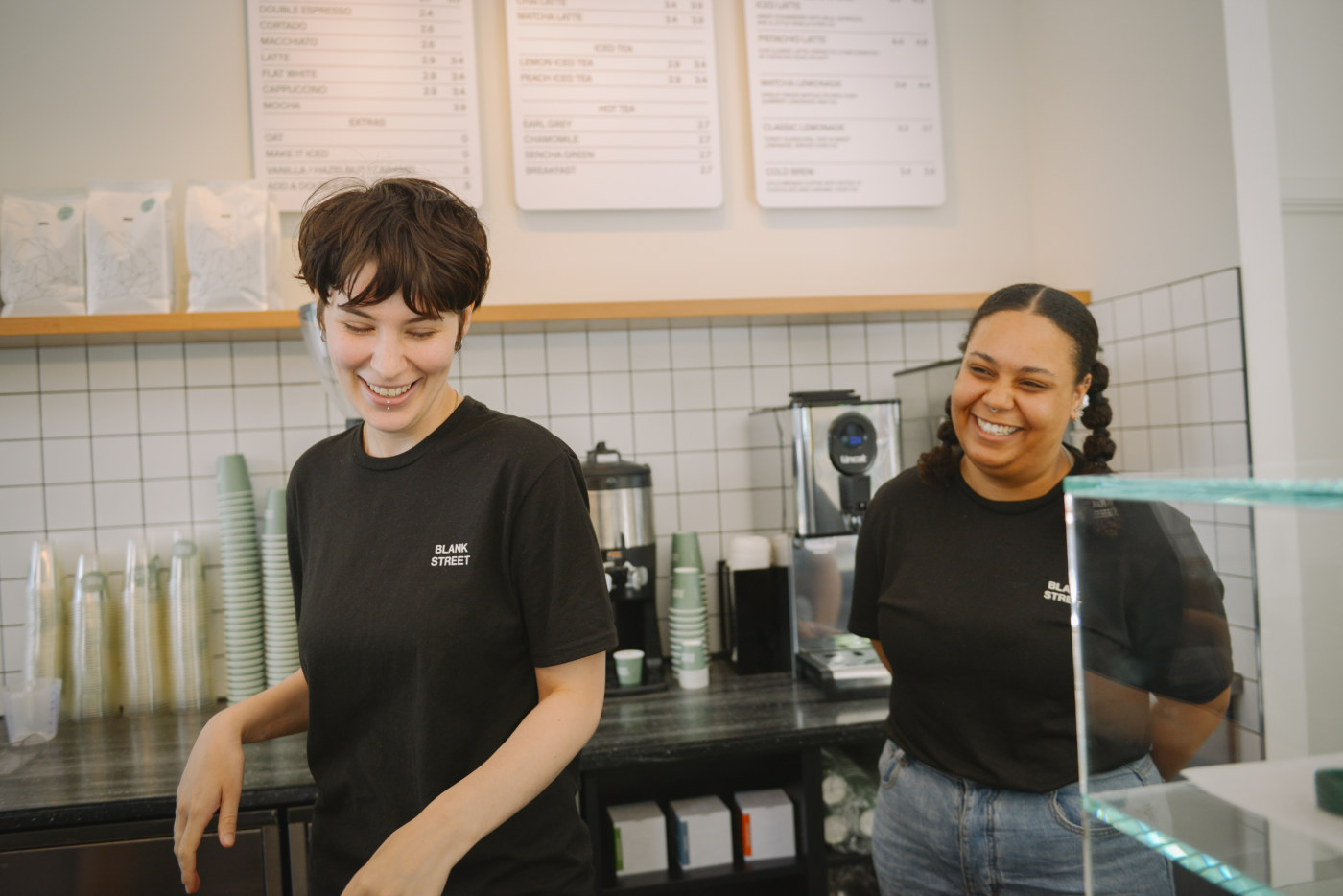
Automation attracted the headlines, sometimes with a suspicious tone, but the machine alone explains little. Any rival can buy similar equipment. The harder thing to copy is the whole arrangement: enough nearby shops to become a reflex, a bar that prevents orders from colliding, a menu that can move fast, an app customers actually keep, and a brand recognizable from half a block away. As Menda put it in the early expansion, “What makes the model work is density.”
The first thing to fail was the floor plan
Success arrived in the wrong cup. Customers bought more iced espresso and matcha than the founders expected, and those drinks created a different production rhythm. Ice, milk, syrups, batching and assembly needed counter space. The smallest stores could not hold the volume. “In the beginning, we opened stores that were too small and couldn't support our volumes,” Menda later said.
This was not a philosophical crisis. It was a bar-flow problem, which is often how strategy announces itself in retail. Blank Street made later shops larger. By 2026 a new lower-Manhattan concept measured roughly 1,300 square feet, about three times the size of some earlier locations. It had seats, large mirrors, brighter handoff staging and “conversation” booths. The chain built for leaving was learning the commercial value of staying.
The green drink ate the coffee company
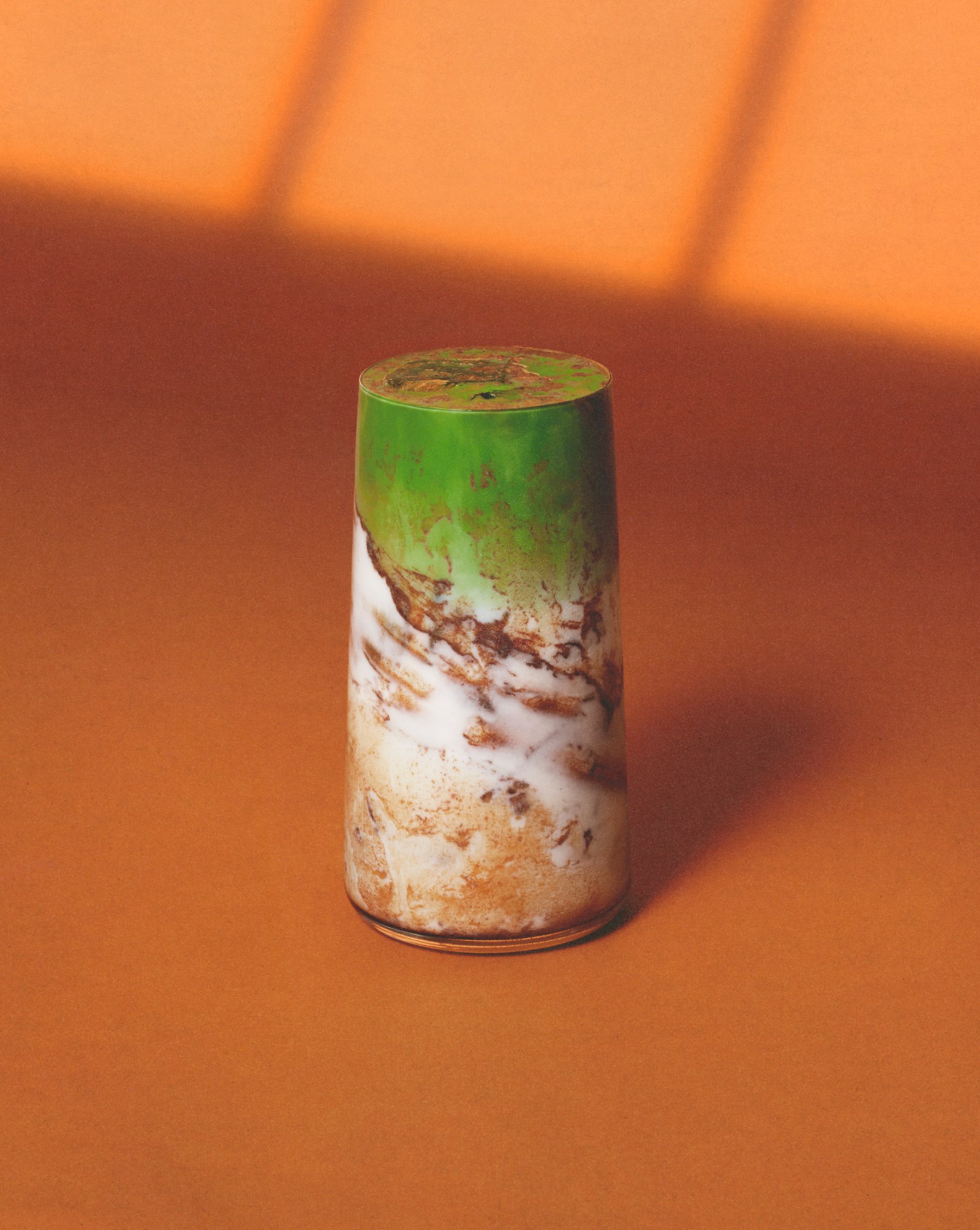
The other revision was hiding in the name. Blank Street Coffee became Blank Street. By early 2025, management said the business was selling about 15,000 matcha drinks a day. By 2026, matcha represented roughly half of sales. Blueberry, Daydream, White Chocolate and Strawberry Shortcake matchas did something a flat white rarely manages: they gave customers a reason to point a camera at the counter.
The 2025 rebrand acknowledged the takeover. Wolff Olins dropped “Coffee” from the public-facing identity, made green the system's organizing color and built a logo around the rectangular window of the original cart. Product photography became closer to a fashion campaign than a cafe menu. The strategy named this mix of habit and novelty “Regularly remarkable.” There is a useful contradiction in the phrase: regularity pays the rent; remarkable gets posted.
Blank Street's customers now include the commuter who wants an ordinary latte and the student who wants a Blueberry Matcha that reads as a small event. Morning throughput and afternoon sociability are different jobs. The larger store is an attempt to do both without becoming a generic lounge with expensive plumbing.
Venture capital bought the right to revise
None of this was financed like a neighborhood cafe. Publicly reported rounds include a $7 million seed, a $25 million Series A and a $20 million Series B. In August 2026, General Atlantic led a $105 million transaction made up of $75 million in new capital and $30 million in secondary shares. The reported valuation was about $650 million. That money paid for more than machines. It funded leases, construction, teams, an app, market launches, menu experiments and the luxury of learning at chain scale.
Capital also raises the stakes. A single owner can keep one beloved shop alive. A venture-backed chain must create enough transactions, in enough markets, to justify the machine around it. Blank Street says it is profitable; in 2026 it also said each shop sold roughly three times as many drinks as it had three years earlier. The West Coast move began cautiously, with Studio City first and Beverly Hills, West Hollywood and Malibu planned around it. The company said it would not rush farther until those first shops developed regulars. After years of speed, that is a notable sentence.
The counter has two sides
A fast cafe still runs on human pace. Blank Street has pitched internal growth and says much of its leadership was promoted from within. It has also faced worker organizing. New York employees joined UFCW Local 1500 and, in 2024, a first contract covered 113 workers at 19 stores. Workers at seven Boston-area locations voted for union representation in 2025 after organizing around staffing, safety, schedules and retention.
This tension belongs in the business model, not in a footnote. Automation can reduce repetitive craft and create more time for hospitality. It can also intensify volume if staffing and space fail to move with demand. The smiling handoff that photographs well is still somebody's shift. Blank Street's next test is whether the polished front of the system and the working back of it can scale together.
What is actually copyable
The easy imitation is mint paint and a seasonal matcha. The useful imitation is observational. Begin with a frequent behavior, reduce the friction surrounding it, cluster distribution where repetition is plausible, and watch for the moment demand breaks the design. Blank Street's most transferable act was not defending its clever small-store thesis. It was admitting the thesis had made the bar too crowded.
A practical field note
- Design around the customer's repeat interval, not the founder's favorite product.
- Use automation where consistency matters and people where recognition matters.
- Treat queues, bottlenecks and odd menu winners as research you did not have to commission.
- Let the format vary by occasion; morning speed and afternoon company need different rooms.
The method has limits. Density fails where foot traffic is weak or customers drive. Automation is less persuasive where visible craft is the reason for the visit. A constantly rotating menu adds complexity that low-volume shops cannot absorb. Bigger rooms bring higher rent, more labor and a bet that people truly want to linger. And without patient capital, an operator may not survive enough iterations to discover which assumption was wrong.
Blank Street began by treating the coffee shop as an inefficient container. Six years later, the container has become the plot. The cart became a micro-cafe; the micro-cafe became a social room; coffee made space for matcha; speed made space for conversation. The interesting company is not the one that found a perfect formula in Williamsburg. It is the one still deciding how much of that formula to erase.