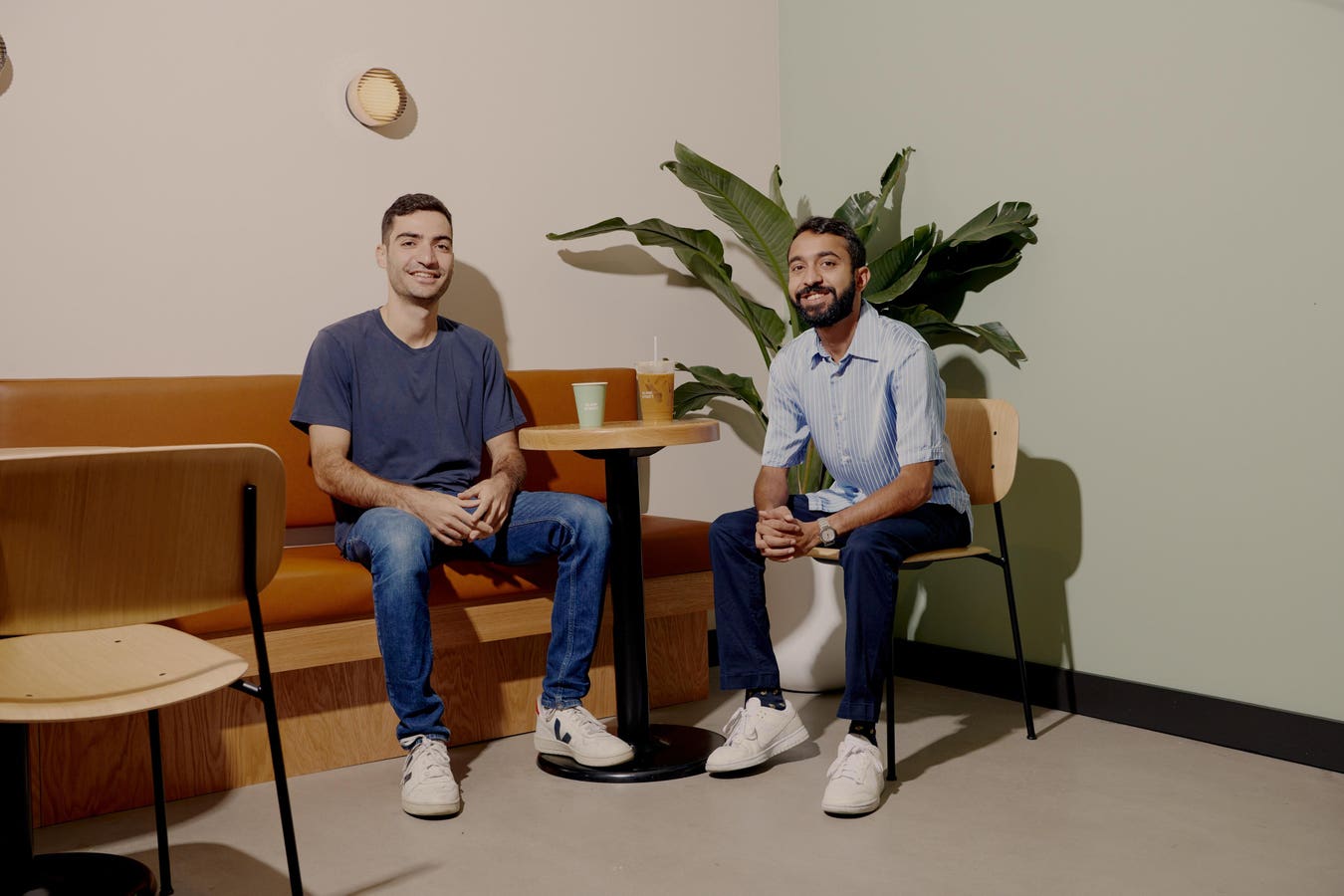
In the summer of 2020, when New York had more urgent concerns than the provenance of its espresso, Issam Freiha and Vinay Menda rolled a battery-powered coffee cart beside the old Wythe Diner in Williamsburg. The cart was handsome, compact and almost comically modest beside the ambition attached to it. There was no salon of laptop users, no wall of coffee theology, no cavernous lease waiting to be fed. There was a machine, a barista, a small menu and the belief that a cup could be good, quick and fairly priced at the same time.
That last conjunction was the business. New Yorkers had learned to choose two of three: specialty quality, everyday convenience or a painless price. Freiha and Menda had surveyed friends and heard the compromise described again and again. People preferred the good independent cup but often bought the chain-store one because it was nearby and the app worked. Blank Street was built in the narrow gap between taste and Tuesday morning.
Freiha did not arrive at that corner through the traditional apprenticeship of roasting and tamping. Born in Beirut and raised in London, he moved to New York for Columbia, where he studied economics and statistics. He joined a campus finance community, worked with a student-run fund and spent internships burrowing into companies and markets. He later recalled having “a knack for diving really deep into the weeds.” It is a revealing preference. Some people admire a field. Freiha seems happiest down among the roots, counting them.
The education of a useful obsession
While still young enough for the dorm room to double as headquarters, Freiha joined friends raising small investment vehicles for New York startups. The undertaking became Alrai Capital and later Reshape Ventures. Its first fund concentrated on transportation technology; its wider interests eventually included consumer technology and digital marketplaces. The glamorous version of venture capital involves instinct and introductions. Freiha’s account was less lacquered: the team pitched roughly 300 possible backers and closed about 10.
Persistence was one lesson. Pattern recognition was another. Yet Freiha now draws a clean border around what finance could teach. It helped him understand what investors seek when they evaluate brands, he has said, but not how to build one. For that, he credits something more kinetic: cycling. The bicycle took him through cities and into hundreds of coffee shops. It trained his eye on pace, place and the peculiar comfort of a familiar counter in an unfamiliar town. Somewhere along the route, the analyst became what he cheerfully calls a prototypical coffee nerd.
“Working in finance was helpful in understanding what investors look for when evaluating brands, but it was not in actually building one.”Issam Freiha
Coffee was not merely a product category waiting for a spreadsheet. Freiha grew up around the household coffee cultures of Beirut and London. It was social, habitual and close at hand. His own fixed point is a morning flat white. He speaks of it with the gravity ordinarily reserved for constitutional rights: the most important part of his day, a simple moment that deserves maximal care and attention.
A chain made from subtraction
The first Blank Street shops treated square footage as a luxury rather than a birthright. Carts, kiosks, pickup windows and storefronts of roughly 200 square feet cost less to open and placed coffee close to foot traffic. Fully automatic Eversys espresso machines handled a portion of the repetition. Mobile payment and ordering reduced friction. The menu was edited rather than encyclopedic. In the early model, one or two employees could operate a location while the machine produced consistent shots.
The original small-format logic
None of this sounds romantic, but romance is expensive to maintain without arithmetic. In 2021, Freiha described the mission as putting high-end specialty coffee on every corner at a price that would not break the customer’s wallet. Blank Street said a cart or kiosk could cost 75 to 80 percent less to open than the large stores its founders used as a benchmark. The company paired its coffee with food from local makers, including Gertie, King David Tacos and Pain d’Avignon. A tiny shop could act as a shelf for a neighborhood’s larger food culture.
The capital arrived quickly: a $7 million seed round, then a $25 million Series A in 2021. Blank Street moved from the cart to a Bedford Avenue storefront and across New York, then to London, Boston and Washington. By 2024, it reported 40 shops in Britain and 44 in the United States. Growth at that speed makes a company easy to see and easier to caricature. The name promised blankness; the business was suddenly everywhere.
The interesting turn is that Freiha’s language has grown less mechanical as the footprint has grown. Earlier accounts foregrounded cost, throughput and payback periods. More recently, he has talked about Blank Street as a “daily luxury” brand. The phrase does not mean chandeliers with the cold brew. It means attention distributed across the drink, the room, the greeting and the cup. Efficiency gets coffee into a hand. Hospitality gives the hand a reason to come back.
Tofu, cigarettes and the problem of sameness
Freiha’s most vivid design brief sounds like the contents of an eccentric refrigerator. Blank Street, he says, lives between “tofu and cigarettes.” Tofu is clean, spare and composed. Cigarettes are energetic, playful and slightly unruly. The stores must be recognizably related without becoming a row of identical waiting rooms. One force maintains the system; the other commits a tasteful misdemeanor.
“Our brand lives at the intersection of two tensions we call ‘tofu and cigarettes.’”Issam Freiha
That duality helps explain how a company founded on operational efficiency found itself making a quilted puffer sleeve for iced cups during a Scottish winter, then carrying the idea into London Fashion Week. It explains the seasonal drinks and collaborations, too. Freiha is careful about authorship. He credits the sleeve to marketing manager Elizabeth Brierley and the interiors to a team led by design director Paola Han. In his telling, leadership is not the habit of collecting other people’s ideas under one’s own name.
He has made the same point about careers inside the company. In a recent public note, Freiha wrote that most of Blank Street’s leadership had grown from within. He singled out colleagues who moved from marketing into creative direction, from chief of staff into new markets, and from assembling the first cart into leading digital and engineering. The examples suggest an operator interested in the distance a person can travel after the job description expires.
Local character remains the harder test. For Blank Street’s move to Los Angeles, the design team toured neighborhoods and studied modernist landmarks before drawing the Studio City shop. The resulting space nodded to the building’s curved overhang and the Case Study House tradition. Freiha also pointed to a personal connection: an early employee who became the company’s real-estate director had grown up nearby. A chain can research a neighborhood. The more delicate task is behaving as though the neighborhood might answer back.
The second cup
Blank Street began by removing things: excess space, a sprawling menu, unnecessary motion behind the bar. Its present challenge is additive. The company has to layer personality, design and care onto a machine built for repetition. Its signature drinks and growing matcha business have widened the identity beyond classic espresso. New shops carry stronger architectural opinions. Freiha speaks now of showing up across a customer’s day - coffee in the morning, matcha with friends in the afternoon, ice cream after dinner.
There is a quiet tension in the idea of daily luxury. Luxury usually depends on scarcity; daily life depends on reliable supply. Freiha’s project is to make care repeatable without making it feel industrial, and to make convenience pleasurable without turning pleasure into another efficiency metric. The small shop was an answer to rent. It also became a stage on which those contradictions are unusually visible.
The cart by the Wythe Diner is now part of company lore, but its real importance is not nostalgia. It imposed discipline. Every object had to justify its place. Every movement mattered. The same might be said of the best coffee rituals. A cup, a few minutes, a familiar order: almost nothing, unless it is yours.
Freiha’s career has moved from evaluating other people’s companies to making one of his own, from spreadsheets to sage green, from the broad promise of technology to the precise temperature of a flat white. The investor learned to operate; the cyclist learned to stop. Blank Street’s future will depend on whether it can keep both instincts alive - the urge to move quickly through a city, and the judgment to make one small corner worth pausing for.